Presentation
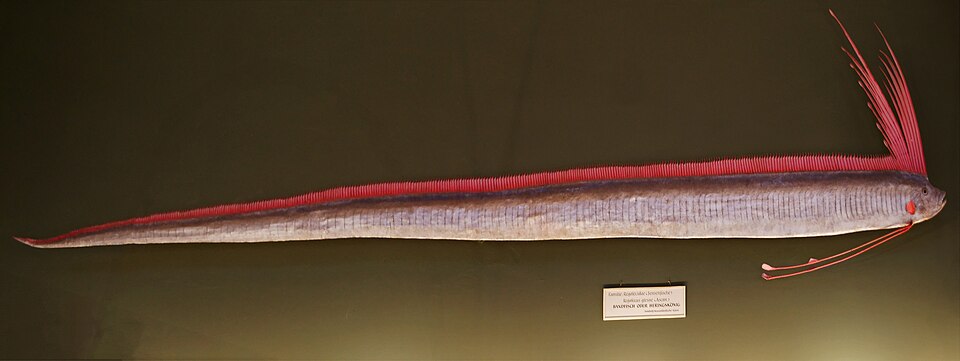
The oarfish (Regalecus glesne) is a deep-sea fish renowned as one of the longest bony fish species known to science. Its ribbon-shaped, silvery body adorned with a red dorsal crest earned it the nickname 'ribbonfish' or 'king of herrings'. It typically inhabits depths between 200 and 1000 metres, which explains how rarely humans encounter it. Its occasional surface appearances and strandings have fuelled accounts of giant sea serpents for centuries. Little studied due to its deep-water habitat, the oarfish remains shrouded in scientific mystery. It has no commercial fishing value and is not commonly consumed.
The oarfish has a highly elongated body flattened from side to side, shaped like a silvery ribbon. Its bright red dorsal fin extends along the entire length of its back, from the top of its head to the tip of its tail. It lacks a tail fin and scales; its skin is covered with a silvery guanine substance. Its head bears a small protractile mouth with no visible teeth, adapted for capturing planktonic prey.
Characteristics
Indicative values: they vary by subspecies, sex and region.
Habitat and distribution
The oarfish lives in the mesopelagic and bathypelagic zones of the oceans, usually between 200 and 1,000 meters deep. It inhabits the open waters of the high seas, far from shore, and avoids shallow waters except when washed ashore by accident. This deep pelagic species does not depend on any particular substrate and moves with ocean currents and plankton availability. Its preference for great depths explains how rarely it encounters humans.
CURRENT RANGE
The oarfish is found in most temperate and tropical oceans worldwide, except in polar waters. It has been recorded in the Atlantic, Pacific, and Indian oceans and occasionally in the Mediterranean. Its exact range remains poorly known because direct sightings are uncommon. Sporadic strandings have been reported on various coastlines around the world, including the western Mediterranean.
Behaviour
The oarfish is generally solitary and surfaces only rarely, except when ill, injured, or disoriented. It moves in vertical or horizontal position by undulating its long dorsal fin, without thrusting its body abruptly. Its presence in surface waters, sometimes following storms, has fuelled marine legends, particularly that of the sea serpent. This secretive behaviour and deep-water habitat make direct observation extremely rare.
Reproduction
Oarfish reproduction is poorly documented due to the difficulty of observing them in their deep natural environment. Larvae and juveniles have been occasionally spotted near the surface, suggesting that eggs are laid in open water. The eggs and larvae are thought to be pelagic, drifting with the plankton until juveniles move to deeper waters. No reliable information about breeding season or reproductive behavior has been established to date.
Peculiarities
The oarfish can shed its tail through autotomy, a rare ability in fish that allows it to lose part of its body without major life-threatening consequences. Its appearances at the surface before certain seismic events have inspired popular beliefs, particularly in Japan, though these lack confirmed scientific foundation. Its unique shape and impressive size make it an emblematic species of the deep sea.
Threats and conservation
The oarfish is not the target of directed fisheries and faces no direct threat from human activity. It may occasionally be caught accidentally as bycatch in certain fishing nets. Ocean pollution and climate change could indirectly affect its deep-sea habitat, though data are lacking to assess these impacts precisely.
Numbers and trends vary across sources and regions. See the IUCN assessment for the latest reference data.
Gallery
1 documented photographs.
References
Profile updated 02 September 2026 · Reviewed by the TunisieVet editorial team.
Comments (0)
No comments yet.
CONSERVATION STATUS
Data deficient (DD)
IUCN source, latest published assessment.
Species health
Documented diseases for this species.
Find a veterinarianThis information is provided for educational purposes only and is not a substitute for a veterinary consultation. If you have any concerns about your animal's health, consult a veterinarian.
To discover around: Oarfish
Videos, facts, stories and records linked to this species.
RECORD
up to 11 m
The longest bony fish
Maximum length recorded in stranded specimens, making the oarfish the longest known bony f...
Similar animals
Other species documented in Animalpedia.

Be among the first to use our app. Sign up and get early Google Play access.
Discover