
Presentation
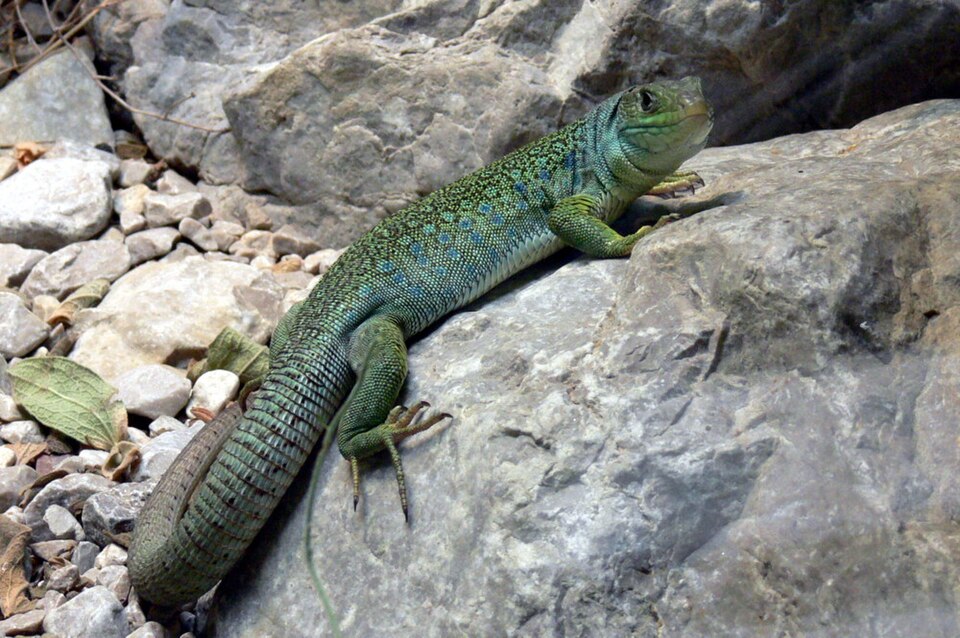
The Ocellated Lizard (Timon lepidus) is the largest lizard in continental Europe, recognizable by its green coat spotted with blue ocelli on the sides. It frequents the dry and rocky environments of the western Mediterranean basin. A diurnal and fierce species, it takes refuge in burrows or under stones at the slightest danger. It plays the role of an ecological indicator in the scrubland and scrubland that it inhabits. Its populations are declining in several regions due to habitat degradation.
Massive and robust body that can exceed 60 cm with tail, large and powerful head with strong jaws. The green or brown dorsal coloring is decorated with black spots rimmed with blue, more marked in adult males. Juveniles display a duller livery, grayish brown spotted with yellow. The long tail can partially regenerate if lost.
Characteristics
Indicative values: they vary by subspecies, sex and region.
Habitat and distribution
It likes dry, sunny and rocky environments such as scrubland, maquis and wastelands. It is also found on the edges of vineyards, in coastal dunes and scree areas. It needs soft soil to dig its burrows and hiding places for thermoregulation.
CURRENT RANGE
The species is present in southwestern Europe, notably in Spain, Portugal, southern France and Italy. It also extends to northwest Africa, including Morocco, Algeria and Tunisia. Its distribution remains fragmented and localized to favorable habitats.
Behaviour
Solitary and territorial animal, active during the day, particularly during hot hours. It appears lively and elusive, quickly taking refuge in its burrow in the event of a threat. Males defend their territory with displays and may engage in fights during the breeding season. It hibernates during the coldest months of the year.
Reproduction
Mating takes place in spring, after emerging from hibernation. The female lays a dozen to thirty eggs in a burrow dug in loose, sunny soil. Incubation lasts approximately two to three months depending on ambient temperature. The young are independent from hatching and receive no parental care.
Peculiarities
Its blue eyespots give it a distinctive appearance reminiscent of small eyes spread across the body. It is the largest lizard native to continental Europe. Its bite can be painful if handled, although it is not venomous.
Threats and conservation
The destruction and fragmentation of its habitat by urbanization and intensive agriculture constitute the main threat. Road mortality and predation by introduced species also affect its populations. Climate change could modify the availability of its favorable habitats in the long term.
Numbers and trends vary across sources and regions. See the IUCN assessment for the latest reference data.
Gallery
1 documented photographs.
References
Profile updated 02 September 2026 · Reviewed by the TunisieVet editorial team.
Comments (0)
No comments yet.
CONSERVATION STATUS
Near threatened (NT)
IUCN source, latest published assessment.
Species health
Documented diseases for this species.
This information is provided for educational purposes only and is not a substitute for a veterinary consultation. If you have any concerns about your animal's health, consult a veterinarian.
To discover around: Ocellated Lizard
Videos, facts, stories and records linked to this species.
RECORD
up to 90 cm
The largest lizard in continental Europe
Maximum total length measured in the largest adult individuals.
Similar animals
Other species documented in Animalpedia.

TunisieVet in your pocket 📱🐾 Access your veterinary services wherever you are. [ Download the app ]
Learn more