
Presentation
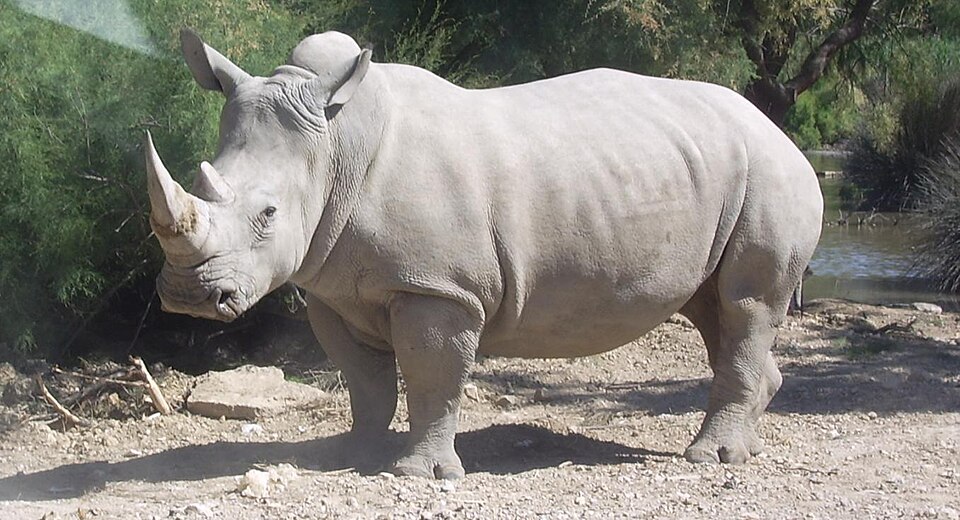
The White rhinoceros is one of the largest living land mammals. Despite its name, its skin is gray. It is distinguished by its imposing size, its two nasal horns and its massive appearance. It is the second largest rhino after the Indian rhino.
The White rhinoceros has two black or grayish nasal horns, the first longer than the second. Its massive body rests on four thick and powerful legs. Its thick, gray skin has deep folds, particularly on the shoulders and sides. It has a large, elongated head with a characteristic square muzzle.
Did you know?
Why do rhinos have horns?
Characteristics
Indicative values: they vary by subspecies, sex and region.
Habitat and distribution
The White rhinoceros inhabits the open savannahs and grassy grasslands of southern Africa. It prefers areas with abundant herbaceous vegetation and regular access to water. It is found in national parks and protected reserves, where it coexists with other large herbivores such as zebras and wildebeest.
CURRENT RANGE
White rhinoceros is endemic to southern Africa, mainly in South Africa and Namibia. Historically, its range covered a large region, but it has shrunk considerably. The majority of the population survives in a few major protected reserves, notably the Kruger Park in South Africa.
Behaviour
The White rhinoceros is generally docile and peaceful, but can become aggressive if it feels threatened. It often lives in groups made up of females and young, while males are generally solitary or territorial. It is active especially in the early morning and late afternoon, resting during the hottest hours.
Reproduction
The White rhinoceros female reaches sexual maturity around 6-7 years old. After a mating, the gestation period lasts about 16 months, giving birth to a single young. The young stays with its mother for 2-3 years before becoming independent.
Peculiarities
The White rhinoceros is the largest of the five current rhino species. Its square lower lip distinguishes it from the black rhino whose lip is pointed. It has an excellent sense of smell but relatively poor vision. White rhinoceros's horns do not contain bone but are made of keratin, like human nails.
Threats and conservation
The White rhinoceros is primarily threatened by poaching, driven by the demand for its horns in traditional Asian medicine. Habitat loss and population fragmentation also make the situation worse. The Near Threatened status reflects recent population improvement following decades of intensive hunting, although challenges remain significant.
Numbers and trends vary across sources and regions. See the IUCN assessment for the latest reference data.
Gallery
1 documented photographs.
References
UICN — Liste rouge des espèces menacées
Profile updated 30 August 2026 · Reviewed by the TunisieVet editorial team.
Comments (0)
No comments yet.
CONSERVATION STATUS
Near threatened (NT)
IUCN source, latest published assessment.
Species health
Documented diseases for this species.
This information is provided for educational purposes only and is not a substitute for a veterinary consultation. If you have any concerns about your animal's health, consult a veterinarian.
Related species
To discover around: White rhinoceros
Videos, facts, stories and records linked to this species.
Similar animals
Other species documented in Animalpedia.

TunisieVet in your pocket 📱🐾 Access your veterinary services wherever you are. [ Download the app ]
Learn more