Presentation
The onager (Equus hemionus) is a wild equid from Asia, closely related to both the donkey and the horse, and adapted to arid and steppe environments. It is distinguished by its light fawn to brown coat, dark dorsal stripe, and slender build that falls between the horse and donkey in form. Gregarious by nature, it lives in fluid herds whose composition varies with the seasons. Once widespread from the Middle East to Mongolia, populations have declined sharply due to hunting and habitat degradation. In Tunisia, a reintroduced population is maintained in parks and reserves for conservation purposes.
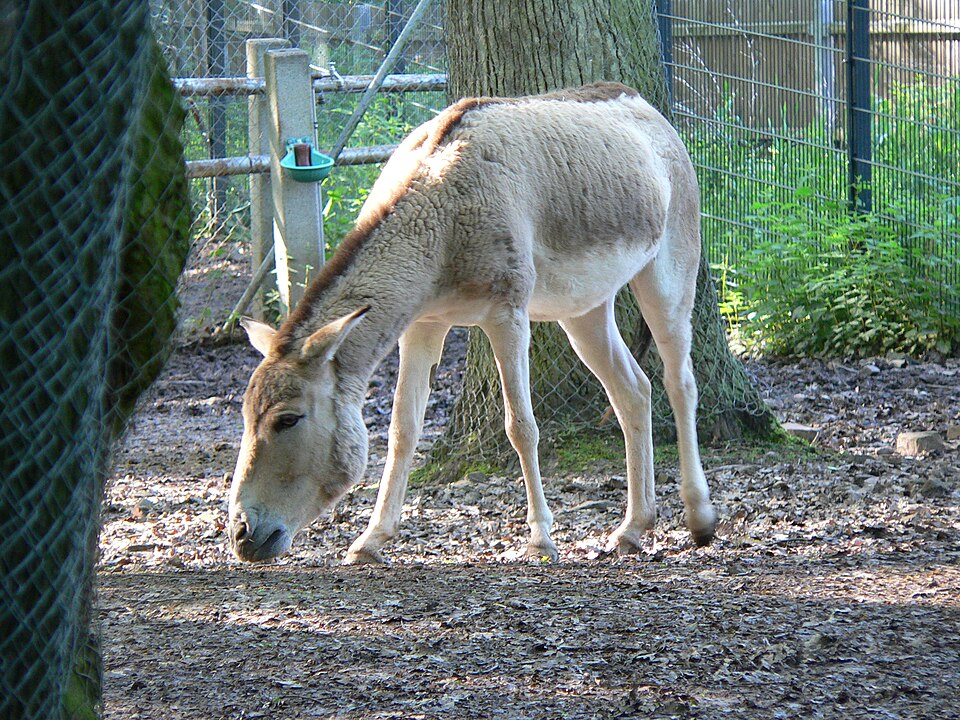
The onager has a robust body, slender legs, and hooves that are narrower than those of a horse. Its coat ranges from pale beige to reddish brown, with a paler belly and a characteristic dark dorsal stripe. Its ears are longer than a horse's but shorter than those of a domestic donkey. It has a short, erect mane with no forelock.
Characteristics
Indicative values: they vary by subspecies, sex and region.
Habitat and distribution
The onager inhabits the arid, semi-desert, and desert steppes of central and western Asia. It favors open plains that offer good visibility for detecting predators. It tolerates significant temperature swings between day and night.
CURRENT RANGE
Historically found from the Middle East through to Mongolia and India, the onager's range has become highly fragmented. Wild populations now survive mainly in Iran, Mongolia, Turkmenistan, and India. Reintroduction programs have established small populations in protected reserves, including in areas outside its historical range.
Behaviour
The onager lives in groups with flexible social structure, often composed of females and young led by a dominant male. Solitary males sometimes defend territory around watering points. Highly mobile, it may cover great distances daily in search of grazing land. It is active mainly at dawn and dusk to minimize exposure to heat.
Reproduction
Gestation lasts approximately eleven months and results in the birth of a single foal. Births typically occur in spring or summer, when food resources are more abundant. The young animal is able to move shortly after birth and remains dependent on its mother for several months. Sexual maturity is reached at around two to three years of age.
Peculiarities
The name "onager" also refers to several subspecies of Equus hemionus, whose status varies considerably by region. The species is renowned for its endurance and ability to survive in environments with very sparse vegetation. Some populations undertake significant seasonal movements depending on water and forage availability.
Threats and conservation
The onager faces threats from hunting, competition with domestic livestock for pasture, and degradation of steppe habitats. Fragmentation of its range by human infrastructure limits exchange between populations. Protection and reintroduction programs exist in several countries to help stabilize population numbers.
Numbers and trends vary across sources and regions. See the IUCN assessment for the latest reference data.
Gallery
1 documented photographs.
References
Profile updated 03 September 2026 · Reviewed by the TunisieVet editorial team.
Comments (0)
No comments yet.
CONSERVATION STATUS
Near threatened (NT)
IUCN source, latest published assessment.
Species health
Documented diseases for this species.
See the 4 diseases of this species Find a veterinarianThis information is provided for educational purposes only and is not a substitute for a veterinary consultation. If you have any concerns about your animal's health, consult a veterinarian.
Related species
Similar animals
Other species documented in Animalpedia.

Be among the first to use our app. Sign up and get early Google Play access.
Discover