
Presentation
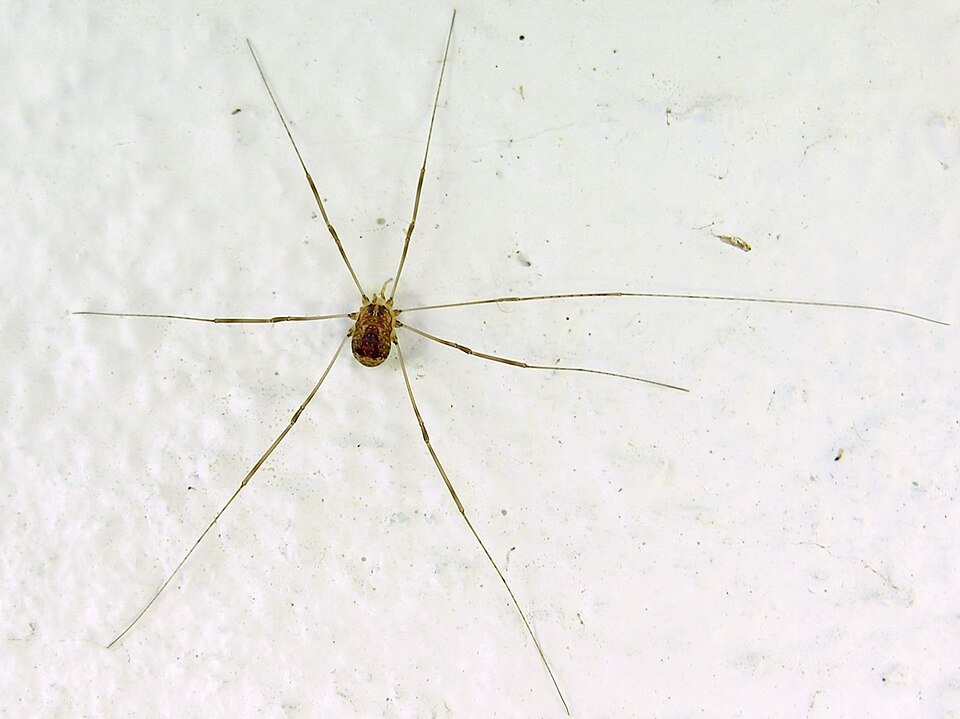
The harvestman, also called a daddy longlegs, is an arachnid defined by a compact body and long, thin legs. Unlike spiders, its cephalothorax and abdomen are fused into a single rounded mass with no visible constriction. It does not produce silk and lacks functional venom glands for hunting. Found on nearly every continent, it inhabits damp environments, woodland areas, and occasionally homes. Its discreet, nocturnal habits mean it often goes unnoticed despite being quite common.
The harvestman's body is oval and rarely exceeds one centimeter, while its legs can be disproportionately long. It has two simple eyes located on a central eye tubercle, unlike spiders which typically have eight. Its short chelicerae are used to grasp and crush food. Body color ranges from light brown to dark gray depending on the species.
Characteristics
Indicative values: they vary by subspecies, sex and region.
Habitat and distribution
Harvestmen favor damp, shaded environments such as forest leaf litter, cellars, and gardens. They are found under stones, bark, and in low vegetation. They also tolerate urban settings, particularly on walls and in corners of buildings. Their presence indicates an environment rich in organic matter.
CURRENT RANGE
Harvestmen are distributed across all continents except Antarctica, with considerable species diversity. In North Africa, several species occur in temperate and Mediterranean zones. In Tunisia, they are found in gardens, wooded areas, and rural dwellings. Their wide distribution reflects their ability to adapt to varied climates.
Behaviour
The harvestman is primarily nocturnal and solitary, though some species gather in dense clusters for protection. When threatened, it can shed a leg (autotomy), which continues to twitch to distract the predator. It moves slowly but can speed up when in danger thanks to its long legs. Contrary to a common misconception, it does not carry venom that is dangerous to humans.
Reproduction
Reproduction occurs through direct mating, without spermatophore transfer as seen in many spiders. The female lays her eggs in moist soil or beneath debris, sometimes shortly after mating. Some species exhibit rudimentary parental care, with the female protecting the clutch. Development progresses through several molts before reaching adulthood.
Peculiarities
Harvestmen are often confused with spiders, though they belong to a distinct order, Opiliones. They do not build webs and do not possess dangerous venom that can be injected, contrary to widespread popular belief. Their ability to lose their legs through autotomy is a notable defensive adaptation. Their long legs enable them to sense their surroundings through vibrations.
Threats and conservation
Harvestmen are not considered threatened globally, with populations generally stable. However, they may suffer locally from destruction of damp habitats and pesticide use. Their small size and inconspicuous nature make them poorly studied from a conservation standpoint. No specific protection measures are typically implemented for this group.
Numbers and trends vary across sources and regions. See the IUCN assessment for the latest reference data.
Gallery
1 documented photographs.
References
Profile updated 28 August 2026 · Reviewed by the TunisieVet editorial team.
Comments (0)
No comments yet.
CONSERVATION STATUS
Least concern (LC)
IUCN source, latest published assessment.
Similar animals
Other species documented in Animalpedia.

📱 عندك صفحة على فايسبوك؟ باهي… أما وين موقعك؟ الصفحة وحدها ما تكفيش. موقعك يخلي الناس تلقاك، يعرفوك أكثر ويثقو في خدمتك. 🌐 موقع باسم مشروعك 📲 يخدم أربعة وعشرين ساعة 🤝 يعطي ثقة واحترافية .📈 يعاونك تكبّر خدمتك خلّيه موجود وين الناس تلوّج عليه 🚀نعملولك موقع يشرّف مشروعك
WhatsApp