
Presentation
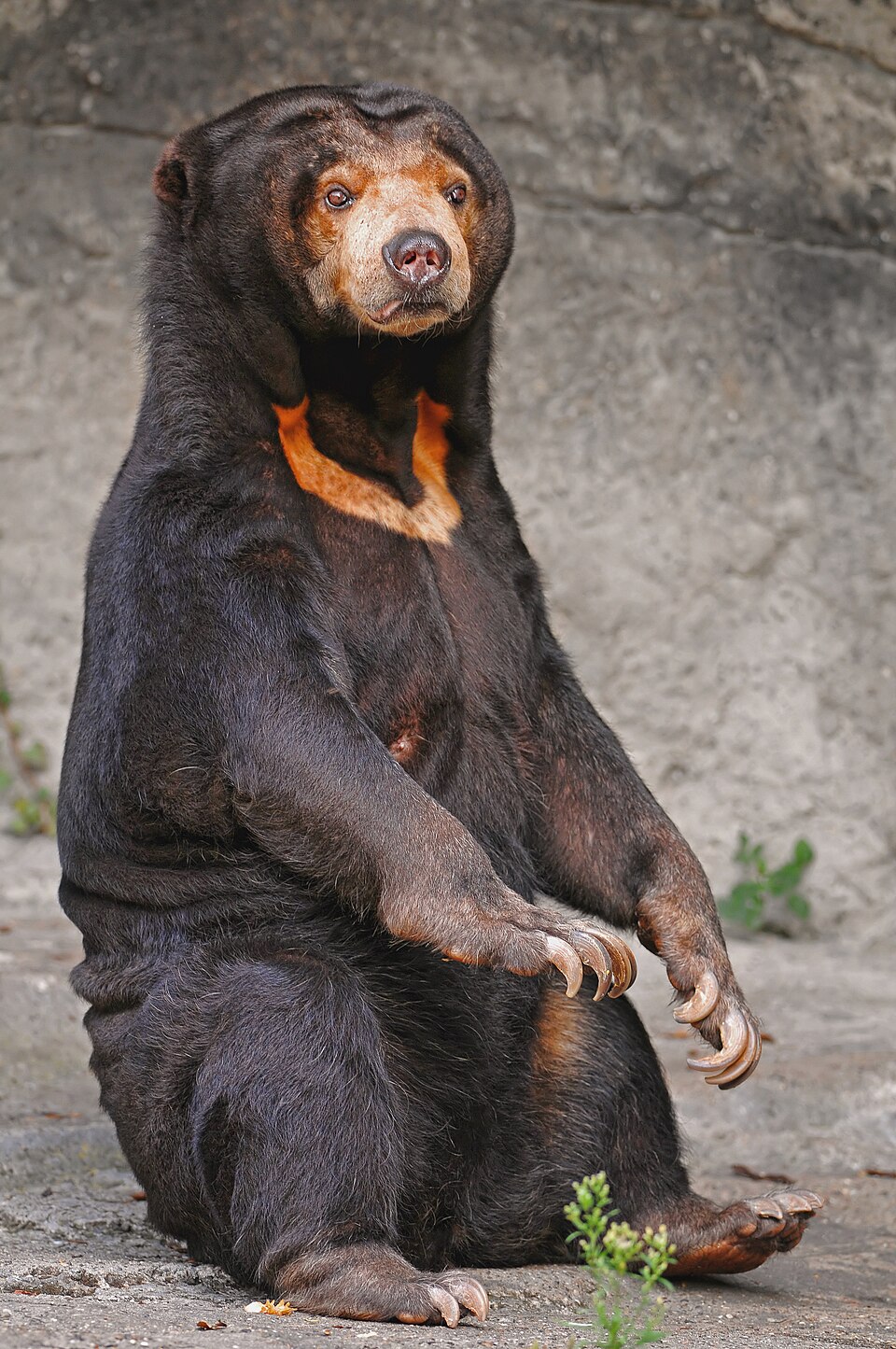
The Sun bear (Helarctos malayanus) is the smallest representative of the Ursidae family, native to the tropical forests of Southeast Asia. It is distinguished by its short black coat and the light horseshoe-shaped patch on its chest. An excellent climber, it spends a large part of its time in trees in search of food. Its discreet and nocturnal lifestyle makes it difficult to observe in the wild. The species is threatened by deforestation and poaching. It remains little studied compared to other bear species.
The Sun bear has a stocky body, short legs, and long, curved claws suitable for climbing. Its coat is short and smooth, black in color, with a clear U-shaped or horseshoe-shaped marking on the chest. Its tongue is particularly long, an asset for extracting honey and insects from cavities. It is the smallest bear in the world.
Characteristics
Indicative values: they vary by subspecies, sex and region.
Habitat and distribution
The species lives in dense, moist lowland tropical forests as well as some montane forests. It relies heavily on the canopy for movement and food. Deforestation is gradually reducing its natural habitat.
CURRENT RANGE
Sun bear is found in Southeast Asia, including Indonesia, Malaysia, Borneo, Sumatra, Thailand, Myanmar and southern China. Its historical range has shrunk considerably in recent decades. Remaining populations are fragmented by habitat loss.
Behaviour
Solitary and primarily nocturnal, the Sun bear is an excellent climber that spends a lot of time in trees feeding or resting. It marks its territory with scratches on the trunks. Unlike many bears, it does not hibernate, with food resources available year-round in its tropical habitat. It can be aggressive if it feels threatened despite its small size.
Reproduction
The female generally gives birth to one or two young after a gestation whose duration can vary due to a phenomenon of embryonic diapause. Births can occur at any time of the year in the absence of marked seasonality. The young remain dependent on their mother for several months before becoming independent. Sexual maturity is reached around three years of age.
Peculiarities
Its exceptionally long tongue, which can reach 20 to 25 cm, allows it to reach honey in the deepest recesses of wild hives. The horseshoe mark on its chest is unique to each individual, a bit like a fingerprint. It is the smallest bear in the world, a size for which it holds a recognized record.
Threats and conservation
Deforestation linked to logging and the expansion of palm oil plantations constitutes the main threat to the species. Poaching for bile, used in traditional Asian medicine, and the illegal trade in live animals are worsening its decline. Habitat fragmentation isolates remaining populations.
Numbers and trends vary across sources and regions. See the IUCN assessment for the latest reference data.
Gallery
1 documented photographs.
References
Profile updated 25 August 2026 · Reviewed by the TunisieVet editorial team.
Comments (0)
No comments yet.
CONSERVATION STATUS
Vulnerable (VU)
IUCN source, latest published assessment.
Species health
Documented diseases for this species.
This information is provided for educational purposes only and is not a substitute for a veterinary consultation. If you have any concerns about your animal's health, consult a veterinarian.
To discover around: Sun bear
Videos, facts, stories and records linked to this species.
RECORD
60 to 70 cm at the withers / up to 65 kg
The smallest bear in the world
Comparative measurement between the eight current bear species, the sun bear being the sma...
Similar animals
Other species documented in Animalpedia.

TunisieVet in your pocket 📱🐾 Access your veterinary services wherever you are. [ Download the app ]
Learn more