
Presentation
The Eurasian magpie (Pica pica) is a passerine bird of the corvid family, recognized by its striking black and white plumage and long tail. It is renowned for its remarkable intelligence, comparable to that of certain primates. Present across much of Eurasia and northwestern Africa, it inhabits both rural and urban areas. Its characteristic call and often noisy behavior make it an easily identifiable species. In Tunisia, it is found in certain regions of the northern part of the country.
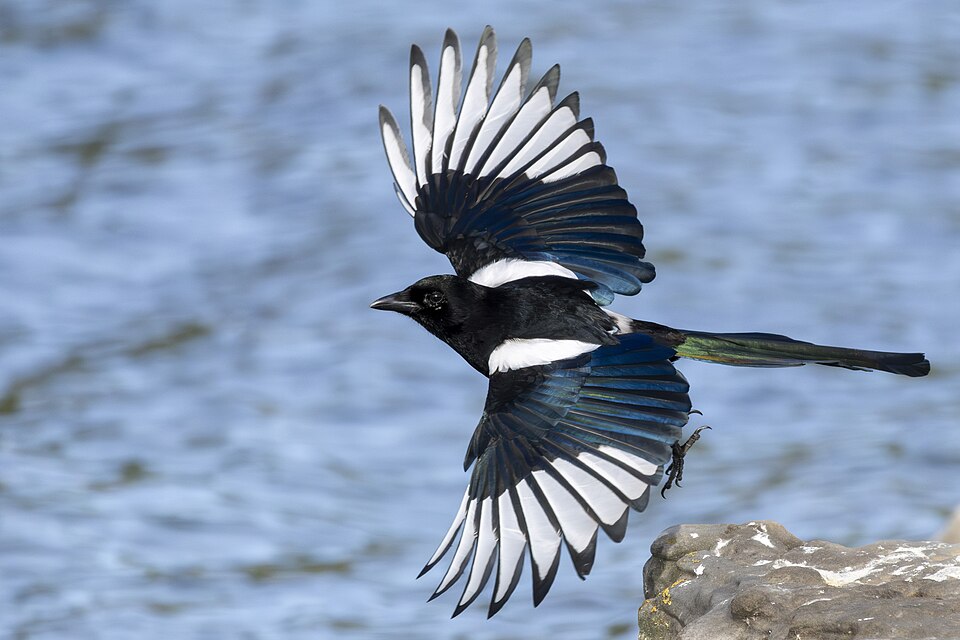
The magpie has black plumage with iridescent blue-green reflections on the wings and tail, contrasting with a white belly and shoulders. Its tail is long and graduated, making up a significant portion of the bird's total length. The beak is robust and black, suited to a varied diet. The wings are broad and rounded, allowing for slow but maneuverable flight.
Characteristics
Indicative values: they vary by subspecies, sex and region.
Habitat and distribution
The magpie frequents open areas scattered with trees, such as farmland, meadows, and forest edges. It has adapted well to urban and suburban environments, where food is readily available. It typically avoids dense forests and areas completely lacking tree cover. In Tunisia, it is mainly observed in agricultural and wooded areas in the north.
CURRENT RANGE
The magpie is widely distributed across Europe, much of Asia, and northwestern Africa, including the Maghreb. It is found in varied habitats, from temperate plains to mountainous regions. In North Africa, it occurs notably in Tunisia, Algeria, and Morocco. It is largely sedentary and does not migrate over long distances.
Behaviour
The magpie is a social bird that often lives in small groups outside the breeding season. It is known for its developed intelligence, problem-solving ability, and capacity to recognize itself in a mirror. It produces repetitive and loud calls to communicate or signal danger. Territorial by nature, it actively defends its nest and food resources.
Reproduction
The female builds a large dome-shaped nest, often placed high in trees, using branches and mud. She typically lays between 5 and 8 eggs per clutch, which she incubates alone for about three weeks. Both parents feed the young after hatching. The young leave the nest around one month after fledging but remain dependent on the adults for several additional weeks.
Peculiarities
The magpie is among the rare animal species capable of recognizing itself in a mirror, a test typically associated with advanced self-awareness. It has an ambivalent cultural reputation, sometimes linked to theft of shiny objects, though this belief is not scientifically confirmed. Its apparently black and white plumage displays iridescent blue and green reflections at certain angles of light.
Threats and conservation
The magpie is not subject to major threats across its global range. Locally, it may be persecuted by some farmers due to crop damage or predation of other birds' eggs. Loss of tree cover in certain regions can locally affect its populations. It remains, however, a common and widely distributed species.
Numbers and trends vary across sources and regions. See the IUCN assessment for the latest reference data.
Gallery
1 documented photographs.
References
Profile updated 04 September 2026 · Reviewed by the TunisieVet editorial team.
Comments (0)
No comments yet.
CONSERVATION STATUS
Least concern (LC)
IUCN source, latest published assessment.
Species health
Documented diseases for this species.
Find a veterinarianThis information is provided for educational purposes only and is not a substitute for a veterinary consultation. If you have any concerns about your animal's health, consult a veterinarian.
Similar animals
Other species documented in Animalpedia.

TunisieVet in your pocket 📱🐾 Access your veterinary services wherever you are. [ Download the app ]
Learn more