
Presentation
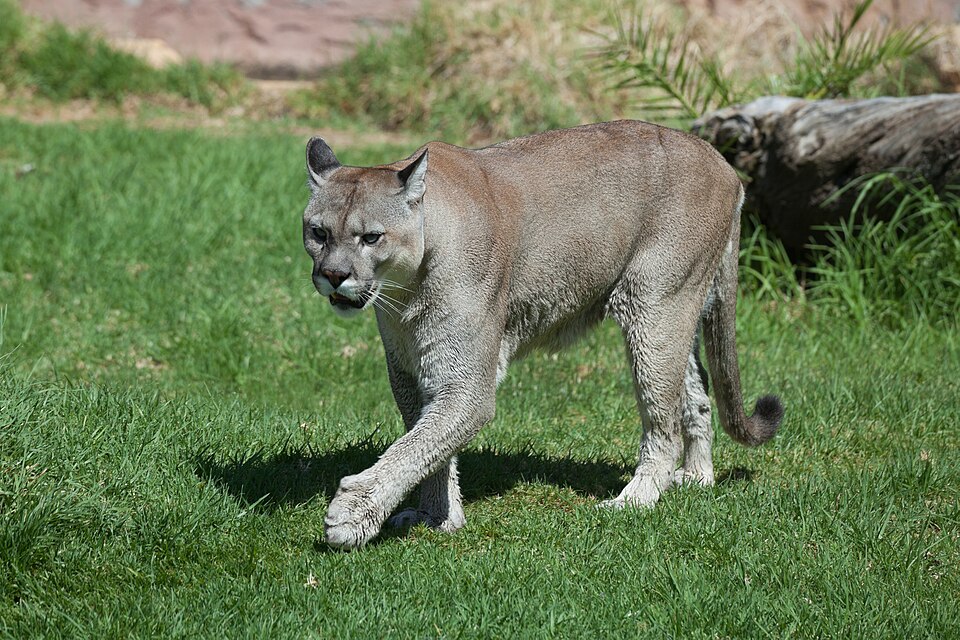
The Puma (Puma concolor) is a large cat native to the American continent, where it has one of the largest ranges among terrestrial mammals. Also called cougar or mountain lion depending on the region, it is distinguished by its plain fawn to gray coat and the absence of a mane or marked patterns. Solitary and discreet, it hunts mainly at dusk and dawn. This opportunistic predator adapts to a wide variety of environments, from tropical forests to deserts and snow-covered mountains. It is not part of the Tunisian fauna.
The Puma has a muscular and elongated body, rear legs longer than the front legs giving it excellent jumping ability. Its head is relatively small in relation to its body, with rounded ears not adorned with tufts. Its coat varies from beige-red to ash gray depending on the population, without distinctive patterns in adulthood. Unlike big cats like the lion, it does not roar but emits hisses, howls and high-pitched cries.
Characteristics
Indicative values: they vary by subspecies, sex and region.
Habitat and distribution
The Puma occupies a wide diversity of habitats, from dense tropical forests and arid deserts to rocky mountains and grasslands. This exceptional ecological plasticity allows it to survive from sea level to several thousand meters of altitude. However, it requires sufficient plant or rock cover to hunt in hiding and hide. Its territory can cover several hundred square kilometers depending on the availability of prey.
CURRENT RANGE
The species is present from Canada to the southern tip of South America, making it one of the land mammals with the most extensive natural range in the Americas. North American populations declined sharply in the eastern part of the continent, where the species was locally exterminated. However, it remains well represented in the western United States, Canada and a large part of Central and South America. Puma is not present in Africa, Europe or Asia.
Behaviour
The Puma is a solitary and territorial animal, males and females only meeting for reproduction. It marks its territory with scratches, urine deposits and visible piles of excrement. An excellent climber and jumper, it can leap several meters in height to escape danger or surprise prey. Its activity is mainly twilight and nocturnal, which limits direct contact with humans.
Reproduction
The female gives birth after a gestation of about three months, giving birth to a litter of one to six young, called kittens. The young are born spotted, a coloring that gradually disappears as they grow. They remain dependent on their mother for twelve to eighteen months before becoming independent. Sexual maturity is reached around two to three years of age.
Peculiarities
The Puma has an impressive number of vernacular names depending on the region, including cougar, mountain lion and panther. It is capable of achieving remarkable vertical and horizontal leaps thanks to the power of its hindquarters. Unlike the “roaring” big cats, it belongs to the small feline group taxonomically and purrs like a domestic cat.
Threats and conservation
The main threats to Puma are habitat loss and fragmentation linked to urbanization and agriculture. Road collisions and conflicts with livestock, which result in regulatory shooting, also affect certain local populations. In certain regions of South America, poaching remains an additional threat. On a global scale, however, the species is not considered threatened.
Numbers and trends vary across sources and regions. See the IUCN assessment for the latest reference data.
Gallery
1 documented photographs.
References
Profile updated 25 August 2026 · Reviewed by the TunisieVet editorial team.
Comments (0)
No comments yet.
CONSERVATION STATUS
Least concern (LC)
IUCN source, latest published assessment.
Species health
Documented diseases for this species.
See the 4 diseases of this species Find a veterinarianThis information is provided for educational purposes only and is not a substitute for a veterinary consultation. If you have any concerns about your animal's health, consult a veterinarian.
Related species
To discover around: Puma
Videos, facts, stories and records linked to this species.
Similar animals
Other species documented in Animalpedia.

TunisieVet in your pocket 📱🐾 Access your veterinary services wherever you are. [ Download the app ]
Learn more