
Presentation
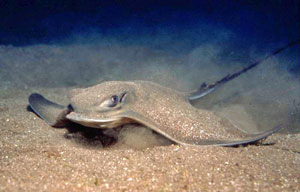
The eagle ray (Myliobatis aquila) is a cartilaginous fish belonging to the order Myliobatiformes. It is characterized by a flattened diamond-shaped body and long, pointed pectoral fins resembling wings. This benthic predator lives in temperate and tropical coastal waters, particularly in the Mediterranean and the Eastern Atlantic. It swims with graceful undulations of its fins, which often earns it the nickname “sea bird”. Its thin tail carries one or more venomous stings used in defense. In Tunisia, it is occasionally observed along the coasts.
The diamond-shaped body is brown to grayish above and white ventrally, providing effective camouflage. The snout is prominent and pointed, giving the head a distinctive beak-like profile. The tail is long, thin and whipped, with one or more venomous spines at its base. The highly developed pectoral fins form “wings” allowing characteristic undulating swimming.
Characteristics
Indicative values: they vary by subspecies, sex and region.
Habitat and distribution
It frequents shallow coastal waters, sandy or muddy bottoms as well as areas close to reefs. It is also occasionally found in the open sea when traveling. It favors coastal areas rich in molluscs and crustaceans, its main source of food.
CURRENT RANGE
eagle ray is present in the Eastern Atlantic Ocean, from Norway to South Africa, as well as throughout the Mediterranean Sea. It also frequents certain areas of the Black Sea. In Tunisia, it is regularly reported along the Mediterranean coasts.
Behaviour
This species is generally solitary but can form small groups during seasonal migrations. It spends much of its time scavenging the seafloor in search of food, sometimes burying itself partially in the sand. It is capable of swimming long distances thanks to its powerful pectoral fins. If it feels threatened, it can use its venomous tail stinger to defend itself.
Reproduction
The eagle ray is ovoviviparous: the eggs develop and hatch inside the mother's body. The young are therefore born already formed, after a gestation which lasts several months. The litter generally numbers from a few individuals to around ten young people depending on the population. Sexual maturity is reached after several years of growth.
Peculiarities
Its nickname “sea bird” comes from its undulating swimming, reminiscent of the flight of a gliding bird. Its venomous tail sting, although rarely fatal to humans, can cause painful wounds. This species is sometimes confused with other eagle rays of the genus Myliobatis present in other regions of the world.
Threats and conservation
eagle ray is threatened by accidental fishing in nets intended for other species. The degradation of coastal habitats, particularly through pollution and coastal urbanization, is reducing their breeding and feeding areas. Its slow growth and low fertility make it vulnerable to overexploitation.
Numbers and trends vary across sources and regions. See the IUCN assessment for the latest reference data.
Gallery
1 documented photographs.
References
Profile updated 28 August 2026 · Reviewed by the TunisieVet editorial team.
Comments (0)
No comments yet.
CONSERVATION STATUS
Endangered (EN)
IUCN source, latest published assessment.
Species health
Documented diseases for this species.
This information is provided for educational purposes only and is not a substitute for a veterinary consultation. If you have any concerns about your animal's health, consult a veterinarian.
To discover around: eagle ray
Videos, facts, stories and records linked to this species.
Similar animals
Other species documented in Animalpedia.

TunisieVet in your pocket 📱🐾 Access your veterinary services wherever you are. [ Download the app ]
Learn more