
Presentation
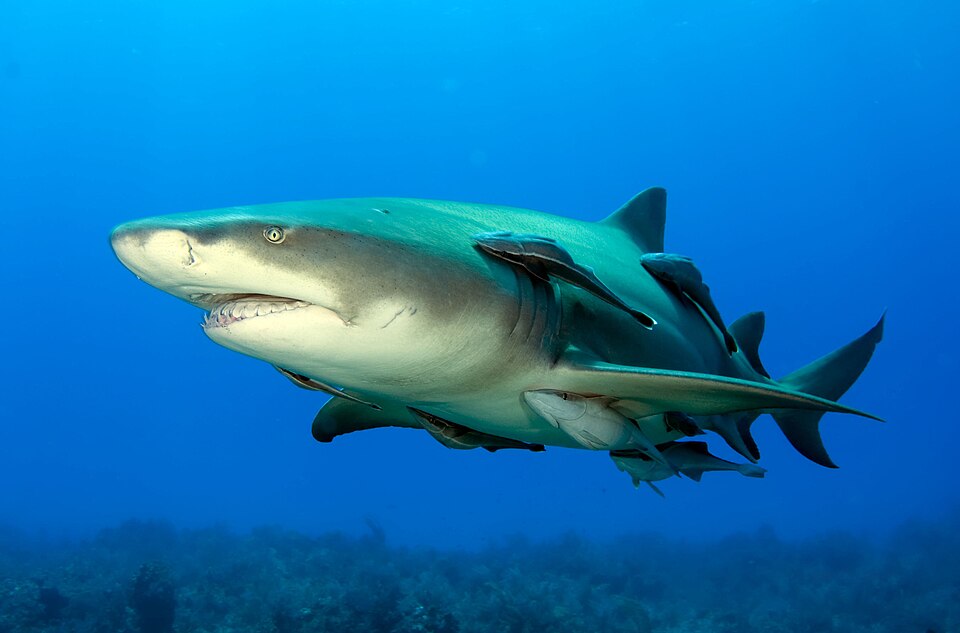
The Lemon shark is a robust shark living in the tropical and subtropical waters of the Atlantic and Pacific. It owes its name to the yellow-brown tint of its skin, which provides effective camouflage on sandy bottoms. This species is particularly studied by scientists because of its tolerance in captivity and its regular presence in shallow coastal areas. It has two dorsal fins of almost identical size, a distinctive feature among sharks. The Lemon shark often frequents mangroves during the first years of its life, which serve as a protective nursery. It is considered to be of little danger to humans unless provoked.
Its massive body and yellowish to brownish coloring distinguish it from other coastal sharks. Its two dorsal fins are of similar size, unlike most species where the first clearly dominates. Its head is broad and rounded, with a short muzzle.
Characteristics
Indicative values: they vary by subspecies, sex and region.
Habitat and distribution
The Lemon shark frequents shallow coastal waters, lagoons, mangroves and coral reefs. Juveniles often stay near mangroves, rich in food and shelter. Adults may venture into slightly deeper waters but generally stay close to shore.
CURRENT RANGE
The species occurs in tropical and subtropical waters of the western and eastern Atlantic, as well as the eastern Pacific. It is found in particular from the American coasts to the African coasts. It is absent from the Mediterranean and has never been recorded in Tunisia.
Behaviour
This species is rather sociable and sometimes forms groups, a rare behavior among sharks. It is mainly active at night, during which it actively hunts. The Lemon shark demonstrates notable learning ability, demonstrated in numerous laboratory studies.
Reproduction
Reproduction is viviparous, with a placenta nourishing the embryos during gestation. Females give birth to around ten young on average after a gestation of around one year. The newborns immediately move to the mangrove areas which serve as a refuge from predators.
Peculiarities
The Lemon shark is one of the most widely used shark species in scientific research due to its good tolerance to captivity. It exhibits fidelity to the birth site, sometimes returning there to reproduce.
Threats and conservation
Overfishing and the destruction of mangroves, essential for the survival of juveniles, threaten the species. Demand for shark fins for some Asian markets is also contributing to its decline. The slow rate of reproduction makes it vulnerable to fishing pressure.
Numbers and trends vary across sources and regions. See the IUCN assessment for the latest reference data.
Gallery
1 documented photographs.
References
Profile updated 28 August 2026 · Reviewed by the TunisieVet editorial team.
Comments (0)
No comments yet.
CONSERVATION STATUS
Near threatened (NT)
IUCN source, latest published assessment.
Species health
Documented diseases for this species.
This information is provided for educational purposes only and is not a substitute for a veterinary consultation. If you have any concerns about your animal's health, consult a veterinarian.
To discover around: Lemon shark
Videos, facts, stories and records linked to this species.
Similar animals
Other species documented in Animalpedia.

TunisieVet in your pocket 📱🐾 Access your veterinary services wherever you are. [ Download the app ]
Learn more