
Presentation
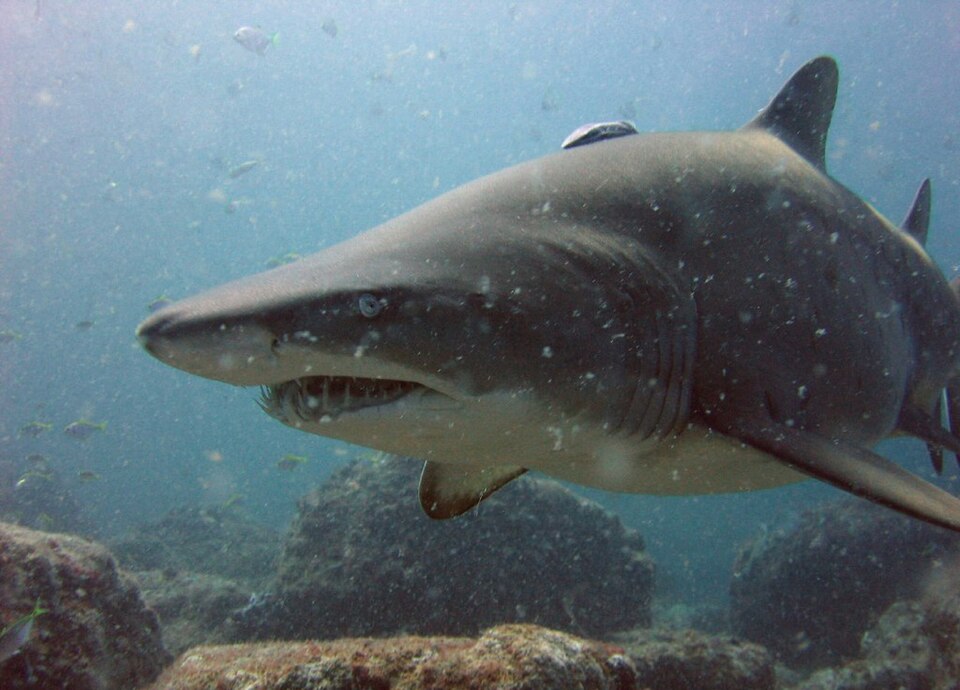
The Bull shark (Carcharias taurus) is a large littoral shark recognizable by its massive silhouette and its sharp teeth visible even with the mouth closed. It frequents temperate and subtropical waters around the world, often near coastlines, shipwrecks and underwater caves. Despite its impressive appearance, it is a rather slow species and not very aggressive towards humans. It is best known in public aquariums for its ability to remain motionless in open water through the ingestion of surface air. The species is now threatened by overfishing and bycatch.
Robust, spindle-shaped body, flattened conical snout, and jaw with long, clearly visible, fine, pointed teeth. The coloring is gray-brown to bronze-gray on the back, lighter on the belly, sometimes marked with dark spots in juveniles. It has two similarly sized dorsal fins, a distinctive trait among large sharks. Its functional swim bladder, powered by air swallowed at the surface, allows it to float effortlessly.
Characteristics
Indicative values: they vary by subspecies, sex and region.
Habitat and distribution
The Bull shark frequents shallow coastal waters, rocky reefs, wrecks and underwater caves up to a hundred meters deep. It also likes surf zones and estuaries where prey is abundant. It can occasionally enter coastal bays and lagoons.
CURRENT RANGE
The species is widely distributed in warm temperate and subtropical waters around the globe, notably along the Atlantic and Mediterranean coasts, as well as in southern Africa, Australia, and parts of Asia and the Americas. It is present rarely and occasionally in the Mediterranean, including occasionally off the Tunisian coast. Populations are fragmented and locally declining.
Behaviour
A generally calm and not very aggressive species, it often adopts gregarious behavior by forming seasonal aggregations, particularly near wrecks. It carries out seasonal migrations linked to reproduction and water temperature. Although involved in a few reported bites, it attacks humans only rarely and generally without predatory intent.
Reproduction
Reproduction is viviparous with a rare phenomenon of intrauterine oophagy and embryonic cannibalism, where the first developed embryo devours its siblings in each uterus. This results in the birth of only one or two young, already well developed, after a gestation of approximately nine to twelve months. Sexual maturity is late, reached around 6 to 10 years old depending on the sex, and the reproductive cycle is slow, which limits the renewal of populations.
Peculiarities
Its mode of reproduction with intrauterine cannibalism is unique among vertebrates and makes it a notable scientific case study. Its ability to swallow air to adjust its buoyancy is also a rare feature among sharks. Despite its menacing appearance, it is often referred to as the most docile large shark seen by divers.
Threats and conservation
Targeted and incidental overfishing, demand for fins and jaws, and degradation of coastal habitats are taking a heavy toll on populations. Its very low reproduction rate makes the species particularly vulnerable to any fishing pressure. Several countries have put in place local protection measures in the face of the observed decline.
Numbers and trends vary across sources and regions. See the IUCN assessment for the latest reference data.
Gallery
1 documented photographs.
References
Profile updated 28 August 2026 · Reviewed by the TunisieVet editorial team.
Comments (0)
No comments yet.
CONSERVATION STATUS
Vulnerable (VU)
IUCN source, latest published assessment.
Species health
Documented diseases for this species.
This information is provided for educational purposes only and is not a substitute for a veterinary consultation. If you have any concerns about your animal's health, consult a veterinarian.
To discover around: Bull shark
Videos, facts, stories and records linked to this species.
Similar animals
Other species documented in Animalpedia.

TunisieVet in your pocket 📱🐾 Access your veterinary services wherever you are. [ Download the app ]
Learn more