
Presentation
The Satin Bowerbird (Ptilonorhynchus violaceus) is a bird native to eastern Australia, renowned for the elaborate courtship display of the male, who builds and decorates an avenue of twigs. The adult male displays glossy blue-black plumage with a satin sheen, while the female and young males are olive-green with scalloped markings. This species belongs to the family Ptilonorhynchidae, known for constructing ornate structures used as courtship arenas rather than nests. The Satin Bowerbird inhabits wet forests and woodland edges, where it feeds mainly on fruits and insects. Its behavior of collecting blue objects to adorn its bower has made it one of the most studied birds in animal ethology.
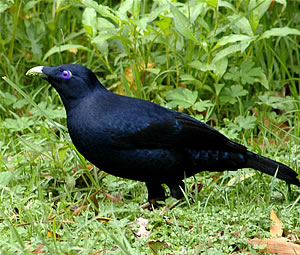
The male measures approximately 27 to 33 cm and displays brilliant blue-black plumage with a pale bill and violet eyes. The female and immature males have olive-green plumage spotted with brown and cream on the underparts. The species is distinguished by marked sexual dimorphism, with the male's striking plumage only appearing after several years of maturation.
Characteristics
Indicative values: they vary by subspecies, sex and region.
Habitat and distribution
The species frequents the humid sclerophyll forests, tropical rainforests and wooded edges of eastern Australia. It favours dense understory vegetation that provides both food and building materials. It is also found in gardens and wooded parks near forested areas.
CURRENT RANGE
The Satin Bowerbird is endemic to eastern Australia, ranging from southern Queensland to Victoria. Its distribution follows the humid coastal belt and the forests adjacent to the Great Dividing Range. The species is found nowhere else in the world in the wild.
Behaviour
The male constructs an avenue-shaped structure made of interwoven twigs, which he decorates with blue, yellow, or shiny objects to attract females. He then performs an elaborate courtship display including dance-like movements and mimicry of vocalizations. Females inspect several bowers before selecting a mate and do not participate in construction. Outside the breeding season, the species remains rather discreet and solitary.
Reproduction
The female builds a simple nest on her own in a tree or dense shrub, away from the male's bower. She typically lays one or two eggs, which she incubates alone for about three weeks. The young remain in the nest for several weeks before fledging and are cared for entirely by the mother. The male takes no part in raising the chicks and continues to maintain his bower to attract other mates.
Peculiarities
The male has a marked preference for blue objects, which he collects from feathers, flowers, bottle tops and plastic fragments. He also uses chewed plant matter to paint the inside of his bower. This decorating behaviour is transmitted and refined over the male's years of experience.
Threats and conservation
Deforestation and fragmentation of forest habitat represent the main potential threats. The species remains nonetheless widely distributed and adapts relatively well to wooded areas modified by humans. No major immediate threats currently affect its populations.
Numbers and trends vary across sources and regions. See the IUCN assessment for the latest reference data.
Gallery
1 documented photographs.
References
Profile updated 03 September 2026 · Reviewed by the TunisieVet editorial team.
Comments (0)
No comments yet.
CONSERVATION STATUS
Least concern (LC)
IUCN source, latest published assessment.
Species health
Documented diseases for this species.
This information is provided for educational purposes only and is not a substitute for a veterinary consultation. If you have any concerns about your animal's health, consult a veterinarian.
Related species
Similar animals
Other species documented in Animalpedia.

TunisieVet in your pocket 📱🐾 Access your veterinary services wherever you are. [ Download the app ]
Learn more