
Presentation
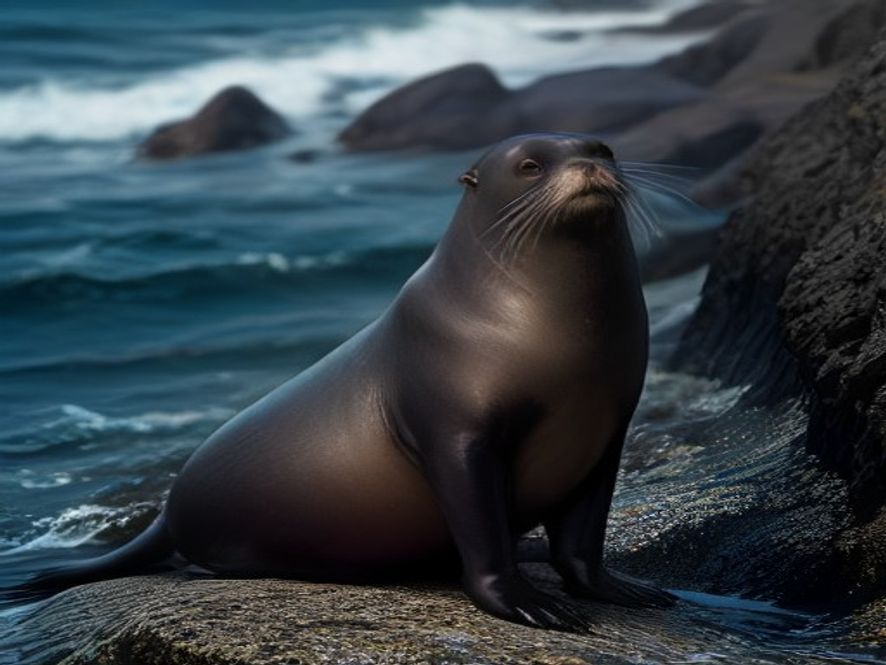
The Sea lion is a marine mammal belonging to the family Otariidae, characterized by the presence of small visible external ears and posterior fins that point forward. This trait allows it to move on land in a relatively agile manner, unlike true seals. Several species of Sea lions inhabit the coasts and islands of the Pacific, South Atlantic and Antarctic oceans. Sociable, it often forms large colonies on beaches and coastal rocks. An excellent swimmer, she hunts fish and cephalopods in coastal waters. It is widely known to the general public thanks to its frequent presence in zoos and dolphinariums.
The body is tapered and covered with short, dense fur, dark brown to gray depending on the species. The forelimbs are transformed into powerful flippers used for propulsion, while the rear flippers can rotate for terrestrial locomotion. Males exhibit marked sexual dimorphism, being significantly larger and more massive than females. Small external ears, absent in seals, easily distinguish the Sea lion from the latter.
Characteristics
Indicative values: they vary by subspecies, sex and region.
Habitat and distribution
The Sea lion frequents rocky coasts, beaches and islands where it forms its resting and breeding colonies. It spends a large part of its time at sea, in coastal and sometimes offshore waters, to feed. Some populations occasionally return to port areas close to human activities.
CURRENT RANGE
Sea lions are found primarily in the Southern Hemisphere and along the coasts of the North Pacific, including around South America, South Africa, Australia, New Zealand, and the North American Pacific coast. They are absent from the Mediterranean and therefore from the Tunisian coast in their natural state. Their distribution is strictly linked to coastal areas rich in fish.
Behaviour
The Sea lion is a gregarious animal that lives in sometimes very dense colonies on rocky or sandy coasts. Dominant males defend a territory and a harem of females during the breeding season, with frequent vocal and physical fights. She is also curious and playful, a behavior exploited in captive animal shows. Its noisy vocalizations are used for communication and territorial defense.
Reproduction
The breeding season gives rise to the formation of harems dominated by a territorial male. The female gives birth to a single young after a gestation of around eleven to twelve months, often shortly after arriving on the breeding beach. The little one is breastfed for several months before gradual weaning.
Peculiarities
Unlike seals, the Sea lion can straighten its body on its rear flippers and move with some ease on land. It has small external ears, absent in true seals, which constitutes an easy criterion of distinction. Its ability to perform acrobatic rotations and jumps in the water makes it particularly suitable for captive shows.
Threats and conservation
Sea lions are threatened by overfishing which is reducing their food resources, as well as marine pollution and fishing nets in which they can become entangled. Some populations have suffered intensive commercial hunting in the past for their fur and blubber. Climate change also affects prey availability in some regions.
Numbers and trends vary across sources and regions. See the IUCN assessment for the latest reference data.
Gallery
1 documented photographs.
References
Profile updated 27 August 2026 · Reviewed by the TunisieVet editorial team.
Comments (0)
No comments yet.
CONSERVATION STATUS
Least concern (LC)
IUCN source, latest published assessment.
Species health
Documented diseases for this species.
This information is provided for educational purposes only and is not a substitute for a veterinary consultation. If you have any concerns about your animal's health, consult a veterinarian.
To discover around: Sea lion
Videos, facts, stories and records linked to this species.
Similar animals
Other species documented in Animalpedia.

TunisieVet in your pocket 📱🐾 Access your veterinary services wherever you are. [ Download the app ]
Learn more