
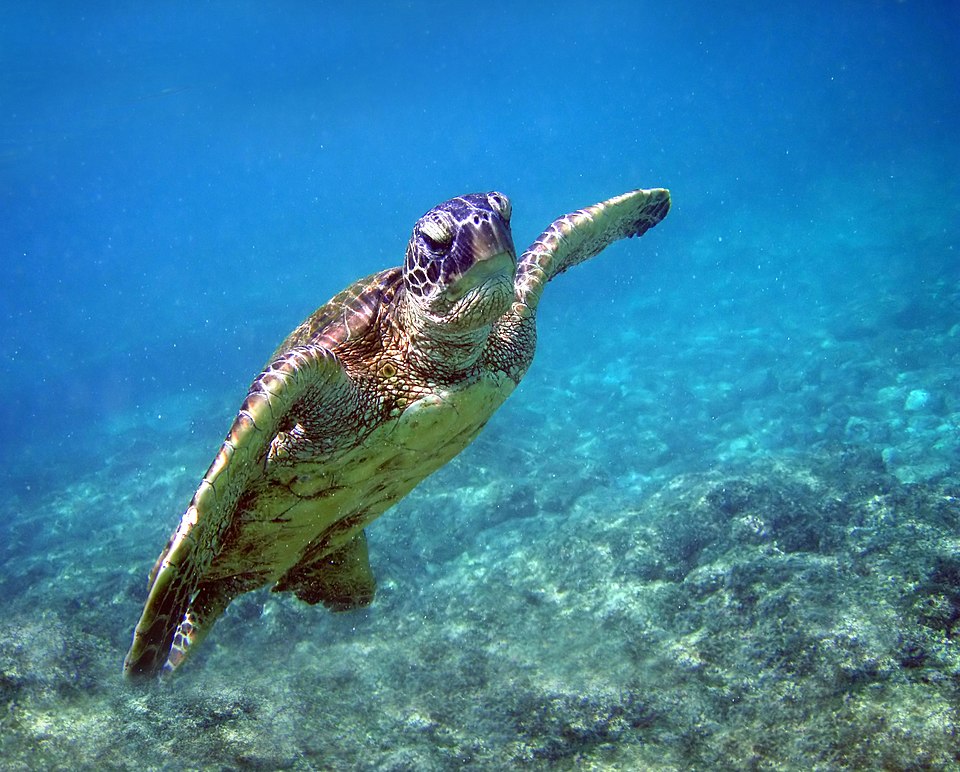
Presentation
The Sea turtle brings together several species of marine reptiles belonging to the families Cheloniidae and Dermochelyidae, of which the loggerhead sea turtle (Caretta caretta) is the most common in the Mediterranean and Tunisia. These animals have a hydrodynamic shell and limbs transformed into fins, perfect adaptations to aquatic life. They travel very long distances between their feeding areas and their native nesting beaches. Although they breathe air and must regularly come to the surface, they spend almost their entire life at sea. Females return to lay their eggs on sandy beaches, sometimes thousands of kilometers from their place of birth. Several species are today threatened by accidental fishing, pollution and degradation of nesting sites.
The carapace is covered with horny scales arranged in plates, providing protection while remaining light. The front limbs, long and flattened like fins, provide propulsion while the hind limbs serve as rudder. Unlike land turtles, the Sea turtle cannot retract its head or limbs under its shell. It has tear glands that eliminate excess salt ingested with seawater.
Characteristics
Indicative values: they vary by subspecies, sex and region.
Habitat and distribution
The Sea turtle lives in the coastal and offshore waters of warm and temperate seas, frequenting both seagrass meadows and the open sea. It uses sandy beaches only for spawning. In the Mediterranean, it frequents coastal areas rich in food as well as certain isolated beaches for nesting.
CURRENT RANGE
Sea turtles are found in tropical, subtropical, and temperate oceans around the world. In the Mediterranean, the loggerhead turtle is the most common species, with nesting sites notably in Greece, Turkey, Libya and occasionally on the Tunisian coast. Other species such as the green turtle and the leatherback turtle frequent these waters more rarely.
Behaviour
The Sea turtle leads an essentially solitary life and carries out long migrations between feeding areas and breeding sites. It is capable of deep and prolonged dives, with some species reaching several hundred meters. Behavior is not very social outside of breeding periods. She faithfully returns to lay eggs on the beach where she was born, thanks to a remarkable sense of orientation linked to the earth's magnetic field.
Reproduction
The female comes out of the water at night to dig a nest in the sand and lay around a hundred eggs on average, several times per season. After an incubation of two to three months, the temperature of the nest determines the sex of the newborns. Young turtles return to the sea as soon as they hatch, a critical phase where predation is very high. Sexual maturity is late, generally reached between 20 and 30 years old depending on the species.
Peculiarities
Some species, such as the leatherback turtle, can dive more than a thousand meters deep. The sex of hatchlings depends on the incubation temperature of the nest, a phenomenon called temperature-dependent sex determination. Sea turtles can live for several decades, with some probably exceeding a century.
Threats and conservation
The main threats are accidental capture in fishing nets, ingestion of plastic waste confused with jellyfish, and the destruction of nesting beaches by coastal urbanization. Global warming also disrupts the sex ratio by changing incubation temperatures. Marine pollution and egg poaching remain significant local threats.
Numbers and trends vary across sources and regions. See the IUCN assessment for the latest reference data.
Gallery
1 documented photographs.
References
Profile updated 31 August 2026 · Reviewed by the TunisieVet editorial team.
Comments (0)
No comments yet.
CONSERVATION STATUS
Vulnerable (VU)
IUCN source, latest published assessment.
Species health
Documented diseases for this species.
This information is provided for educational purposes only and is not a substitute for a veterinary consultation. If you have any concerns about your animal's health, consult a veterinarian.
To discover around: Sea turtle
Videos, facts, stories and records linked to this species.
Similar animals
Other species documented in Animalpedia.

TunisieVet in your pocket 📱🐾 Access your veterinary services wherever you are. [ Download the app ]
Learn more