
Presentation
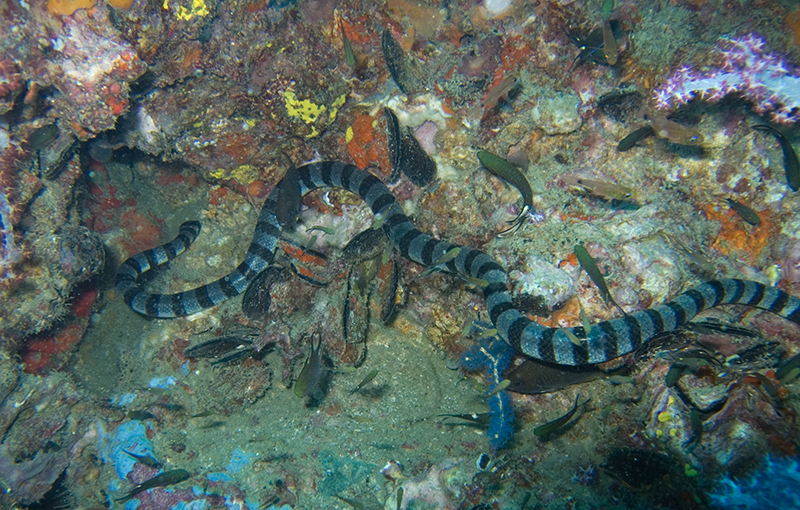
The Sea snake brings together several dozen species of the Hydrophiinae subfamily, reptiles totally adapted to marine life. Their bodies are laterally flattened and their oar-shaped tail allows them to swim efficiently. They possess a powerful neurotoxic venom used to immobilize their prey, mainly fish and eels. Unlike terrestrial snakes, they can remain submerged for several hours thanks to specific respiratory adaptations. Most species live in tropical waters of the Indo-Pacific and are rarely aggressive towards humans. This group illustrates a remarkable evolutionary convergence between reptiles and the aquatic environment.
The body is elongated, compressed laterally, with a flat tail serving as a fin. The nostrils are located on the top of the snout and can close underwater using valves. The scales are generally smooth and coloring varies from yellow to black with banded patterns depending on the species.
Characteristics
Indicative values: they vary by subspecies, sex and region.
Habitat and distribution
The Sea snake frequents shallow coastal waters, coral reefs and estuaries. Some species venture into the open ocean, while others stay close to mangroves and coastal areas. They are absent from cold waters and are concentrated in tropical and subtropical zones.
CURRENT RANGE
Sea snake occurs mainly in the tropical waters of the Indian Ocean and the Pacific Ocean. It is found from the Persian Gulf to the coasts of Australia and Japan. It is absent from the Atlantic Ocean and is not present in the Mediterranean or Tunisia.
Behaviour
The Sea snake is generally not very aggressive and avoids contact with humans, biting only rarely and often without injecting venom. It can remain submerged for several hours before returning to the surface to breathe. Some species form large gatherings to breed or rest near the coast.
Reproduction
Most sea snake species are ovoviviparous, giving birth to live young directly in the sea without ever returning to land. A minority of species, more closely related to sea kraits, come ashore to lay their eggs. Sexual maturity is generally reached after several years.
Peculiarities
Sea snake has a partial cutaneous respiratory capacity that complements pulmonary respiration. Its venom is among the most powerful in the animal kingdom, although human envenomations are rare. Its oar-shaped tail and valved nostrils are unique adaptations among snakes.
Threats and conservation
Major threats include coral reef degradation and marine pollution. Accidental capture in fishing nets also affects some local populations. The destruction of mangroves reduces coastal habitats used by certain species.
Numbers and trends vary across sources and regions. See the IUCN assessment for the latest reference data.
Gallery
1 documented photographs.
References
Profile updated 02 September 2026 · Reviewed by the TunisieVet editorial team.
Comments (0)
No comments yet.
CONSERVATION STATUS
Least concern (LC)
IUCN source, latest published assessment.
Species health
Documented diseases for this species.
This information is provided for educational purposes only and is not a substitute for a veterinary consultation. If you have any concerns about your animal's health, consult a veterinarian.
To discover around: Sea snake
Videos, facts, stories and records linked to this species.
Similar animals
Other species documented in Animalpedia.

TunisieVet in your pocket 📱🐾 Access your veterinary services wherever you are. [ Download the app ]
Learn more