
Presentation
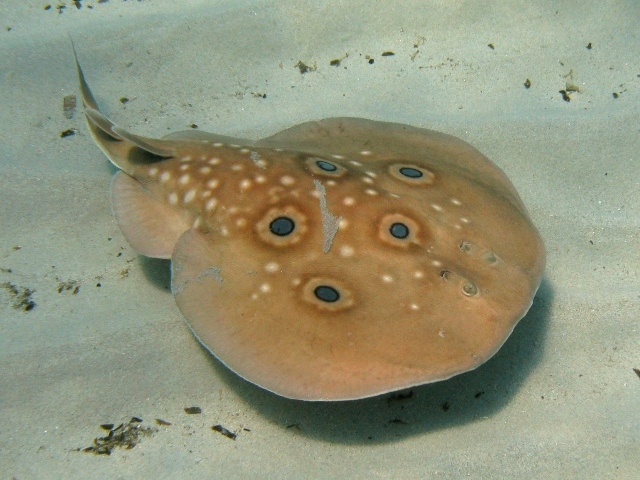
Torpedo ray refers to several species of cartilaginous fish belonging to the Torpedinidae family, capable of generating an electrical discharge using specialized organs located on either side of the head. Its body is flattened, rounded, disc-shaped, with smooth skin and generally devoid of scales. Coloration varies from uniform brown to mottled brown depending on the species, which allows it to blend into sandy or rocky seabeds. It lives mainly in the Mediterranean and the eastern Atlantic, including along the Tunisian coast. This discreet predator spends a large part of its time semi-buried, motionless, waiting for its prey. Its electric discharge, which can reach several tens of volts, serves both as a means of hunting and of defense.
The discoidal body is lined with broad pectoral fins fused to the head, extended by a muscular tail carrying one or two dorsal and one caudal fins. The skin is soft, without visible dermal denticles, unlike other rays. The eyes are small and located on the top of the disc, while the electrical organs, clearly visible through transparency, occupy a large part of the sides.
Characteristics
Indicative values: they vary by subspecies, sex and region.
Habitat and distribution
It frequents the sandy, muddy or rocky bottoms of the coast up to a few hundred meters deep. It is found both near the coast and on the continental shelf, often near seagrass beds. It likes quiet areas where it can stay buried without being disturbed.
CURRENT RANGE
Torpedo ray is present in the Mediterranean and the eastern Atlantic, from the European coasts to the African coasts. It is regularly observed along the Tunisian coasts, particularly in the Gulf of Gabès and Tunis. Its distribution generally follows temperate and subtropical coastal zones.
Behaviour
It is a solitary and not very active animal, mainly nocturnal or crepuscular. It spends the day partially buried in sand or mud, moving only to hunt or breed. Its electric discharge also constitutes an effective defense against predators and deters any direct contact.
Reproduction
The Torpedo ray is ovoviviparous: the eggs develop inside the body of the female and the young are born already formed. A litter generally consists of a few individuals to around ten juveniles depending on the species. Sexual maturity is reached after several years of growth.
Peculiarities
Its ability to produce electricity relies on electrical organs made up of stacked cells called electrocytes, functioning like miniature biological batteries. This particularity makes it a classic subject of study in neurophysiology since Antiquity, with Greek and Roman doctors already using its contact to relieve certain pain.
Threats and conservation
It is sometimes accidentally caught in fishing nets as bycatch. The degradation of coastal habitats and pollution of the seabed can locally affect its populations. It is not subject to targeted fishing due to its low commercial value and the risk of electric shock.
Numbers and trends vary across sources and regions. See the IUCN assessment for the latest reference data.
Gallery
1 documented photographs.
References
Profile updated 28 August 2026 · Reviewed by the TunisieVet editorial team.
Comments (0)
No comments yet.
CONSERVATION STATUS
Least concern (LC)
IUCN source, latest published assessment.
Species health
Documented diseases for this species.
This information is provided for educational purposes only and is not a substitute for a veterinary consultation. If you have any concerns about your animal's health, consult a veterinarian.
To discover around: Torpedo ray
Videos, facts, stories and records linked to this species.
RECORD
up to about 200 volts depending on the species
Natural electric discharge
Electrical power measured in certain large species of torpedoes during defensive or huntin...
Similar animals
Other species documented in Animalpedia.

TunisieVet in your pocket 📱🐾 Access your veterinary services wherever you are. [ Download the app ]
Learn more