Presentation
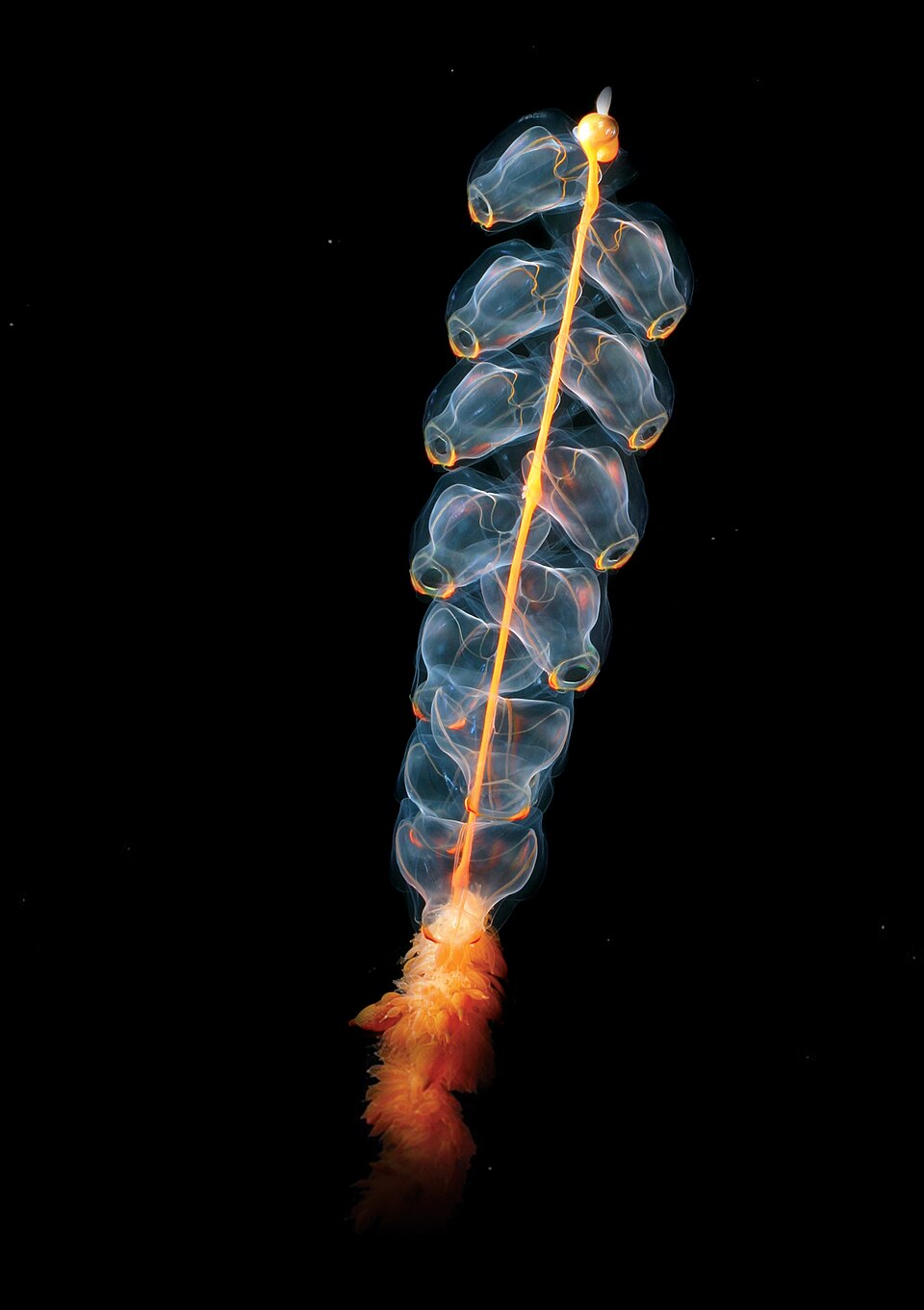
Siphonophores make up an order of colonial marine cnidarians related to jellyfish and corals. Each visible individual is actually a colony made up of many specialized zooids, genetically identical, each performing a specific function—buoyancy, propulsion, prey capture, digestion, and reproduction. The Portuguese man o' war and Praya dubia are among the best-known representatives. Some deep-sea species rank among the longest known colonial organisms. Their translucent, gelatinous bodies make them difficult to observe and study. They inhabit all oceans worldwide, from the surface to the abyssal depths.
The body consists of a chain of specialized zooids connected by a common axis, often topped by a gas-filled float (pneumatophore). Stinging tentacles bear nematocysts capable of injecting paralyzing venom. Depending on the species, the colony can range from a few centimeters to several tens of meters in length.
Characteristics
Indicative values: they vary by subspecies, sex and region.
Habitat and distribution
Siphonophores inhabit the entire water column of the ocean, from the surface down to the abyssal zones. Some species such as the Portuguese man o'war float at the surface driven by wind, while others live in open water or near the bottom in the deep ocean.
CURRENT RANGE
Siphonophores are found in all the world's oceans, from tropical to polar waters. Some surface-dwelling species like the Portuguese man o'war can occasionally drift as far as the Mediterranean, including near the Tunisian coast during particular weather conditions.
Behaviour
These animals typically drift passively with currents; some adjust their depth by changing the gas in their float. Swimming species move through coordinated pulsations of their nectophores. Many deep-sea species are bioluminescent, which likely serves to attract prey or provide defense.
Reproduction
Reproduction combines sexual and asexual phases within the colony's life cycle. Specialized reproductive zooids, called gonozooids, produce gametes that are released into the water where fertilization occurs. Larvae then develop by progressively forming the other zooids of the future colony through budding.
Peculiarities
A siphonophore is not a single organism but a colony of interdependent zooids, unable to survive in isolation. Some deep-sea species rank among the longest known organisms, sometimes exceeding the size of a blue whale. Their venom can cause painful stings in humans, particularly in the case of the Portuguese man o'war.
Threats and conservation
Ocean warming and acidification threaten the plankton balance on which these animals depend. Plastic and chemical pollution of the seas also affects their habitat. However, they are not subject to specific conservation monitoring, owing to insufficient data on most species.
Numbers and trends vary across sources and regions. See the IUCN assessment for the latest reference data.
Gallery
1 documented photographs.
References
Profile updated 01 September 2026 · Reviewed by the TunisieVet editorial team.
Comments (0)
No comments yet.
CONSERVATION STATUS
Data deficient (DD)
IUCN source, latest published assessment.
Species health
Documented diseases for this species.
Find a veterinarianThis information is provided for educational purposes only and is not a substitute for a veterinary consultation. If you have any concerns about your animal's health, consult a veterinarian.
To discover around: Siphonophore
Videos, facts, stories and records linked to this species.
RECORD
up to approximately 40-45 m (Praya dubia)
One of the longest colonial organisms
Maximum estimated length for a colony fully extended in open water in the deep ocean.
Similar animals
Other species documented in Animalpedia.

Be among the first to use our app. Sign up and get early Google Play access.
Discover