
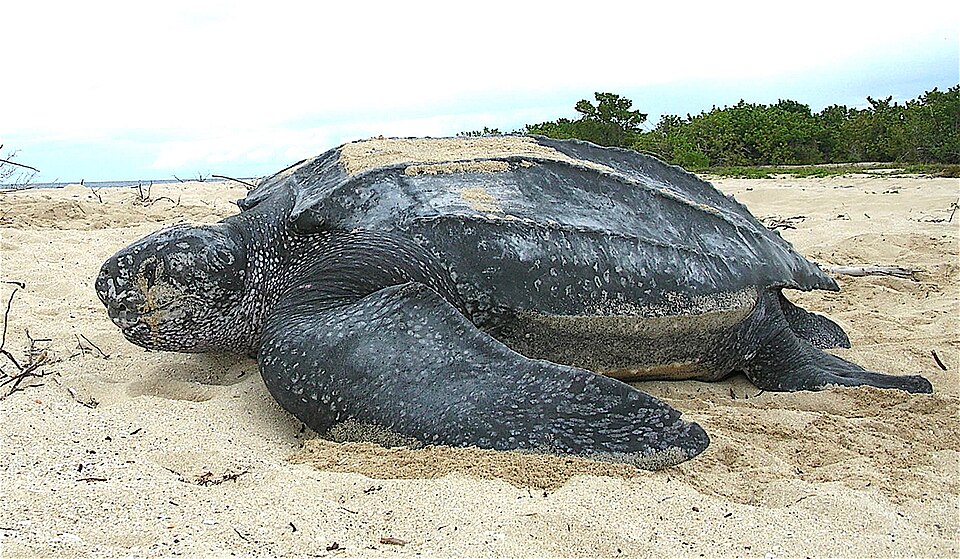
Presentation
The Leatherback turtle (Dermochelys coriacea) is the largest sea turtle in the world and the only reptile capable of maintaining a body temperature higher than that of its aquatic environment. It is distinguished by a flexible shell, devoid of horny scales, covered with rubbery skin covered with longitudinal ridges. A great traveler, she travels the world's oceans in search of jellyfish, her almost exclusive food. An ancient species, it is the only surviving representative of the Dermochelyidae family. Vulnerable on a global scale, it is subject to numerous threats linked to human activities, notably fishing and plastic pollution. It is occasionally reported in the Mediterranean, including off Tunisia.
Unlike other sea turtles, it does not have a rigid bony shell but rather thick, leathery skin reinforced with small bony plates, hence its name. Its body is covered with longitudinal ridges which improve its hydrodynamics. Its front flippers are proportionally the longest of all sea turtles. It is also distinguished by a unique ability to partially regulate its body temperature (gigantothermy).
Characteristics
Indicative values: they vary by subspecies, sex and region.
Habitat and distribution
Leatherback turtle lives in the open ocean, in temperate and tropical waters of all the world's oceans. It frequents both warm equatorial waters and colder seas thanks to its partial thermoregulation. It approaches the coasts only when laying eggs, on suitable sandy beaches. The rest of the time, it leads a strictly pelagic life, far from the shores.
CURRENT RANGE
This species is the most widely distributed sea turtle in the world, occurring in the Atlantic, Pacific and Indian Oceans. It also frequents the Mediterranean Sea, where it is observed occasionally, including off the Tunisian coast. Its major nesting sites are found in tropical areas, notably the Caribbean, West Africa and Southeast Asia. Its migratory routes can cover tens of thousands of kilometers per year.
Behaviour
The Leatherback turtle is a tireless swimmer, capable of covering thousands of kilometers between feeding areas and nesting sites. It dives to very great depths, often exceeding 1000 meters, in search of jellyfish. Solitary outside of reproduction, it shows no marked social behavior. Its ability to maintain a body temperature slightly higher than that of the water allows it to frequent cold seas.
Reproduction
The female returns to lay eggs on the sandy beaches where she herself was born, a phenomenon called natal philopatry. She digs a nest and lays around a hundred eggs on average, several times per breeding season. Incubation lasts about two months and the temperature of the sand determines the sex of the future turtles. Newborns must reach the sea alone as soon as they hatch, a very risky phase in the face of predators.
Peculiarities
It is the largest living sea turtle and one of the largest living reptiles. It is also the only living representative of its family, Dermochelyidae, all other related species being extinct. Its flexible shell without keratinized scales clearly distinguishes it from other sea turtles. It can dive deeper than any other known turtle.
Threats and conservation
It is threatened by accidental capture in fishing gear, particularly nets and longlines. The ingestion of floating plastic waste, confused with jellyfish, causes numerous deaths. Coastal development and artificial lighting disrupt egg laying and the orientation of newborns towards the sea. Global warming also threatens the balance of the sexes, determined by the incubation temperature.
Numbers and trends vary across sources and regions. See the IUCN assessment for the latest reference data.
Gallery
1 documented photographs.
References
Profile updated 01 September 2026 · Reviewed by the TunisieVet editorial team.
Comments (0)
No comments yet.
CONSERVATION STATUS
Vulnerable (VU)
IUCN source, latest published assessment.
Species health
Documented diseases for this species.
This information is provided for educational purposes only and is not a substitute for a veterinary consultation. If you have any concerns about your animal's health, consult a veterinarian.
To discover around: Leatherback turtle
Videos, facts, stories and records linked to this species.
RECORD
up to 1.8 m long and 700 kg
The largest sea turtle
Measurement taken on exceptional adult individuals observed in the North Atlantic.
Similar animals
Other species documented in Animalpedia.

TunisieVet in your pocket 📱🐾 Access your veterinary services wherever you are. [ Download the app ]
Learn more