
Presentation
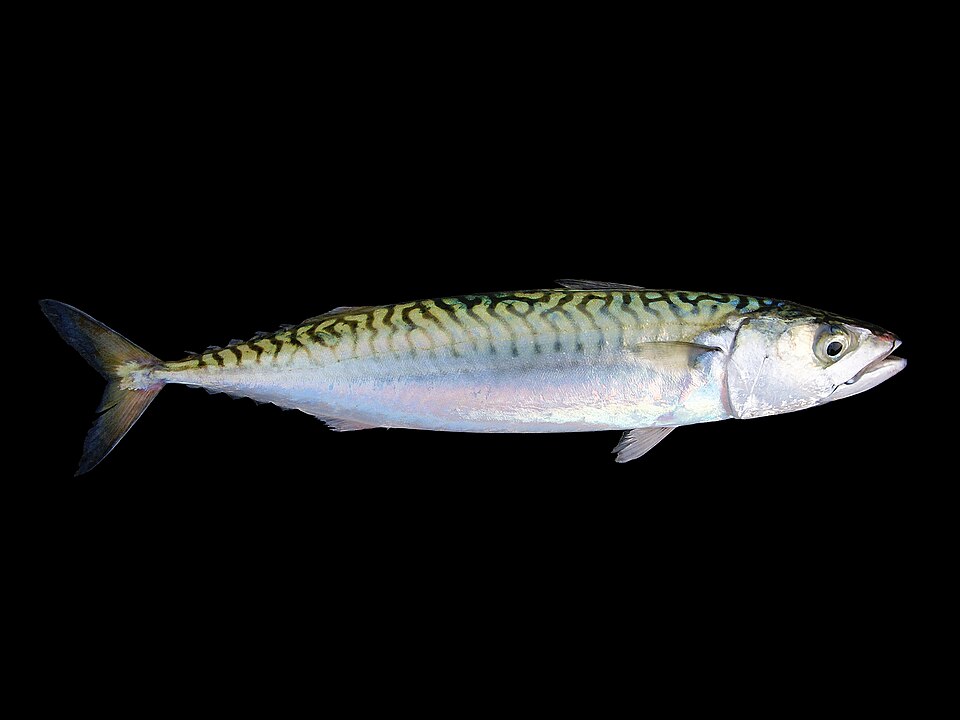
The common Mackerel (Scomber scombrus) is a pelagic marine fish belonging to the Scombridae family, the same as tuna. It can be recognized by its blue-green back streaked with sinuous black stripes and its silvery belly, as well as its streamlined body adapted to rapid swimming. It lives in often very numerous schools in the temperate and cold waters of the North Atlantic and the Mediterranean. An emblematic species of coastal fishing, it constitutes an important food resource for humans as well as for many marine predators. Its fatty flesh, rich in omega-3, makes it a widely consumed fish, fresh, smoked or canned.
The body is fusiform, elongated and slightly compressed laterally, favoring rapid swimming in open water. The back has patterns of irregular dark stripes on a metallic blue-green background, while the sides and belly are silvery with no visible scales. The caudal fin is strongly indented, typical of fast pelagic fish. It does not have a swim bladder, which requires it to swim continuously to avoid sinking.
Characteristics
Indicative values: they vary by subspecies, sex and region.
Habitat and distribution
The Mackerel lives in open water, generally between the surface and a depth of 200 meters, both in coastal areas and offshore. It frequents temperate and cool, well-oxygenated waters, where it finds abundant concentrations of plankton. It approaches coasts and littoral zones during breeding and intense feeding periods. In winter, it retreats to deeper and more thermally stable waters.
CURRENT RANGE
The species is present in the North Atlantic, from the North American coasts to the European coasts, as well as in the Mediterranean Sea and the Black Sea. It is particularly abundant in the English Channel, the North Sea and along the European Atlantic coasts. In the Mediterranean, it frequents Tunisian waters in particular where it is the subject of traditional fishing. Its distribution varies according to the seasons depending on migrations linked to reproduction and the search for food.
Behaviour
The Mackerel is a gregarious species that forms large schools that can number several thousand individuals, a behavior that protects it from predators. It makes significant seasonal migrations, coming closer to the coast in spring and summer to breed and feed, then returning to deeper waters in winter. It is a fast and tireless swimmer, active day and night depending on the season. It is sensitive to water temperature, which strongly influences its movements.
Reproduction
Spawning takes place in spring and summer, generally in the open sea, when the water temperature becomes favorable. A female can release several hundred thousand pelagic eggs during a single breeding season, fertilized in open water by males. The eggs and larvae drift with the currents before the juveniles join the adult schools. Sexual maturity is reached around the age of 2 to 3 years.
Peculiarities
The Mackerel does not have a swim bladder, a rare feature among pelagic fish which requires it to swim continuously to maintain its position in the water column. Its flesh is particularly rich in omega-3 fatty acids, which makes it a nutritionally recommended fish. It deteriorates quickly after capture, hence a long tradition of smoking and preservation after fishing.
Threats and conservation
Overfishing constitutes the main threat weighing on certain populations, particularly in the North-East Atlantic where quotas are the subject of regular scientific debates. Warming waters modify migratory routes and the distribution of stocks, creating tensions between fishing countries. Marine pollution and degradation of coastal spawning areas can also affect juvenile recruitment.
Numbers and trends vary across sources and regions. See the IUCN assessment for the latest reference data.
Gallery
1 documented photographs.
References
Profile updated 29 August 2026 · Reviewed by the TunisieVet editorial team.
Comments (0)
No comments yet.
CONSERVATION STATUS
Least concern (LC)
IUCN source, latest published assessment.
Species health
Documented diseases for this species.
This information is provided for educational purposes only and is not a substitute for a veterinary consultation. If you have any concerns about your animal's health, consult a veterinarian.
Similar animals
Other species documented in Animalpedia.

TunisieVet in your pocket 📱🐾 Access your veterinary services wherever you are. [ Download the app ]
Learn more