
Presentation
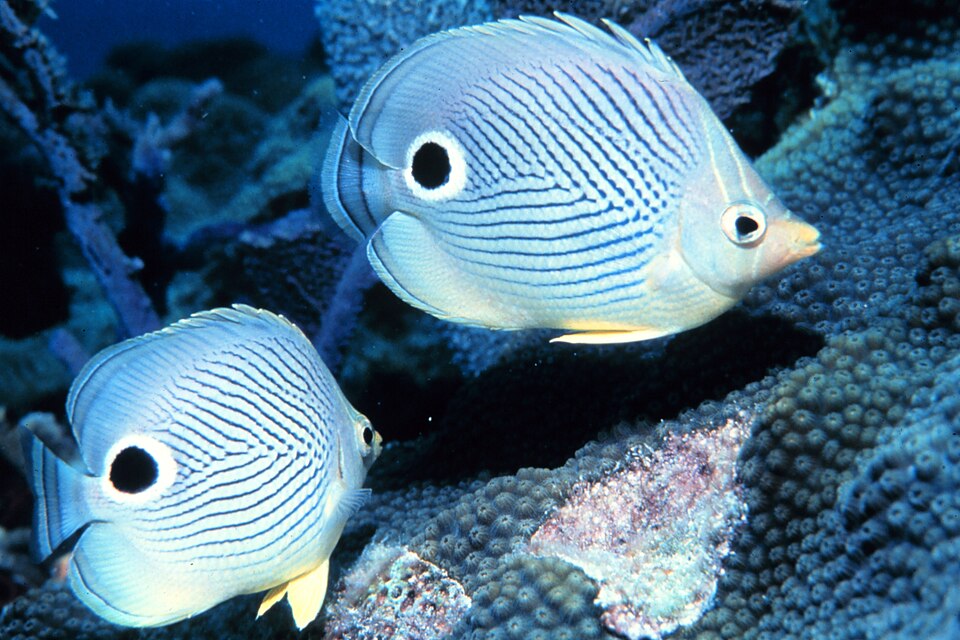
Butterflyfish refers to a group of tropical marine fishes belonging to the family Chaetodontidae, recognizable by their laterally flattened bodies and their bright colors. Their coat often has contrasting patterns, stripes, spots or false eyes, which allow them to blend in with corals or deceive predators. Most species measure between 10 and 20 centimeters and live in pairs or small groups on coral reefs. Their elongated snout and protractile mouth allow them to extract small invertebrates hidden in the crevices of the coral. Very popular in marine aquariums, they nevertheless remain difficult to maintain in captivity due to their specialized diet. The name “Butterflyfish” evokes the graceful movement of their fins when swimming.
The body is very laterally compressed, disc-shaped, which facilitates movement between coral branches. The dorsal fin is continuous and often extended by spiny rays. A false eye (ocelli) near the tail and a dark stripe across the real eye are common patterns in many species. Coloration varies from bright yellow to white, black or blue depending on the species.
Characteristics
Indicative values: they vary by subspecies, sex and region.
Habitat and distribution
Butterflyfish live primarily in coral reefs in shallow tropical waters. They also sometimes frequent lagoons and coastal rocky areas rich in invertebrates. Their presence is closely linked to the health of corals, on which a large part of their diet depends.
CURRENT RANGE
This family is widely distributed in the tropical and subtropical waters of the Indian and Pacific Oceans, as well as in the Caribbean for certain Atlantic species. The greatest diversity of species is found around the Coral Triangle in Southeast Asia. No species of this family is present in the Mediterranean or on the Tunisian coasts.
Behaviour
These fish are diurnal and take refuge in the cracks of the reef at night to escape predators. Many species form stable monogamous pairs that defend a common territory. They are generally not very aggressive towards other species but can be territorial towards their conspecifics. Some species gather in schools when breeding or to feed.
Reproduction
Reproduction occurs by external fertilization, usually during nocturnal gatherings near the surface. The eggs are pelagic and drift with the currents before hatching. The larva, called tholichthys, has a temporary bony shell which disappears during metamorphosis. The juveniles then return to the coral reefs where they complete their growth.
Peculiarities
The false eye located near the tail of many species serves to disorient predators as to the fish's actual direction of flight. Some species change color slightly depending on their mood or reproductive status. Their tubular snout, particularly elongated in certain species, allows them to reach prey in the narrowest corners of the coral.
Threats and conservation
The degradation of coral reefs linked to global warming and bleaching constitutes the main threat to this group. Coastal pollution and the destruction of reef habitats also reduce available food resources. Some popular aquarium species experience localized capture pressure.
Numbers and trends vary across sources and regions. See the IUCN assessment for the latest reference data.
Gallery
1 documented photographs.
References
Profile updated 30 August 2026 · Reviewed by the TunisieVet editorial team.
Comments (0)
No comments yet.
CONSERVATION STATUS
Least concern (LC)
IUCN source, latest published assessment.
Species health
Documented diseases for this species.
This information is provided for educational purposes only and is not a substitute for a veterinary consultation. If you have any concerns about your animal's health, consult a veterinarian.
Similar animals
Other species documented in Animalpedia.

TunisieVet in your pocket 📱🐾 Access your veterinary services wherever you are. [ Download the app ]
Learn more