
Presentation
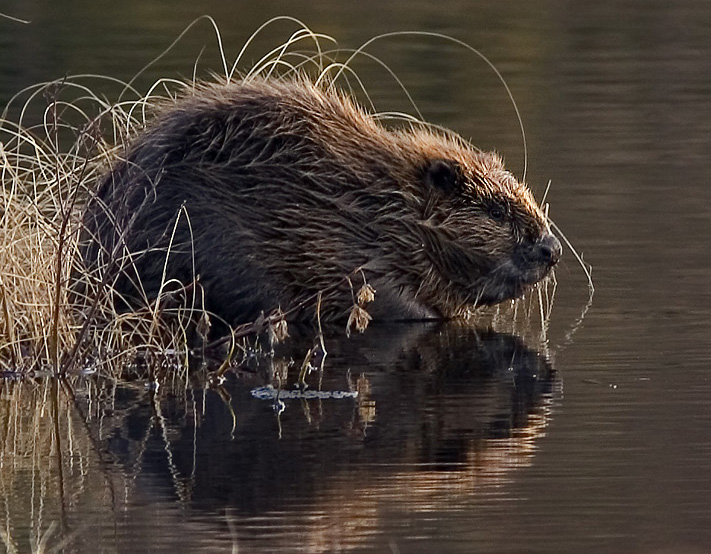
The Beaver is a large semi-aquatic rodent known for its ability to modify its environment by building dams and huts. Its stocky body, flat, scaly tail and webbed hind legs make it an excellent swimmer. It lives in North America (Beaver canadensis) and in Eurasia (Beaver fiber), two close but distinct species. Active mainly at dusk and night, it shapes the waterways it occupies in a sustainable manner. Its continuously growing incisors allow it to gnaw wood constantly. It is one of the rare animals capable of creating complete ecosystems through its activity.
The Beaver has a dense, waterproof brown coat, a flattened tail serving as a rudder and fat reserve, and webbed hind legs. Its orange incisors, rich in iron, grow continuously and allow it to cut down trees. It has anal glands secreting Beaveréum, used to mark its territory.
Characteristics
Indicative values: they vary by subspecies, sex and region.
Habitat and distribution
The Beaver frequents rivers, lakes, ponds and wetlands bordered by deciduous forests. It needs permanent access to water as well as abundant woody vegetation to feed and build its dams. It can also colonize watercourses in agricultural areas or close to inhabited areas.
CURRENT RANGE
The Eurasian Beaver occurs in Europe and northern Asia, with populations reintroduced in several countries after near extinction. The Canadian Beaver occupies North America, from Canada to northern Mexico. The species is absent from Africa and does not occur in the wild in Tunisia.
Behaviour
The Beaver is a territorial animal, mainly nocturnal and crepuscular, living in family groups called colonies. He builds dams to regulate the water level around his hut and travels mainly by swimming. A very skilled builder, he cuts down trees with his teeth to obtain building materials and food. It communicates by scent marking with the Beaveréum and by tail slaps on the water in case of danger.
Reproduction
Breeding occurs once a year, usually in winter, and gestation lasts about three months. The female gives birth to one to four young in the spring in the family hut. The young stay with their parents for up to two years before leaving the colony to found their own territory. Sexual maturity is reached around two to three years of age.
Peculiarities
Beaver is capable of radically transforming a landscape by creating wetlands favorable to many other species. The Beaveréum that it secretes has historically been used in perfumery and traditional medicine. Its flat tail serves as both a propellant, a balancer on land and an energy reserve.
Threats and conservation
The Beaver was heavily hunted for its fur and Beaveréum, leading to its near extinction in Europe in the 20th century. Thanks to protection and reintroduction programs, its populations have largely recovered. The main current threats remain the destruction of wetlands and conflicts with agricultural activities.
Numbers and trends vary across sources and regions. See the IUCN assessment for the latest reference data.
Gallery
1 documented photographs.
References
Profile updated 21 August 2026 · Reviewed by the TunisieVet editorial team.
Comments (0)
No comments yet.
CONSERVATION STATUS
Least concern (LC)
IUCN source, latest published assessment.
Species health
Documented diseases for this species.
See the 8 diseases of this species Find a veterinarianThis information is provided for educational purposes only and is not a substitute for a veterinary consultation. If you have any concerns about your animal's health, consult a veterinarian.
To discover around: Beaver
Videos, facts, stories and records linked to this species.
RECORD
up to 30 kg
The largest rodent in Eurasia and North America
Measurement taken on wild adult individuals, making the beaver the second largest rodent i...
Similar animals
Other species documented in Animalpedia.

TunisieVet in your pocket 📱🐾 Access your veterinary services wherever you are. [ Download the app ]
Learn more