
Presentation
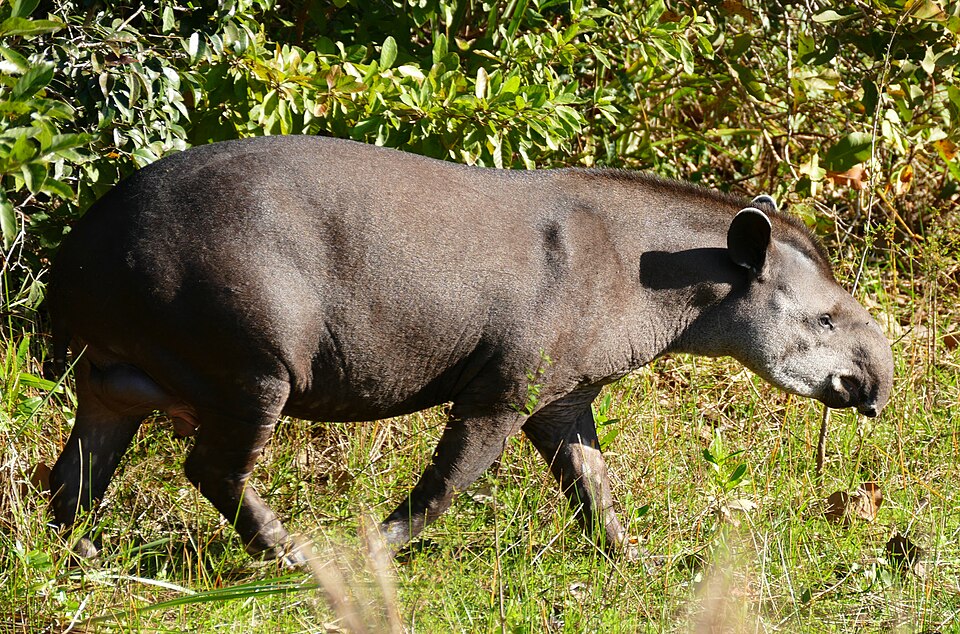
The South American tapir is the largest land mammal native to South America. It is distinguished by a small prehensile proboscis formed by the extension of the nose and the upper lip, which it uses to grasp vegetation. Its massive, stocky body is covered in short, dark brown fur, while a short, bristly mane adorns its nape. The young are born striped with light bands, a camouflage that disappears with age. Discreet and mainly nocturnal, this herbivore lives near water points where it likes to bathe. It plays an important ecological role as a seed disperser in tropical forests.
The tapir has a massive body, short legs and a flexible trunk allowing it to catch leaves and fruits. Its thick skin and short coat protect it from dense brush. Its rounded ears and poor eyesight are compensated by a highly developed sense of smell and hearing.
Characteristics
Indicative values: they vary by subspecies, sex and region.
Habitat and distribution
The South American tapir frequents tropical rainforests, swampy areas and the edges of rivers and lakes. It likes environments offering permanent access to water, essential for its thermoregulation. It is also found in wooded savannah in certain regions.
CURRENT RANGE
The species is distributed in South America, east of the Andes, from Venezuela and Colombia to northern Argentina. The Amazon basin constitutes its main stronghold. Its presence is increasingly fragmented due to deforestation.
Behaviour
A solitary and primarily nocturnal animal, the South American tapir is an excellent swimmer and diver that spends a lot of time in water to cool off and escape predators. It marks its territory with urine deposits and regularly used paths. Although discreet, it can be aggressive if it feels threatened.
Reproduction
Gestation lasts about 13 months, one of the longest for land mammals of this size. The female gives birth to a single young, striped white and cream, which stays with her for up to a year. Sexual maturity is reached around 3 to 4 years of age.
Peculiarities
Its mobile proboscis, unique among large South American herbivores, is its most distinctive feature. The striped young are reminiscent of those of other tapir species around the world. It is also the largest representative of the tapiridae family.
Threats and conservation
Deforestation and fragmentation of its forest habitat constitute the main threat. Hunting for meat and competition with livestock in some areas are worsening its decline. Road collisions also affect populations close to populated areas.
Numbers and trends vary across sources and regions. See the IUCN assessment for the latest reference data.
Gallery
1 documented photographs.
References
Profile updated 18 August 2026 · Reviewed by the TunisieVet editorial team.
Comments (0)
No comments yet.
CONSERVATION STATUS
Vulnerable (VU)
IUCN source, latest published assessment.
Species health
Documented diseases for this species.
See the 8 diseases of this species Find a veterinarianThis information is provided for educational purposes only and is not a substitute for a veterinary consultation. If you have any concerns about your animal's health, consult a veterinarian.
To discover around: South American tapir
Videos, facts, stories and records linked to this species.
Similar animals
Other species documented in Animalpedia.

TunisieVet in your pocket 📱🐾 Access your veterinary services wherever you are. [ Download the app ]
Learn more