
Presentation
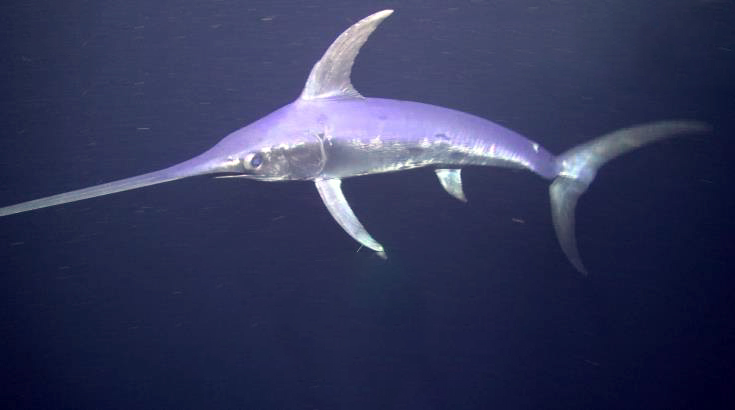
The Swordfish (Xiphias gladius) is a large pelagic marine fish recognizable by its long, flattened, sword-shaped rostrum. Solitary and powerful swimmer, it frequents the temperate and tropical waters of all oceans, including the Mediterranean. A fast predator, it hunts fish and cephalopods in open water. This species has been exploited commercially for a long time and is the subject of significant fishing in Tunisia, particularly in the Sicily Channel.
The body is fusiform, robust and lacks scales in adults, adapted to rapid swimming. The rostrum, an extension of the upper jaw, can represent almost a third of the total length of the body. The first dorsal fin is high and rigid, while the pelvic fins are absent, a peculiarity among large pelagics.
Characteristics
Indicative values: they vary by subspecies, sex and region.
Habitat and distribution
Swordfish lives in open ocean waters, from surface level to several hundred meters deep. It frequents both coastal areas and the open sea, particularly near thermal fronts favorable to the concentration of prey. In the Mediterranean, it is regularly observed in areas of strong current such as the Strait of Sicily.
CURRENT RANGE
The species is present in the Atlantic, Pacific and Indian oceans, as well as the Mediterranean Sea. It occupies a wide band of temperate to tropical latitudes. In Tunisia, it is fished in particular in the waters of the Sicily Canal and off the coast of Cap Bon.
Behaviour
It is a solitary species, except during the breeding season, which does not form schools. It carries out significant daily vertical migrations, sometimes descending to several hundred meters depth. The Swordfish is able to tolerate temperature variations thanks to an organ that warms the eyes and the brain.
Reproduction
Reproduction takes place in warm waters, generally in spring and summer depending on the region. The female is very prolific and can release several million eggs during laying. Fertilization is external and the larvae, planktonic, develop in the open sea without parental care.
Peculiarities
The sword-shaped rostrum, which gives its name to the species, serves both as a hunting weapon and as a hydrodynamic organ. Adult Swordfish loses its teeth and most of its scales, unlike young individuals. It is among the fastest fish in the oceans.
Threats and conservation
The main threat is overfishing, with Swordfish being highly sought after for its meat in many Mediterranean countries and elsewhere. Ocean pollution, particularly by mercury which accumulates in its flesh, constitutes a health and ecological concern. Bycatch linked to longline fishing also affects certain populations.
Numbers and trends vary across sources and regions. See the IUCN assessment for the latest reference data.
Gallery
1 documented photographs.
References
Profile updated 29 August 2026 · Reviewed by the TunisieVet editorial team.
Comments (0)
No comments yet.
CONSERVATION STATUS
Near threatened (NT)
IUCN source, latest published assessment.
Species health
Documented diseases for this species.
This information is provided for educational purposes only and is not a substitute for a veterinary consultation. If you have any concerns about your animal's health, consult a veterinarian.
To discover around: Swordfish
Videos, facts, stories and records linked to this species.
RECORD
approximately 60 to 100 km/h peak
One of the fastest fish
Estimated top speed during short accelerations in open water.
Similar animals
Other species documented in Animalpedia.

TunisieVet in your pocket 📱🐾 Access your veterinary services wherever you are. [ Download the app ]
Learn more