
Presentation
The central taipan (Oxyuranus microlepidotus) is a venomous snake endemic to the arid regions of Australia. It is considered the world's most venomous snake based on toxicity testing of its venom on mice. Discreet and not typically aggressive, it generally avoids contact with humans and flees when it can. Its extremely potent venom is an adaptation designed to kill its prey quickly, mainly small mammals. Despite its theoretical danger, human bites are rare because the species lives in remote, sparsely populated areas.
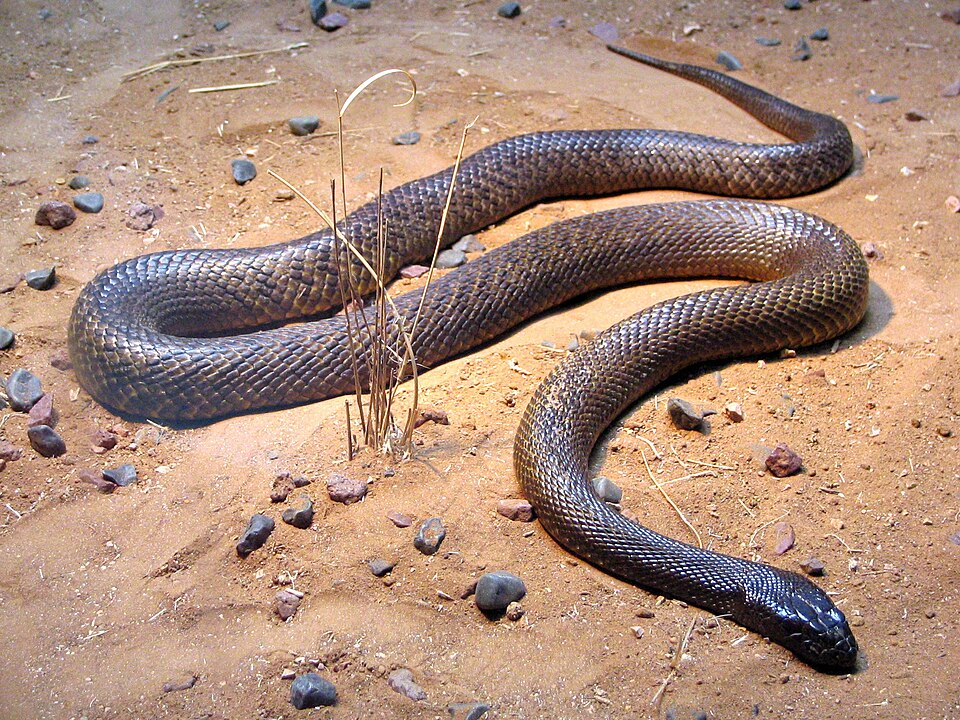
The central taipan displays coloration ranging from light brown to olive-brown depending on the season, darker in winter and lighter in summer. Its body is slender and muscular, suited for rapid ground movement. The head is slightly darker than the rest of the body and has an elongated shape. Its scales are smooth and glossy.
Characteristics
Indicative values: they vary by subspecies, sex and region.
Habitat and distribution
The inland taipan lives in arid and semi-arid regions of central Australia, particularly in rocky plains and areas of cracked soil. It uses burrows dug by other animals to shelter from extreme temperatures. This remote habitat greatly limits encounters with human populations.
CURRENT RANGE
The species is endemic to Australia and is found in desert zones of the centre-east of the continent, particularly on the borders of Queensland and South Australia. Its range is restricted to remote and arid regions. No subspecies is recognized outside this limited territory.
Behaviour
This snake is diurnal and active mainly in the morning, withdrawing into burrows or crevices during the hottest hours. It is naturally shy and avoids confrontation with predators or humans rather than bite. When cornered, however, it can rear up and strike repeatedly in quick succession.
Reproduction
Reproduction occurs during the austral spring, following a mating period in which males may fight for access to females. The female lays between 12 and 20 eggs, which she deposits in abandoned burrows or damp crevices. Incubation lasts approximately two to three months, and hatchlings are independent from the moment they emerge.
Peculiarities
The inland taipan possesses the most toxic venom of all known land snakes, measured by its median lethal dose in mice. A single bite theoretically contains enough venom to kill dozens of adult humans. Despite this potency, no human deaths have ever been officially recorded, thanks to its shy nature and the availability of an effective antivenom.
Threats and conservation
The species faces no major identified threats due to its remote habitat, which is little exploited by humans. Climate change and degradation of arid soils could eventually affect its prey and habitat. It is not targeted by illegal trade because of the difficulty of capturing and handling it.
Numbers and trends vary across sources and regions. See the IUCN assessment for the latest reference data.
Gallery
1 documented photographs.
References
Profile updated 09 September 2026 · Reviewed by the TunisieVet editorial team.
Comments (0)
No comments yet.
CONSERVATION STATUS
Least concern (LC)
IUCN source, latest published assessment.
Species health
Documented diseases for this species.
Find a veterinarianThis information is provided for educational purposes only and is not a substitute for a veterinary consultation. If you have any concerns about your animal's health, consult a veterinarian.
To discover around: Central Taipan
Videos, facts, stories and records linked to this species.
RECORD
LD50 ≈ 0.025 mg/kg
The world's most venomous snake
Toxicity measured by median lethal dose (LD50) in mice, by subcutaneous injection.
Similar animals
Other species documented in Animalpedia.

TunisieVet in your pocket 📱🐾 Access your veterinary services wherever you are. [ Download the app ]
Learn more