Presentation
Tardigrades form a phylum of microscopic aquatic invertebrates that typically measure less than a millimeter in length. Their segmented bodies bear four pairs of short legs tipped with claws, earning them the nickname 'water bear'. They live in the thin film of water surrounding mosses, lichens, and sediments across all continents, including polar regions. They are renowned for their exceptional ability to withstand desiccation and extreme conditions through a state of suspended animation called cryptobiosis. First discovered in the eighteenth century, more than a thousand species have now been described. They are inconspicuous animals, invisible to the naked eye, but studied intensively in extreme biology and astrobiology.
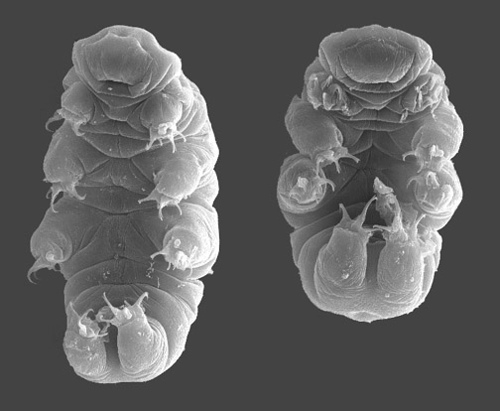
The tardigrade body is short, cylindrical, and segmented into four sections, each bearing a pair of clawed legs. They possess a flexible cuticle that they shed periodically as they grow. Their digestive system includes a piercing stylet used to suck out the contents of cells they feed on. They lack a differentiated respiratory or circulatory system; gas exchange occurs by diffusion across the cuticle.
Characteristics
Indicative values: they vary by subspecies, sex and region.
Habitat and distribution
Tardigrades live in the film of water surrounding mosses, lichens, damp soil, and sediments. They are found in both freshwater and coastal marine environments, from mountain peaks to the ocean floor. Their main requirement is the presence—even if intermittent—of moisture around their body.
CURRENT RANGE
This phylum is present on all continents, from polar regions to tropical zones, including Tunisia where it is found in damp mosses and lichens. Its wide distribution is due to its resistance capacity, which enables passive dispersal by wind or water.
Behaviour
Tardigrades move slowly across damp substrates using their clawed legs, which is the origin of their name meaning 'slow walker'. When faced with desiccation, extreme cold, or oxygen deprivation, they enter cryptobiosis: they expel nearly all water from their body and contract into a form called a 'tun', suspending their metabolism. This state can persist for years or even decades before the animal reactivates when moisture returns. Outside these periods, their activity is limited to feeding and reproduction.
Reproduction
Depending on the species, reproduction is either sexual or parthenogenetic, with females capable of reproducing without fertilization. Eggs are laid in the old cuticle during molting or directly into the environment. Development is direct, with no larval stage; juveniles resemble miniature adults. Growth continues through successive molts until adult size is reached.
Peculiarities
Tardigrades tolerate temperatures ranging from near absolute zero to over 150°C, as well as extreme pressures and radiation doses far exceeding the human lethal dose. Individual specimens have survived direct exposure to the vacuum of space during experiments in orbit. This resistance makes them a model organism for studying survival biology and astrobiology.
Threats and conservation
As a very widely distributed and resistant group, tardigrades are not considered threatened. Localized degradation of damp micro-habitats, such as desiccation of mosses in urban settings, can affect local populations without threatening the phylum as a whole. Their global conservation status has not been evaluated due to their abundance and inconspicuous nature.
Numbers and trends vary across sources and regions. See the IUCN assessment for the latest reference data.
Gallery
1 documented photographs.
References
Profile updated 31 August 2026 · Reviewed by the TunisieVet editorial team.
Comments (0)
No comments yet.
CONSERVATION STATUS
Data deficient (DD)
IUCN source, latest published assessment.
To discover around: Tardigrade
Videos, facts, stories and records linked to this species.
RECORD
Survival in the vacuum of space and extreme radiation
The most resilient animal to extreme conditions
Demonstrated notably during experiments with direct exposure in orbital space on dehydrate...
Similar animals
Other species documented in Animalpedia.

Be among the first to use our app. Sign up and get early Google Play access.
Discover