
Presentation
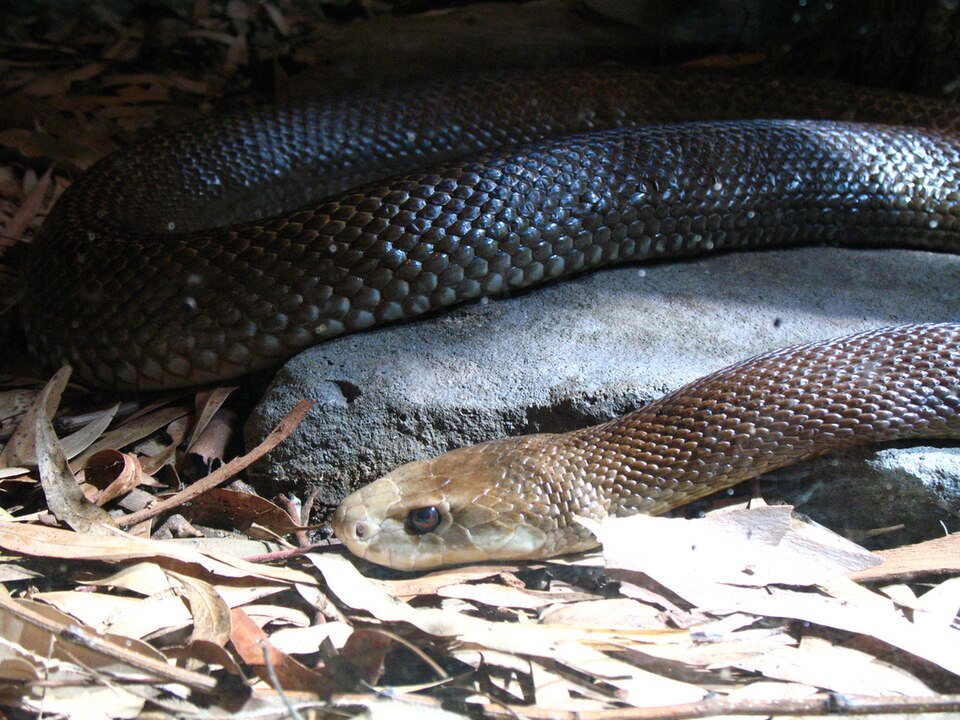
The Taipan is a venomous snake native to Australia and New Guinea, reputed to possess one of the most toxic venoms among land snakes. It belongs to the Elapidae family, which includes snakes with fixed hooks located at the front of the jaw. Its body is slender, its elongated and narrow head is barely distinguishable from the neck, and its coloring varies from light brown to reddish brown depending on the season. Discreet and rather shy, it generally avoids humans but can be aggressive if it feels cornered. It actively hunts small mammals in grassy areas and coastal savannahs. Its venom, injected in large quantities, acts quickly on the nervous system and blood coagulation.
The Taipan features a thin, muscular body, a slender head and large, round eyes. Its dorsal coloring varies from light brown to dark brown, sometimes with red highlights, while the belly is paler. The scales are smooth and shiny, and the tail is relatively short compared to the body.
Characteristics
Indicative values: they vary by subspecies, sex and region.
Habitat and distribution
The coastal Taipan frequents areas of grassy savannah, tropical forest edges and coastal environments in northern and eastern Australia and southern New Guinea. It appreciates habitats offering dense vegetation for hiding, near areas where rodents abound. It is also sometimes found on the outskirts of cultivated areas where its prey is abundant.
CURRENT RANGE
The species occurs along the northern and eastern coasts of Australia as well as southern New Guinea. It is absent from Africa, Europe and the Americas, its natural range being strictly limited to Oceania and nearby island Southeast Asia.
Behaviour
It is a diurnal snake, active especially early in the morning, which moves quickly on the ground. It is naturally fearful and seeks to flee rather than face danger, but it can react strongly and bite repeatedly if cornered or surprised. Outside of hunting periods, it remains discreet and takes refuge in abandoned burrows or under dense vegetation.
Reproduction
The Taipan is oviparous and generally lays between 7 and 20 eggs per clutch, deposited in a burrow or sheltered cavity. Incubation lasts approximately two to three months depending on ambient temperature. The young are autonomous from hatching and already have functional venom.
Peculiarities
The venom of the coastal Taipan contains a toxin, taipoxin, which acts simultaneously on the nervous system and blood clotting. Without treatment, an untreated bite can be fatal within hours. The development of effective antivenom has significantly reduced bite-related mortality since the 1950s.
Threats and conservation
The species is not globally threatened and benefits from a wide distribution area. Locally, the destruction of its habitat by agriculture and urbanization can reduce its populations. Eradication campaigns linked to the fear it inspires also constitute one-off pressure.
Numbers and trends vary across sources and regions. See the IUCN assessment for the latest reference data.
Gallery
1 documented photographs.
References
Profile updated 02 September 2026 · Reviewed by the TunisieVet editorial team.
Comments (0)
No comments yet.
CONSERVATION STATUS
Least concern (LC)
IUCN source, latest published assessment.
Species health
Documented diseases for this species.
This information is provided for educational purposes only and is not a substitute for a veterinary consultation. If you have any concerns about your animal's health, consult a veterinarian.
To discover around: Taipan
Videos, facts, stories and records linked to this species.
RECORD
LD50 estimated very low in mice
One of the most toxic venoms in the world
Measurement of venom toxicity carried out in the laboratory by subcutaneous injection in m...
Similar animals
Other species documented in Animalpedia.

TunisieVet in your pocket 📱🐾 Access your veterinary services wherever you are. [ Download the app ]
Learn more