
Presentation
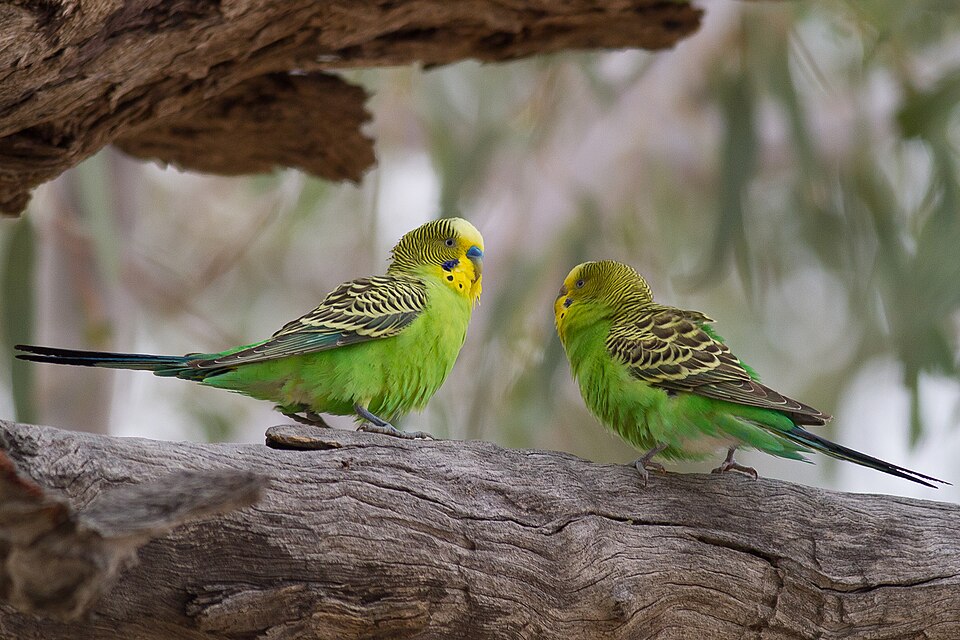
The Budgerigar is a small parrot native to Australia, characterized by its green and yellow plumage decorated with fine wavy black lines. A very popular species in captivity, it is one of the most widespread pet birds in the world thanks to its modest size and its ability to reproduce sounds.
Small, elegant parrot with a tapered body and a long, pointed tail. The plumage displays a green and yellow gradient, with thin black bars that cover the back, wings and head. Males usually have a blue cere (bare area above the bill), while females have a white or brown cere.
Characteristics
Indicative values: they vary by subspecies, sex and region.
Habitat and distribution
A typical species of semi-arid regions and Australian steppes, the Budgerigar frequents grassy savannahs, meadows and bushy areas near water points. It is well adapted to drought conditions and moves regularly depending on the availability of food resources.
CURRENT RANGE
Budgerigar is endemic to Australia, where it is widely distributed in the central and eastern regions of the continent. Through the bird trade, it was introduced to many countries around the world, where it is now bred in captivity almost universally.
Behaviour
Very social and active bird, often observed in large flights in its natural habitat. The Budgerigar is curious, playful and vocal, producing a variety of high-pitched calls and trills. She has a great learning capacity, capable of memorizing melodies and even a few words.
Reproduction
Budgerigar breeds using cavities in trees. The female usually lays 4 to 6 eggs and incubates them for about 18 days. The young leave the nest after 4 to 5 weeks. In captivity, the species breeds easily and successfully.
Peculiarities
The Budgerigar has a remarkable aptitude for vocal mimicry, with some individuals managing to pronounce hundreds of words. Its color variants in captivity are very numerous and highly sought after, far from the natural green-yellow. It is also the best-selling pet bird in the world.
Threats and conservation
Classified as LC (Least Concern) status by the IUCN, Budgerigar does not face any significant threat. Wild populations in Australia remain stable and abundant, while captive populations are extremely well established.
Numbers and trends vary across sources and regions. See the IUCN assessment for the latest reference data.
Gallery
1 documented photographs.
References
UICN — Liste rouge des espèces menacées
Profile updated 03 September 2026 · Reviewed by the TunisieVet editorial team.
Comments (0)
No comments yet.
CONSERVATION STATUS
Least concern (LC)
IUCN source, latest published assessment.
Species health
Documented diseases for this species.
See the 4 diseases of this species Find a veterinarianThis information is provided for educational purposes only and is not a substitute for a veterinary consultation. If you have any concerns about your animal's health, consult a veterinarian.
To discover around: Budgerigar
Videos, facts, stories and records linked to this species.
Similar animals
Other species documented in Animalpedia.

TunisieVet in your pocket 📱🐾 Access your veterinary services wherever you are. [ Download the app ]
Learn more