
Presentation
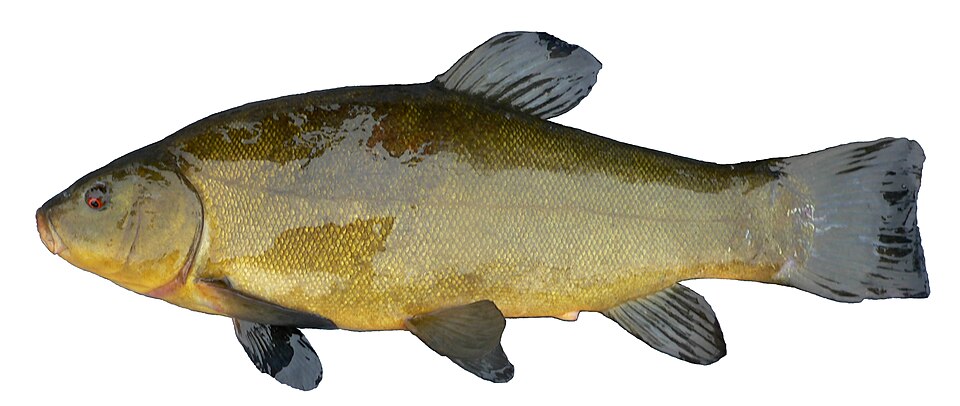
The Tench (Tinca tinca) is a freshwater fish from the Cyprinidae family, recognizable by its stocky body and thick skin covered with abundant mucus. Its color varies from olive green to golden brown, with golden reflections on the sides. It has small scales well embedded in the skin and small barbels at the corners of the mouth. This discreet fish lives near the bottom in calm, vegetated waters. It is appreciated by fishermen for its flesh and its resistance out of water, which earned it the nickname “medicine fish” in ancient folklore.
Massive, rounded body, covered with thick, viscous skin rich in protective mucus. Small, deeply embedded scales, green-brown coloring with golden highlights depending on the environment. Rounded fins, often tinged with orange-red, and a small short barbel at each corner of the mouth.
Characteristics
Indicative values: they vary by subspecies, sex and region.
Habitat and distribution
The Tench prefers calm, stagnant or slow-moving waters, rich in aquatic vegetation: ponds, lakes, canals and marshy areas. It tolerates waters low in oxygen and high temperatures, which makes it robust in degraded environments. The muddy bottom serves as a refuge and a preferred feeding area.
CURRENT RANGE
Native to Europe and temperate Asia, Tench has been widely introduced elsewhere for fishing and aquaculture, notably in North Africa. It is found in many bodies of fresh water across Eurasia. Introduced populations also exist in North Africa, including in Tunisia, in certain dams and hill reservoirs.
Behaviour
A rather sedentary and solitary species, the Tench remains hidden in aquatic vegetation or mud during the day. It becomes more active at dusk and at night to feed. In winter, it goes into partial lethargy, buried in the muddy bottom, which allows it to tolerate conditions of low oxygenation.
Reproduction
Breeding takes place in spring and summer, when water temperatures exceed 18-19°C. The female lays her adhesive eggs on aquatic vegetation, in several successive clutches. The eggs hatch after a few days and the larvae remain attached to the plants until their yolk sac is absorbed.
Peculiarities
Its abundant skin mucus allows it to survive several hours out of water if its skin remains moist, hence its old nickname of “medicine fish” supposed to heal other fish by contact. It can also withstand very low oxygen water thanks to its high physiological tolerance.
Threats and conservation
The degradation of wetlands and the pollution of stagnant water threaten certain populations locally. Competition with introduced species can also reduce its numbers in certain environments. Overall, the species remains common and is not considered globally threatened.
Numbers and trends vary across sources and regions. See the IUCN assessment for the latest reference data.
Gallery
1 documented photographs.
References
Profile updated 30 August 2026 · Reviewed by the TunisieVet editorial team.
Comments (0)
No comments yet.
CONSERVATION STATUS
Least concern (LC)
IUCN source, latest published assessment.
Species health
Documented diseases for this species.
This information is provided for educational purposes only and is not a substitute for a veterinary consultation. If you have any concerns about your animal's health, consult a veterinarian.
Similar animals
Other species documented in Animalpedia.

TunisieVet in your pocket 📱🐾 Access your veterinary services wherever you are. [ Download the app ]
Learn more