
Presentation
The termite is a social insect belonging to the order Blattodea, related to cockroaches. It lives in structured colonies containing specialized castes: workers, soldiers, and reproductives. These insects are best known for their ability to digest wood thanks to symbiotic microorganisms present in their gut. Some species build monumental nests called termite mounds, which can reach several metres in height. The termite plays an important ecological role in the breakdown of organic matter.
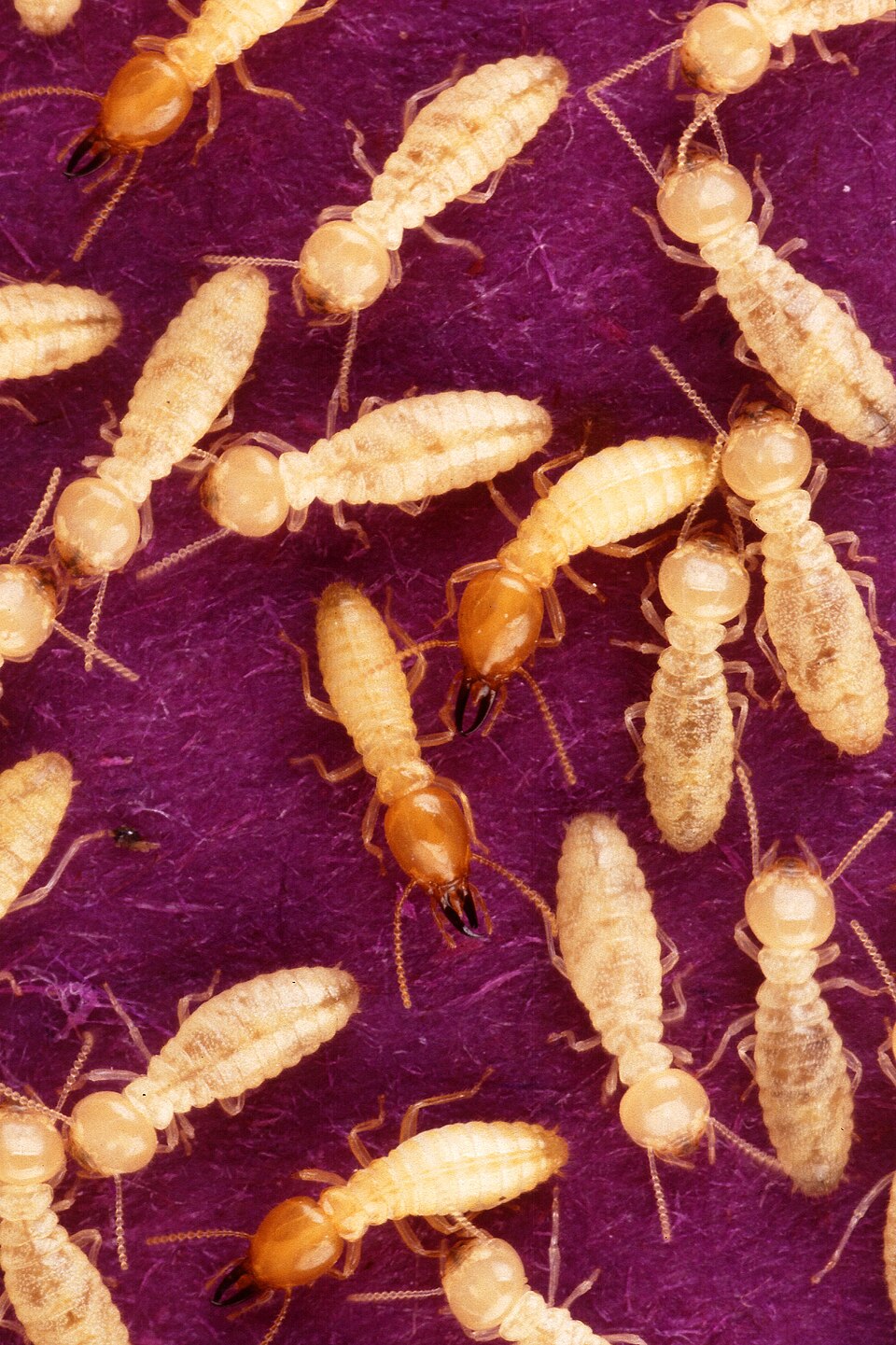
The termite has a soft body, generally pale or translucent, measuring from a few millimetres to over one centimetre depending on caste. Workers are blind and wingless, whereas reproductive individuals develop wings during swarming. Soldiers are distinguished by a broad head and powerful jaws adapted for defending the colony.
Characteristics
Indicative values: they vary by subspecies, sex and region.
Habitat and distribution
The termite occupies varied environments, ranging from tropical forests to arid zones, as well as grasslands and urban areas. It settles in dead wood, soil, or builds aerial termite mounds depending on the species. Its presence is closely linked to the availability of cellulose-rich material.
CURRENT RANGE
The termite is present on all continents except Antarctica, with greater diversity in tropical and subtropical regions. It is particularly abundant in Africa, Southeast Asia, South America, and Oceania. Certain species are also found in the Mediterranean region, notably in North Africa.
Behaviour
The termite lives exclusively in organized society, with strict division of labour between castes. Communication within the colony relies largely on chemical signals called pheromones. Colonies may number from a few hundred to several million individuals depending on the species.
Reproduction
Reproduction is ensured by a royal pair, consisting of a queen and a king, which can live for several years or even several decades in some species. The queen lays a considerable number of eggs throughout her life, sometimes several thousand per day in the most prolific species. During the breeding season, winged individuals called alates leave the colony to establish new termite mounds.
Peculiarities
The termite is often mistakenly confused with the ant, although it is taxonomically very distant from ants and more closely related to cockroaches. The termite mounds of certain African and Australian species are among the largest structures built by insects. Termites are also capable of causing significant material damage by attacking the wooden frameworks and structures of buildings.
Threats and conservation
The termite is not among endangered species, and some populations are even considered pests due to damage caused to wooden structures. It is frequently the subject of control and eradication campaigns in urban areas. Climate change and deforestation are, however, altering the distribution of certain species.
Numbers and trends vary across sources and regions. See the IUCN assessment for the latest reference data.
Gallery
1 documented photographs.
References
Profile updated 10 September 2026 · Reviewed by the TunisieVet editorial team.
Comments (0)
No comments yet.
CONSERVATION STATUS
Least concern (LC)
IUCN source, latest published assessment.
Species health
Documented diseases for this species.
Find a veterinarianThis information is provided for educational purposes only and is not a substitute for a veterinary consultation. If you have any concerns about your animal's health, consult a veterinarian.
To discover around: Termite
Videos, facts, stories and records linked to this species.
Similar animals
Other species documented in Animalpedia.
