
Presentation
The Nile crocodile is one of the largest carnivorous reptiles in the world and the largest crocodilian in Africa. Boasting an exceptionally powerful jaw and a massive body covered in scales, it is an aquatic predator perfectly adapted to life in tropical and subtropical fresh waters.
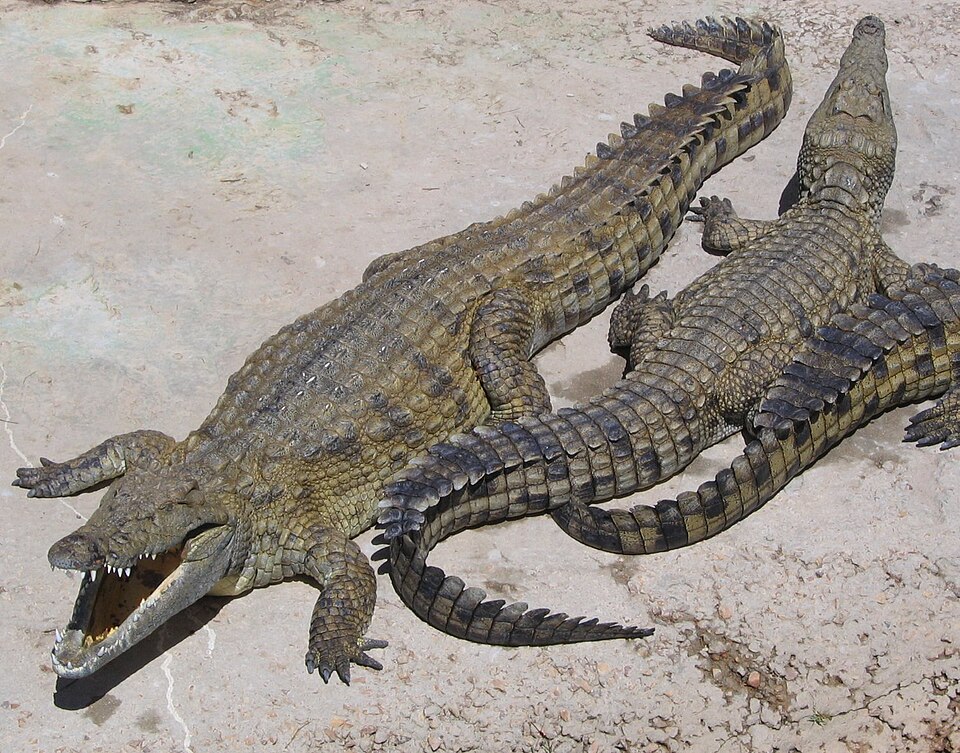
Nile crocodile has an elongated, laterally flattened body covered with bony scales arranged in regular rows. Its head is massive with a jaw reinforced by impressive musculature, capable of developing exceptional biting force. The eyes and nostrils are positioned on the top of the skull, allowing it to remain on the surface while observing its surroundings.
Did you know?
Which animal has the strongest bite?
Characteristics
Indicative values: they vary by subspecies, sex and region.
Habitat and distribution
Nile crocodile occupies rivers, lakes, wetlands and freshwater ponds throughout sub-Saharan Africa. It prefers habitats with steep banks and dense riparian vegetation which provide it with nesting sites and shelter. It also adapts to crater lakes, man-made reservoirs and river deltas. This species can tolerate significant variations in salinity and has colonized some estuarine systems.
CURRENT RANGE
Nile crocodile is widely distributed in sub-Saharan Africa, present in at least 35 countries. Its range extends from Senegal and Sudan in the west to Somalia in the east, and from Lake Chad in the north to South Africa in the south. Significant populations remain in major river systems such as the Nile, Congo, Zambezi and Limpopo. The species has disappeared from many rivers in northern Africa, notably in Tunisia and Algeria, where it was once common.
Behaviour
The Nile crocodile is a primarily aquatic but amphibious creature, spending the majority of its time in water where it hunts with a patiently predatory strategy. It is diurnal and twilight, most active at dawn and dusk. Although generally solitary, individuals may group together near permanent watering holes during dry seasons. It is a territorial animal that can become aggressive if threatened.
Reproduction
The Nile crocodile is oviparous with a seasonal reproductive system. Females dig nests in sand or loose earth, usually near stream banks, where they lay between 25 and 80 eggs. Incubation lasts approximately 60 to 90 days. Unlike most crocodilians, some Nile females show parental behaviors and protect their nests as well as the young after hatching.
Peculiarities
The Nile crocodile has a bite force estimated between 3700 and 9100 kilograms, among the strongest in the animal kingdom. Its eyes have a nictitating membrane that protects the cornea underwater. This crocodilian can hold its breath for several hours by slowing down its metabolism. Some Nile populations have developed cooperative behaviors when hunting, sometimes forming groups to surround large prey.
Threats and conservation
Although Nile crocodile is currently continentally stable, local populations face threats from habitat loss due to river alteration, pollution, and historical overexploitation for the leather trade. The construction of dams modifies the water regime and would fragment populations. Conflict with humans persists, particularly in areas where human population densities are high near water.
Numbers and trends vary across sources and regions. See the IUCN assessment for the latest reference data.
Gallery
1 documented photographs.
References
UICN — Liste rouge des espèces menacées
Profile updated 16 August 2026 · Reviewed by the TunisieVet editorial team.
Comments (0)
No comments yet.
CONSERVATION STATUS
Least concern (LC)
IUCN source, latest published assessment.
Species health
Documented diseases for this species.
This information is provided for educational purposes only and is not a substitute for a veterinary consultation. If you have any concerns about your animal's health, consult a veterinarian.
To discover around: Nile crocodile
Videos, facts, stories and records linked to this species.
Similar animals
Other species documented in Animalpedia.

TunisieVet in your pocket 📱🐾 Access your veterinary services wherever you are. [ Download the app ]
Learn more