
Presentation
The wasp is a flying insect belonging to the order Hymenoptera, often mistaken for a bee because of its yellow and black striped body. Its body is hairless, unlike a bee's, and it has a very narrow waist marking a sharp division between the thorax and abdomen. It typically lives in organized social colonies built around a queen, constructed in papery nests made from chewed wood fibres. Found on almost every continent, it plays an important role in controlling populations of pest insects. Some species are solitary and do not form colonies. It is known for its painful sting, which it can inflict multiple times, unlike a bee.
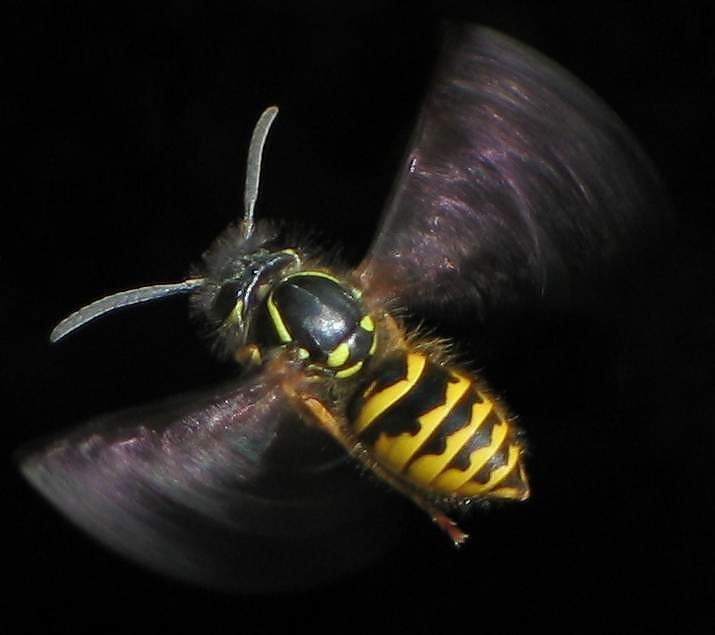
The wasp's body displays alternating yellow and black markings, a warning signal to predators. It has two pairs of transparent membranous wings and a smooth sting connected to a venom gland, which it can use repeatedly. Its narrow waist, called the petiole, distinctly separates the thorax from the abdomen. Its powerful jaws allow it to chew wood and capture prey.
Characteristics
Indicative values: they vary by subspecies, sex and region.
Habitat and distribution
The wasp inhabits a wide variety of environments, from urban gardens to forest edges, passing through agricultural areas and meadows. It builds its nest in various cavities: under roofs, in tree hollows, underground, or in hedges. Its ability to adapt allows it to colonize both rural environments and heavily urbanized spaces.
CURRENT RANGE
Wasps are found on all continents except Antarctica, with great species diversity in temperate and tropical regions. In North Africa, including Tunisia, several common species are widely distributed. Their distribution generally follows that of available food resources and nesting sites.
Behaviour
The social wasp lives in an annual colony dominated by a foundress queen, surrounded by sterile workers that build the nest, hunt, and defend it. The colony may number several thousand individuals at the peak of summer before declining in autumn. It becomes aggressive when its nest is threatened and can sting multiple times in succession, unlike honeybees. Solitary species, by contrast, lead independent lives centred on laying eggs and hunting to feed their own larvae.
Reproduction
Only the fertilized queen survives the winter, hibernating in shelter before founding a new colony in spring. She lays the first eggs in an initial nest that she builds alone, then the worker wasps from this first generation take over the tasks. Late in the season, new queens and males are produced, mate, and then the entire colony declines as cold weather arrives. The complete cycle generally lasts a single season in temperate social species.
Peculiarities
Unlike the honeybee, the wasp has a smooth stinger without a barb, which allows it to sting multiple times without dying. Some species, such as parasitoid wasps, lay their eggs directly inside other insects, whose larvae develop at the expense of the host. The nest is made from chewed wood fibers mixed with saliva, forming a material similar to paper.
Threats and conservation
The wasp is not threatened globally, and some species are even considered pests in agricultural or urban contexts. Intensive pesticide use and the destruction of natural habitats can, however, affect some populations locally. Certain invasive exotic species, such as the Asian hornet, disrupt the ecosystems they colonize.
Numbers and trends vary across sources and regions. See the IUCN assessment for the latest reference data.
Gallery
1 documented photographs.
References
Profile updated 25 August 2026 · Reviewed by the TunisieVet editorial team.
Comments (0)
No comments yet.
CONSERVATION STATUS
Least concern (LC)
IUCN source, latest published assessment.
Species health
Documented diseases for this species.
Find a veterinarianThis information is provided for educational purposes only and is not a substitute for a veterinary consultation. If you have any concerns about your animal's health, consult a veterinarian.
To discover around: Wasp
Videos, facts, stories and records linked to this species.
Similar animals
Other species documented in Animalpedia.
