
Presentation
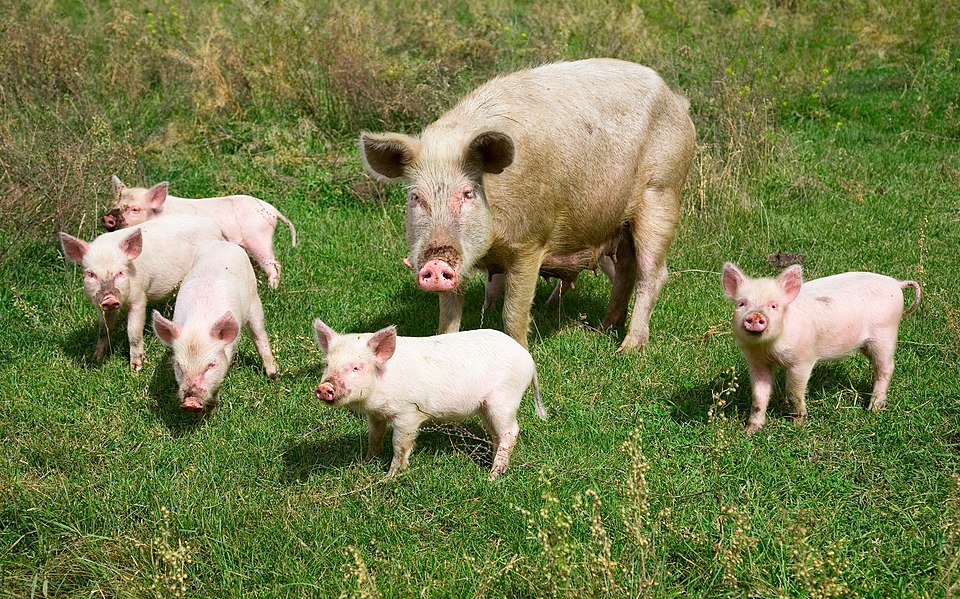
The domestic Pig is an artiodactyl mammal belonging to the Suidae family. Originating from the domestication of the European wild boar around 9,000 years ago, it diversified into numerous breeds raised globally for the production of meat and other products.
The domestic Pig has a stocky, massive body, thick skin that can be pink, black or spotted depending on the breed. It has four short, sturdy legs, a short, curved tail, and a triangular head with a movable snout.
Did you know?
Do pigs sweat?
Characteristics
BREEDS
Indicative values: they vary by subspecies, sex and region.
Habitat and distribution
In breeding, the Pig adapts to many environments. It is found on farms with well-ventilated enclosures, meadows or forest rangelands. It prefers areas with access to water, shade and mud. The species tolerates a variety of climates, from temperate to warmer regions.
CURRENT RANGE
Domestic Pig is high globally, on every continent except Antarctica. The largest populations are found in Asia (especially China), Europe and America. It is not present in Tunisia due to the religious principles which govern the local diet.
Behaviour
The domestic Pig is a gregarious and social animal that naturally lives in groups. He is intelligent, curious and capable of learning quickly. It communicates through various grunts and loves to wallow in mud for thermoregulation and protection against parasites.
Reproduction
The female (sow) reaches sexual maturity between 6 and 8 months. Gestation lasts approximately 114 days and typically results in a litter of 8 to 12 Pigelets. Breastfeeding lasts 3 to 4 weeks. Several litters are possible per year depending on breeding conditions.
Peculiarities
The Pig has an exceptionally developed sense of smell, 2000 times more sensitive than that of humans, allowing it to detect truffles underground. It has an intelligence comparable to that of a dog and is capable of solving complex problems.
Threats and conservation
As a domestic animal, the Pig does not face conservation threats. However, raised populations can be affected by various diseases (Pigine plague, influenza, etc.) and intensive breeding conditions pose ethical and health issues.
Numbers and trends vary across sources and regions. See the IUCN assessment for the latest reference data.
Gallery
1 documented photographs.
References
Profile updated 03 September 2026 · Reviewed by the TunisieVet editorial team.
Comments (0)
No comments yet.
CONSERVATION STATUS
Not evaluated (NE)
IUCN source, latest published assessment.
Species health
Documented diseases for this species.
See the 6 diseases of this species Find a veterinarianThis information is provided for educational purposes only and is not a substitute for a veterinary consultation. If you have any concerns about your animal's health, consult a veterinarian.
Related species
To discover around: Pig
Videos, facts, stories and records linked to this species.
Similar animals
Other species documented in Animalpedia.

TunisieVet in your pocket 📱🐾 Access your veterinary services wherever you are. [ Download the app ]
Learn more