Presentation
The babiroussa is a wild suid native to Indonesia, famous for the curved tusks of males that pierce the skin of the snout. It belongs to the Suidae family but forms a genus of its own, Babyrousa, distinct from wild boars and domestic pigs. Its body is sparsely haired, and its grayish, wrinkled skin gives it an archaic appearance. It lives in small groups in the humid tropical forests of Sulawesi and neighboring islands. A discreet and little-studied species, it remains threatened by deforestation and hunting. The babiroussa is sometimes called a "deer pig" because of its spectacular tusks.
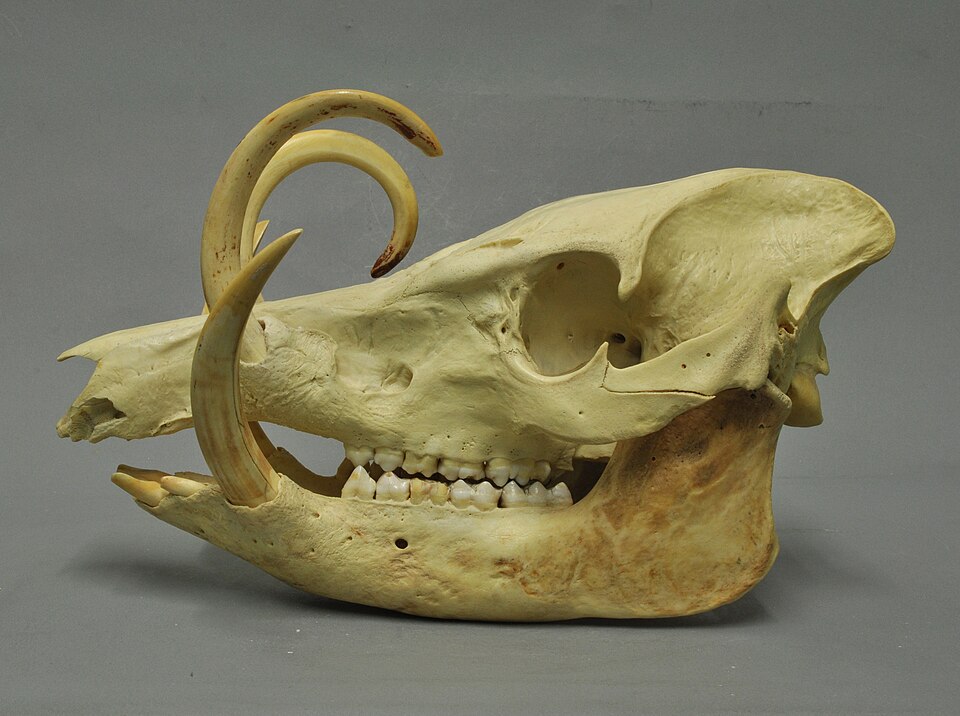
The babiroussa is distinguished by the upper tusks of males that grow vertically, pierce the skin of the snout, and curve toward the forehead. Its skin is gray, thick, and almost hairless, with pronounced folds. Its body is sturdy but relatively slender compared to other suids, with long legs adapted for walking through dense forest.
Characteristics
Indicative values: they vary by subspecies, sex and region.
Habitat and distribution
The babirusa inhabits humid tropical forests, often near water sources, rivers, or wetland areas. It also frequents forest edges and mangrove zones on certain islands. Its dependence on dense forest makes it a species highly sensitive to deforestation.
CURRENT RANGE
The babirusa is endemic to the island of Sulawesi and a few nearby Indonesian islands such as Buru and the Sula Islands. Its range is naturally restricted and fragmented. No wild populations exist outside this Indonesian region.
Behaviour
The babiroussa lives in small family groups composed of females and young, while adult males are often solitary or temporarily join groups. It is active mainly during the day, alternating feeding and rest periods. Males engage in ritualized displays when they encounter each other, rearing up on their hind legs to collide at chest level.
Reproduction
Female babirusas give birth after a gestation period of approximately five months, typically producing one or two young. Newborns are mobile very quickly and follow their mother shortly after birth. Sexual maturity is reached around one year of age, and breeding is not strictly seasonal.
Peculiarities
The most striking feature of the babirusa is the canine teeth of males, which actually pierce through the skin of the snout and grow upward. These tusks are fragile and often break before reaching their maximum size, which limits serious injuries between rivals. This unique characteristic inspired its name, which means 'deer-pig' in Malay.
Threats and conservation
The babirusa is threatened by deforestation linked to logging and agriculture, which reduces its natural habitat. Hunting for meat, sometimes intensive in certain regions of Indonesia, places additional pressure on the species. Its naturally low population density makes it particularly vulnerable to these cumulative pressures.
Numbers and trends vary across sources and regions. See the IUCN assessment for the latest reference data.
Gallery
1 documented photographs.
References
Profile updated 04 September 2026 · Reviewed by the TunisieVet editorial team.
Comments (0)
No comments yet.
CONSERVATION STATUS
Vulnerable (VU)
IUCN source, latest published assessment.
Species health
Documented diseases for this species.
Find a veterinarianThis information is provided for educational purposes only and is not a substitute for a veterinary consultation. If you have any concerns about your animal's health, consult a veterinarian.
To discover around: Babiroussa
Videos, facts, stories and records linked to this species.
Similar animals
Other species documented in Animalpedia.

Be among the first to use our app. Sign up and get early Google Play access.
Discover