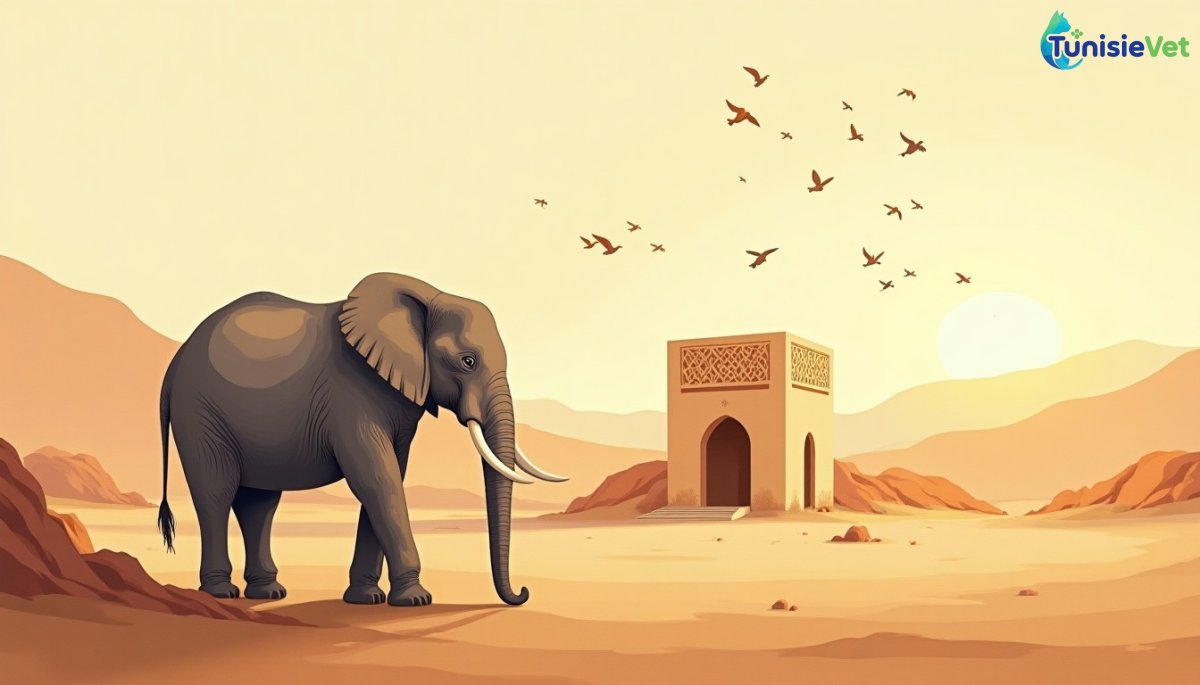
In the very year of the Prophet's ﷺ birth, a powerful king marched on Mecca with an army of elephants to destroy the Kaaba. What became of this expedition is told in the Qur'an, in a chapter bearing the name of the animal that stood still before the sacred city.
That year, known in tradition as "the Year of the Elephant," an extraordinary event marked the history of Mecca and the Kaaba. Abraha, the Abyssinian governor of Yemen, had built a great sanctuary there to divert Arab pilgrims to himself. Seeing that the Arabs continued to flock to the Kaaba, he decided to march on Mecca at the head of a powerful army to destroy it. According to the accounts preserved by scholars of Qur'anic commentary, this army included one or more elephants—rare and impressive creatures in the Arabian peninsula—intended to strike fear into hearts and clear a path for the troops.
The Elephant That Refused to Advance
It is reported that when Abraha's army drew near Mecca, the elephant leading the column, often called Mahmoud in the narrations of the exegetes, came to a complete halt before the sacred city. No matter what efforts were made to drive it forward toward the Kaaba, the animal would lie down or stubbornly refuse to go any further. Yet if it was directed in another direction, it would immediately resume its march without difficulty. This behaviour, seen as a clear sign, threw the army into confusion as it stood at the gates of the sacred city.
Meanwhile, in Mecca, the inhabitants, including the Prophet's ﷺ grandfather, Abd al-Muttalib, had withdrawn to the surrounding mountains, entrusting the Kaaba to divine protection rather than to their own forces, which were entirely inadequate against such an army.
The Qur'anic Account in Surah Al-Fil
It is this event that the Qur'an recounts in Surah Al-Fil ("The Elephant"), which takes its very name from this episode. God describes how He destroyed the army that sought to harm the Sacred House, sending against it birds that pelted them with stones of baked clay, reducing them to the state of chewed straw.
﴿ أَلَمْ تَرَ كَيْفَ فَعَلَ رَبُّكَ بِأَصْحَابِ الْفِيلِ ﴿١﴾ أَلَمْ يَجْعَلْ كَيْدَهُمْ فِي تَضْلِيلٍ ﴿٢﴾ وَأَرْسَلَ عَلَيْهِمْ طَيْرًا أَبَابِيلَ ﴿٣﴾ تَرْمِيهِم بِحِجَارَةٍ مِّن سِجِّيلٍ ﴿٤﴾ فَجَعَلَهُمْ كَعَصْفٍ مَّأْكُولٍ ﴿٥﴾ ﴾
"Have you not considered how your Lord dealt with the People of the Elephant? Did He not render their plan into failure? He sent against them birds in flocks, striking them with stones of baked clay, and He made them like eaten straw."
(Surah Al-Fil, verses 1 to 5)
The commentators report that these birds, called "Ababil," flew in dense formations and hurled small stones at the soldiers with devastating force, bringing the expedition to an end before it could reach its objective. Abraha himself, gravely afflicted, died shortly after his return to Yemen.
Thus, while the elephant—a beast of war meant to embody the crushing might of men—stood immobile of its own accord before the Kaaba, it was simple birds that accomplished the destruction of the army. This contrast, emphasized by many commentators, recalls that true power belongs to God alone, and that even the humblest creatures can, by His will, overturn the plans of the mightiest.
This story, so deeply inscribed in Arab memory that it served as a chronological marker for the Prophet's ﷺ birth year, also invites us to look with care upon the animals that pass through our lives. The motionless elephant and the birds sent forth in flocks remind us that each creature, however humble or imposing, holds a place willed in the order of the world. To remember this is to learn to treat with gentleness and respect all the animals around us—quiet reflections of a wisdom that surpasses us.