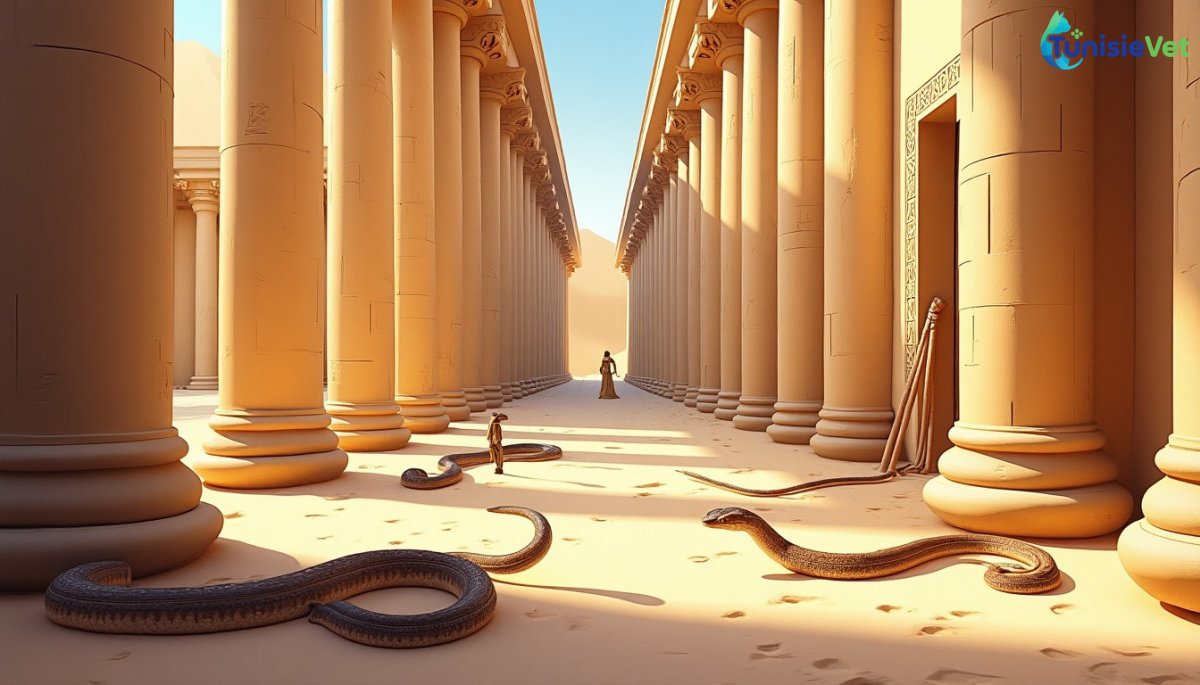
Before Pharaoh, the sorcerers cast their ropes and staffs, which seemed to become serpents through the power of their illusion. But a single staff, entrusted by Allah to Musa, would reveal the truth in an instant.
In the courtyard of Pharaoh's palace, a vast crowd had gathered. This day was meant to settle, in the eyes of all, between the word of Musa (Moses) ﷺ and the power of the sorcerers assembled by Pharaoh to confound him. What few yet knew was that this duel would unfold around a staff and ropes transformed, in appearance, into serpents.
The Challenge to the Sorcerers
Pharaoh, troubled by Musa's ﷺ mission, had summoned the most skilled sorcerers from throughout the land. The Quran relates this confrontation in several surahs, notably Surah Al-A'raf, Surah Ta-Ha, and Surah Ash-Shu'ara. The sorcerers asked Musa ﷺ who, between them and him, would cast first. He invited them to cast first.
They then cast their ropes and their staffs, and through sorcery and optical illusion, these appeared to move like serpents before the eyes of the assembly. Surah Ta-Ha describes the impression felt by Musa ﷺ himself in these terms:
﴿ فَإِذَا حِبَالُهُمْ وَعِصِيُّهُمْ يُخَيَّلُ إِلَيْهِ مِن سِحْرِهِمْ أَنَّهَا تَسْعَىٰ ﴾
And behold, their ropes and their staffs, by the effect of their magic, appeared to him to be moving.
(Surah Ta-Ha, verse 66)
The Miracle of Musa's Staff
Allah then reassured Musa ﷺ, commanding him not to fear, for his staff would become a true serpent through an authentic miracle, not through illusion. Musa ﷺ cast his staff, and it truly transformed into a serpent, swallowing all that the sorcerers had presented as animated ropes and staffs.
This moment was decisive: the sorcerers, experts in their craft, immediately understood the difference between their art and what they had just witnessed. They recognized that this was not a trick of magic like their own, but a sign from Allah. The Quran relates that they then prostrated themselves, acknowledging the Lord of Musa and Harun (Aaron), despite Pharaoh's anger and the threats he levelled against them.
This account is mentioned in several places in the Quran, each surah illuminating a different aspect: the confrontation itself, the recognition of the sorcerers, or again their steadfastness in their new faith in the face of Pharaoh's threats.
A Lesson Beyond the Image of the Serpent
This account is not centred on the serpent as an animal, but on what it represents: the distinction between human illusion, however skilful, and the true miracle granted by Allah to His prophet. The form of the serpent, an animal often feared, serves here to impress the minds and to make visible, in a spectacular way, the truth in the face of deception.
Even when prophetic accounts speak of animals in symbolic or miraculous contexts, they remind us of the particular place these creatures hold in creation. Serpents, birds, or any other living being deserve, in all ordinary circumstances of our lives, respect and gentleness: not to harm them without reason, not to frighten them needlessly, and to recognize in them creatures willed by Allah, to whom it is fitting to show kindness in our daily lives.