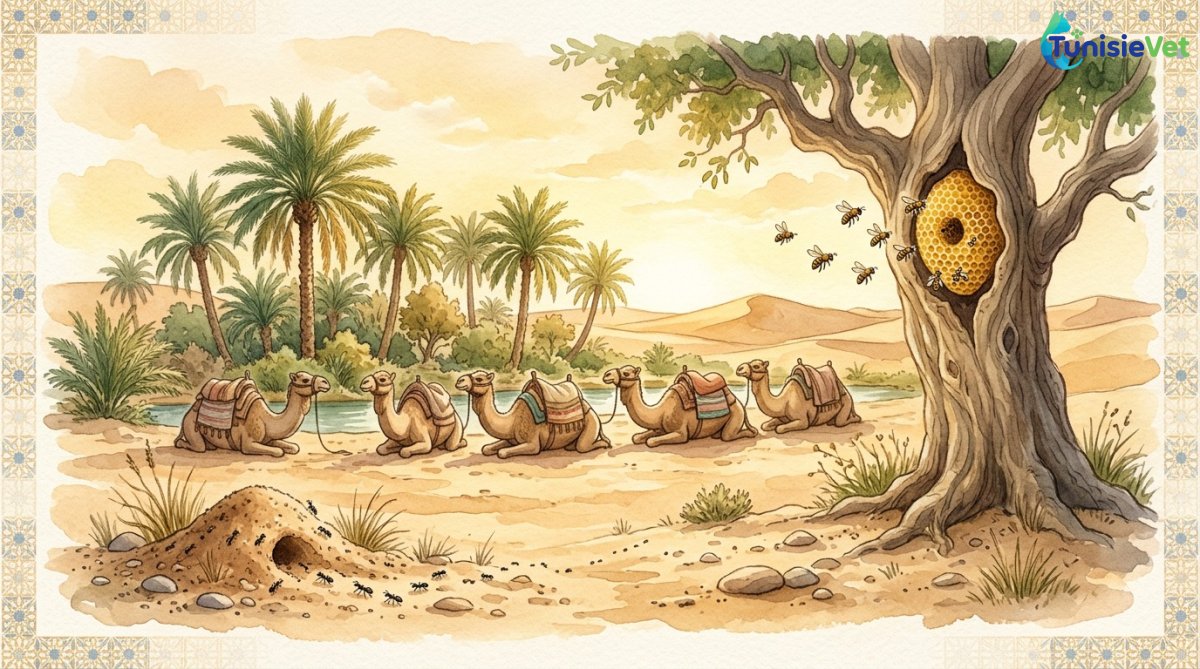
From the orderly flight of birds to the industrious hive of bees, the Quran repeatedly turns to animals to invite human beings to reflect. Why this persistent gaze upon the animal world?
In many passages of the Quran, attention turns to the animal world: birds flying in the sky, cattle grazing, bees producing their honey, the ant organizing its colony. This is not mere scenery; it is a repeated invitation to observe, to think, and to recognize in creation a wisdom that surpasses mankind.
Animals as Signs for Reflection
Surah An-Nahl, whose name means "The Bees," devotes several verses to the behaviour of this insect. It is reported that God "inspires" the bee to build its dwellings in mountains, in trees, and in the homes of men, then to feed on fruits so as to produce a beverage of varying colours, in which there is healing for people. Scholars of interpretation often cite this passage as an example of the precision found in the animal world, long before modern science would describe the social organization of hives.
In the same manner, Surah An-Naml, "The Ants," recounts the episode in which the Prophet Sulaiman (Solomon), at the head of his army, crosses a valley. An ant then warns its people to enter their dwellings so they will not be crushed without realizing it. Sulaiman, who understands the language of ants, smiles at this word and thanks God for it. According to some interpreters, this passage illustrates both the intelligence attributed to the ant and the humility of the prophet before a creature so small.
A Constant Invitation to Observation
The Quran does not merely cite animals as isolated examples: it encourages, in a general way, to observe creation so as to recognize signs within it. In Surah Al-Ghachiya, the question is posed: "Do they not consider how the camels have been created?" This verse, among others, invites the reader to look carefully at the animals around them, not out of mere curiosity, but as a path toward reflection and recognition.
It is also reported, in a hadith from Sahih al-Bukhari, that the Prophet ﷺ mentioned the case of a man forgiven by God for giving drink to a thirsty dog, and conversely, the case of a woman punished for having left a cat to starve after confining it. These accounts show that attention given to animals, in the prophetic tradition, is never a secondary detail: it is directly connected to the moral conduct of the human being.
Why This Gaze Upon Animals?
Several reasons emerge from these examples. First, animals bear witness to an order and precision that transcend chance: the organized hive, the disciplined ant colony, the flight of birds in the sky without visible support. Second, their behaviour often serves as a mirror or lesson: the ant that warns its own, the bee that works without ceasing. Finally, the way in which man treats animals becomes, in Islamic tradition, an indicator of his own righteousness.
Thus, when the Quran draws attention to animals, it is not simply to admire nature: it is also a way of reminding the human being of their responsibility toward the creatures that share their world. Caring for an animal, ensuring its wellbeing, respecting its place in the balance of creation—this is to extend that same spirit of attention and gratitude that the texts invite us to cultivate. This is, at its heart, the simplest and most consistent message: observe animals in order to learn better how to respect them.