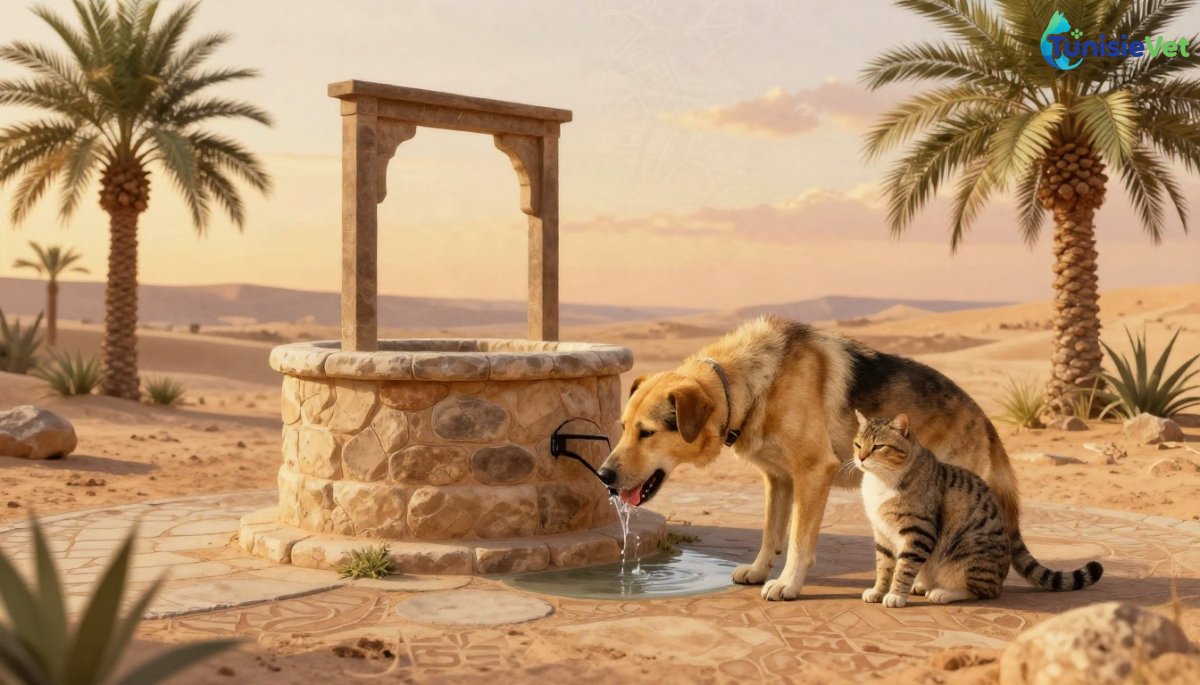
A thirsty dog beside a well, a cat shut in: two authentic accounts from the Prophet ﷺ show how much the way we treat animals matters. Here is why these lessons are worth passing on from a very young age.
A man was walking along a path under a scorching sun when thirst overcame him. He found a well, climbed down into it, drank until his thirst was quenched, and then climbed back up. That is when he noticed a dog panting and licking the damp earth, so great was its thirst. This is one of the most famous accounts that the Prophet ﷺ passed on to his companions, reported in Sahih al-Bukhari and Sahih Muslim.
The Shoe Full of Water
According to this hadith, the man thought that this dog was suffering from the same thirst as he had. He went back down into the well, filled his shoe with water, held it in his mouth to climb back up, and then gave the dog something to drink. The Prophet ﷺ reported that God was pleased with him and forgave his sins.
The companions then asked: "O Messenger of God, is there a reward for us in treating animals kindly?" He ﷺ replied that there is a reward for every creature with a moist liver, that is to say for every living being (Sahih al-Bukhari). A simple act, for a small creature, is therefore never insignificant.
The Lesson of the Cat
Another hadith, also reported by al-Bukhari and Muslim, tells of a woman who was punished because of a cat. She had shut it in until it died; she had neither fed it nor given it water, and had not let it go free to feed on the small creatures of the earth. This account reminds us that an animal placed in our care depends entirely on us.
These two scenes complement each other: one shows the value of a gesture of compassion, the other the weight of neglect. They speak to adults as well as to children, and they are easily understood at a child's level.
A Way of Seeing That Is Learned Early
The Quran also invites us to look at animals with consideration. In Surah Al-An'am (verse 38), God reminds us that there is no creature on earth, nor any bird flying on its wings, that does not form communities like humans. The animal is not an object: it is a creature, with its needs, its way of living and its place in creation.
It is also reported, in the collections of Abu Dawud and at-Tirmidhi, that the Prophet ﷺ said: those who show mercy, the Most Merciful will show mercy to them. Showing a child how to give water to a thirsty cat, to stroke gently, not to pull a dog's tail or frighten a bird, is to help them practise this mercy every day.
Habits formed in childhood often carry on into adulthood. A child who learns to observe, to feed and to protect develops patience, empathy and a sense of responsibility, qualities that also benefit their relationships with other people.
In summary: kindness toward animals is not a minor detail; it is a school of gentleness. Giving a child the example of the man at the well is teaching them that a mouthful of water offered with compassion can count before God, and that every living being deserves our attention and protection.