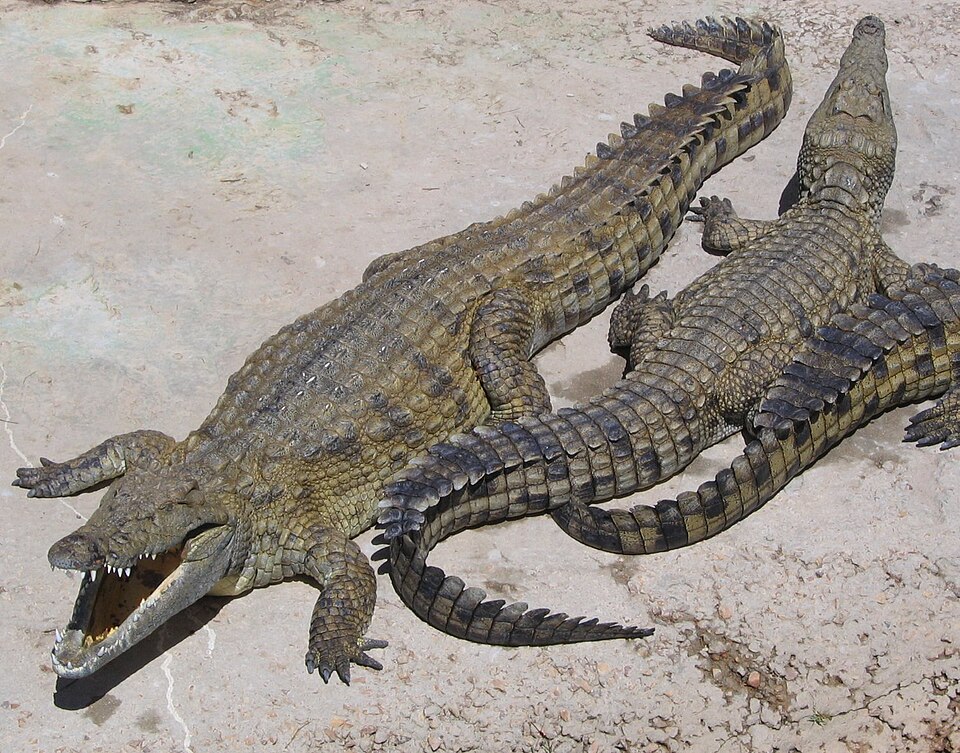
The Nile Crocodile is among the land animals with the most powerful bite measured to date, with a force that can exceed 3,000 newtons in the largest adult individuals — a record shared with other large crocodilians such as the saltwater crocodile.
An asymmetrical muscular mechanism
This power comes from overdeveloped adductor muscles (jaw closure), occupying a large part of the reptile's skull and neck. Conversely, the muscles responsible for opening the mouth are remarkably weak. It is this imbalance which explains a counterintuitive observation: it is possible to keep the mouth of a crocodile closed with the hands or a simple strap, while no human force can force it open once closed.
This muscular architecture serves the species' hunting strategy: the Nile Crocodile captures its prey - fish, ungulates coming to drink, sometimes large mammals - by a brutal seizure and prolonged holding underwater, rather than by chewing which would require powerful opening muscles.
Figures to be interpreted with caution
The biting force of an individual strongly depends on its size: in crocodilians, it increases with body mass in a relationship which means that an adult of several meters develops a force much greater than that of a juvenile of a few tens of centimeters. The record values also come from various experimental protocols - force sensors placed in the laboratory or in the field, captive or wild animals - which explains significant differences between the studies depending on the individuals tested and the methods used. Comparing figures from different sources without taking into account the size of the animal and the protocol therefore leads to misleading conclusions about the true ranking of the most powerful bites in the animal kingdom.