Black Soldier Fly in Livestock: Valuable Asset or Agricultural Risk?

The black soldier fly (Hermetia illucens) is now considered an asset to livestock farming rather than a threat to crops, provided its breeding is properly managed. Its larvae transform organic waste into protein for animal feed. This article explains practically how to use it, its real benefits, and the precautions to take before getting started.
1. What is the black soldier fly and why is it generating such interest?
The black soldier fly is an insect native to warm regions, now found in many temperate and Mediterranean zones. Unlike the common housefly, it is not considered a vector for disease transmission and does not bite. The adult lives briefly and eats almost nothing: it is the larva that interests livestock farmers.
This larva has a remarkable capacity to consume large quantities of organic matter: vegetable and fruit scraps, brewery grain, pomace, kitchen waste without meat. As it develops, it accumulates proteins and lipids, making it a valuable food source for poultry and farmed fish.
2. Concrete benefits for livestock farming
A local and renewable source of protein
Dried or fresh larvae can be incorporated into the diet of laying hens, broiler chickens, and certain farmed fish such as tilapia or carp. They provide proteins and fats useful for growth, as a complement to a balanced diet.
Valorizing organic waste
By digesting kitchen, market, or market garden waste, larvae reduce the volume of matter to be disposed of. The residue from their digestion, sometimes called organic fertilizer, can be used to amend the soil in a vegetable garden or orchard.
A solution suited to small operations
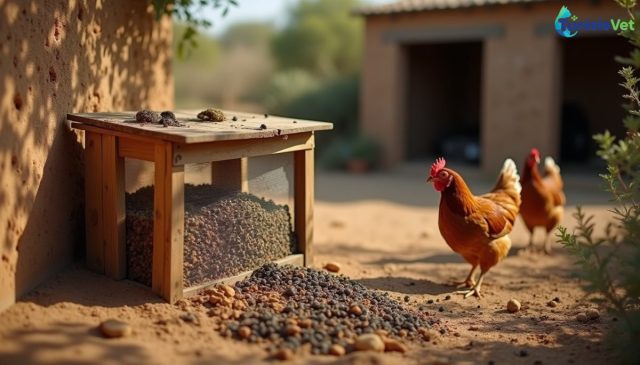
Breeding black soldier fly larvae requires little space and can be done in bins or compact structures, making it suitable for a family farm or backyard operation without heavy equipment investment.
3. How to start a larva breeding program on the farm
- Set up an attractive egg-laying bin, placed in a sheltered location away from direct sunlight and rain, in a temperate environment.
- Add fresh and varied organic waste (fruits, vegetables, kitchen scraps) while avoiding overly salty, fatty, or excessive meat products.
- Monitor substrate moisture: if too dry, larvae develop poorly; if too wet, odors and mold appear.
- Harvest larvae at maturity before they transform into pupae, to distribute them to poultry or fish.
- Keep a few individuals for breeding if you wish to maintain continuous production.
Larvae can be given live, dried, or ground depending on the species being fed. It is advisable to introduce them gradually into the ration and never substitute them entirely for a balanced diet, particularly for young growing animals.
4. Risks and limitations to understand before starting
Despite its advantages, the black soldier fly is not without limitations. Poorly managed breeding can encourage the proliferation of unwanted insects if bins are not properly sealed or maintained. Larvae that escape can colonize unintended spaces.
From an agricultural standpoint, the fear of a threat to crops remains largely unfounded: the adult black soldier fly does not feed on plants and does not lay eggs on cultivated vegetation, but only on decomposing organic matter. The main risk therefore is not to the crops themselves, but rather stems from poor waste management and the resulting odor nuisances.
It is also important never to feed larvae with waste containing chemicals, spoiled meat scraps, or potentially contaminated materials, in order to avoid health risks for the animals that subsequently consume them.
5. Black soldier fly and agricultural crops: separating fact from fiction
| Common belief | Reality |
|---|---|
| The black soldier fly attacks crops | It does not feed on living plants, only on decomposing organic matter |
| It spreads diseases like the common housefly | It is not recognized as a vector of pathogens to humans |
| Its breeding requires large facilities | A family operation is possible with compact bins |
| Larvae completely replace conventional feed | They should remain a supplement, integrated gradually into the diet |
6. Health precautions for animals fed on larvae
Before incorporating black soldier fly larvae into the diet of poultry or fish, it is recommended to:
- Introduce larvae progressively to observe the animals' tolerance;
- Maintain a reasonable proportion in the overall ration, without disrupting nutrient balance;
- Observe the general condition of the animals after introducing a new feed;
- Seek professional advice if uncertain about the quality of substrate used to feed the larvae.
In case of digestive troubles or unusual behavior after introducing larvae, it is preferable to consult a professional. Livestock farmers can rely on the veterinarian directory to find a practitioner competent in animal nutrition and poultry or aquaculture farming.
Summary
- The black soldier fly is an asset to livestock farming, not a threat to agricultural crops.
- Its larvae convert organic waste into protein for poultry and fish.
- A family operation is possible with a bin, shade, and controlled moisture.
- Larvae should complement, not replace, a balanced diet.
- Veterinary monitoring is recommended when introducing a new feed.
Frequently Asked Questions
Is the black soldier fly dangerous to crops?
No, it does not feed on cultivated plants and does not lay eggs on living vegetation. It targets only decomposing organic matter, making it an ally rather than an agricultural pest.
Can you feed chickens with black soldier fly larvae?
Yes, larvae can be distributed live or dried as a supplement to regular feed. It is advisable to introduce them gradually and not make them the sole food source.
How do you prevent nuisances when breeding larvae at home?
You must use a properly sealed bin, control moisture, and avoid overly odorous or excessive meat waste. Regular maintenance limits bad odors and prevents other insects from proliferating.
When properly managed, the black soldier fly offers a practical solution for converting organic waste and supplementing animal feed, without posing any real threat to crops. If you have doubts about integrating it into your livestock operation, a veterinarian's advice remains the best guarantee for your animals' health.
Leave a comment
Be the first to comment on this article.