
Presentation
Honey bee is a hymenopteran social insect that lives in organized colonies that can number several tens of thousands of individuals. Domesticated since Antiquity, it is one of the most important species for ecological balance and the human economy, particularly for the pollination of crops and the production of honey.
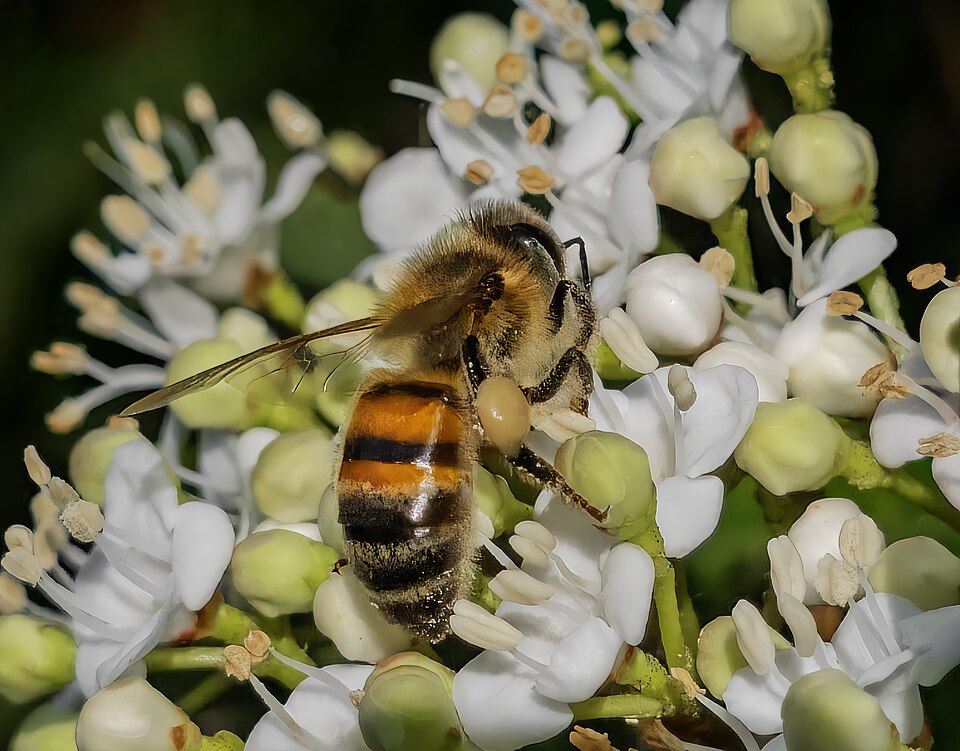
Honey bee has a segmented body covered in dense hairs, with an abdomen striped with alternating yellow and black rings. It has two pairs of wings that lock together when flying, large compound eyes, and powerful mandibles. Individuals from the same colony are distinguished by their role: queen, drones (males) and workers (sterile females).
Did you know?
How long does a bee live?
Characteristics
Indicative values: they vary by subspecies, sex and region.
Habitat and distribution
The Honey bee adapts to many environments: forests, meadows, cultivated areas and farms. It nests in tree hollows in the wild or in hives made by man. It prefers areas with abundant and varied flora, providing nectar and pollen throughout the growing season.
CURRENT RANGE
Honey bee is present on all continents (except Antarctica). Originally from the Middle East and North Africa, it was gradually introduced by humans to all temperate and Mediterranean regions. It is one of the most widely distributed and exploited insect species by humanity.
Behaviour
Honey bee is a highly social insect that communicates with its conspecifics through complex dances (notably the figure 8 dance) to indicate the location of food sources. She works in harmony with the hive, where each individual performs specific tasks according to their age and role. It is capable of generating heat collectively to maintain the temperature of the colony.
Reproduction
Honey bee reproduction is highly organized. The queen, the only fertile female, lays hundreds of eggs per day during the active season. Drones (males) fertilize flying queens during nuptial flights. A colony reproduces by swarming: a new queen emerges and part of the colony follows her to form a new hive.
Peculiarities
The Honey bee has ultraviolet vision which allows it to detect floral patterns invisible to the human eye. It stores the nectar in a specialized crop and enzymatically transforms it into honey. A hive can produce several kilos of honey per year. Propolis, a mixture of plant resin, is used to seal and sterilize the hive.
Threats and conservation
Although Honey bee is widely cultivated, it faces real challenges: varroa mites (parasitic mites), pesticides, viral and fungal diseases, and loss of natural habitats. The intensive use of certain neonicotinoid insecticides particularly affects its navigation and reproduction.
Numbers and trends vary across sources and regions. See the IUCN assessment for the latest reference data.
Gallery
1 documented photographs.
References
UICN — Liste rouge des espèces menacées
Profile updated 03 September 2026 · Reviewed by the TunisieVet editorial team.
Comments (0)
No comments yet.
CONSERVATION STATUS
Data deficient (DD)
IUCN source, latest published assessment.
Species health
Documented diseases for this species.
See the 4 diseases of this species Find a veterinarianThis information is provided for educational purposes only and is not a substitute for a veterinary consultation. If you have any concerns about your animal's health, consult a veterinarian.
To discover around: Honey bee
Videos, facts, stories and records linked to this species.
Similar animals
Other species documented in Animalpedia.

TunisieVet in your pocket 📱🐾 Access your veterinary services wherever you are. [ Download the app ]
Learn more