
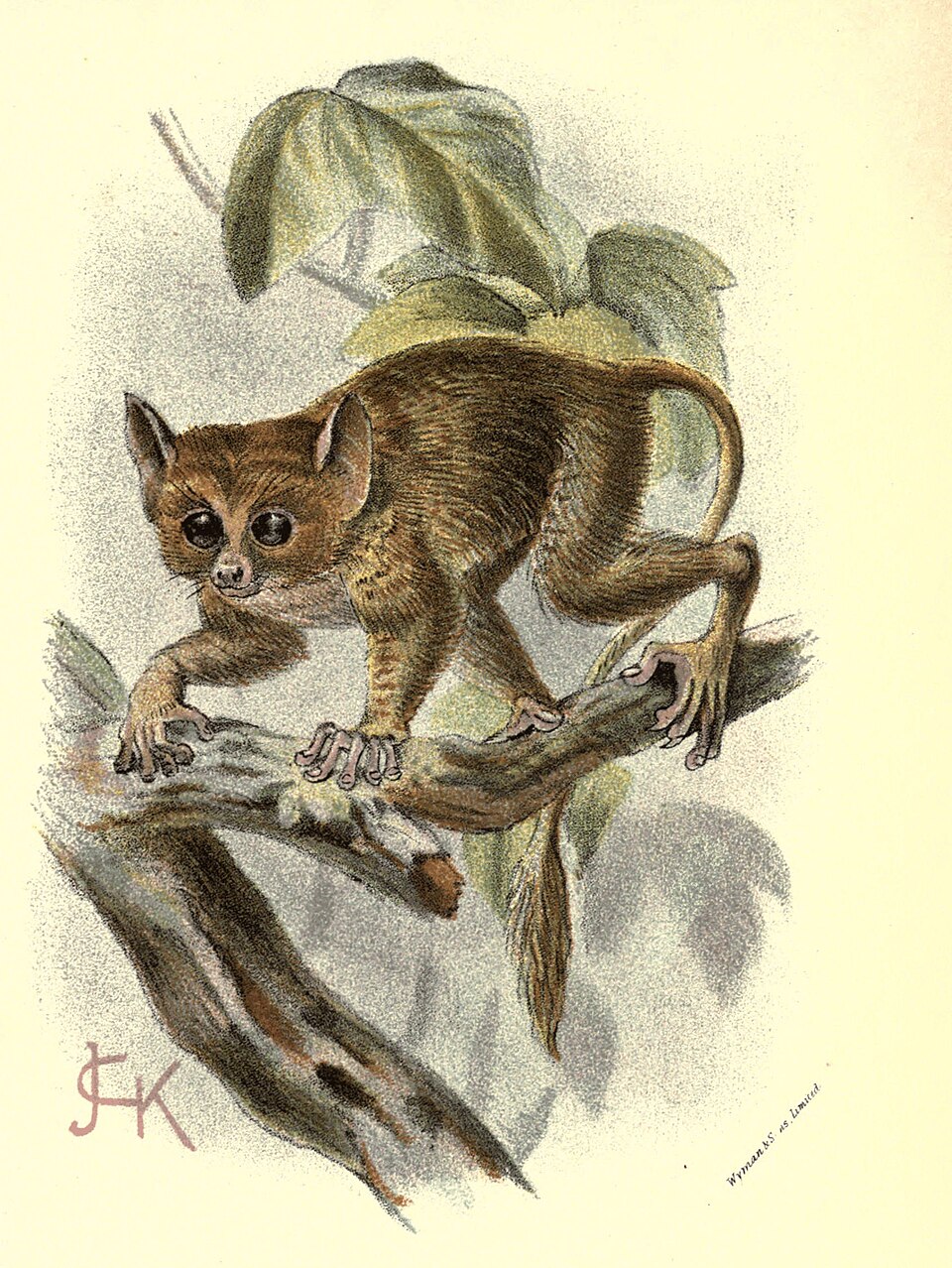
Presentation
The Tarsier is a small nocturnal primate native to the islands of Southeast Asia, recognizable by its immense, fixed eyes, proportionally the largest in the animal kingdom. It belongs to the Tarsiidae family, the only surviving family of its infraorder. Its tiny size, its ability to turn its head 180 degrees and its fingers equipped with adhesive discs make it a singular animal. It lives in small family groups in dense vegetation and moves by powerful leaps between branches. Several species are threatened by deforestation and the loss of their natural habitat.
The Tarsier measures between 10 and 15 cm long, not including the tail, which can reach 20 to 25 cm. Its eyes, fixed in their sockets, are so large that the animal must rotate its head almost 360 degrees to change its point of view. Its long fingers end in adhesive pads making it easier to grip branches, and its highly developed hind legs allow it to perform remarkable jumps.
Characteristics
Indicative values: they vary by subspecies, sex and region.
Habitat and distribution
The Tarsier lives in dense, primary and secondary tropical forests, as well as mangrove and bamboo areas. It favors the low and middle strata of vegetation where it finds shelter and prey. The disappearance of these forests directly threatens its populations.
CURRENT RANGE
Tarsier is found only in Southeast Asia, including the Philippines, Indonesia, and Borneo. Each species occupies a restricted geographical area, often limited to an island or an archipelago. This island distribution makes it particularly vulnerable to local changes in its environment.
Behaviour
A nocturnal and arboreal animal, the Tarsier spends the day hidden in dense vegetation to protect itself from predators. It communicates by ultrasonic vocalizations that are often imperceptible to the human ear. Solitary or living in small family groups depending on the species, it marks its territory with odorous secretions.
Reproduction
The female gives birth to a single young after a gestation of approximately six months. The newborn is particularly developed at birth, capable of quickly clinging to branches. He is breastfed then weaned in a few weeks before gradually becoming independent.
Peculiarities
Tarsier has the largest eyes relative to body size of any mammal. It is capable of jumping up to several meters thanks to its overdeveloped hind limbs. Unlike most primates, it can only be kept in captivity with great difficulty due to its extreme stress in the face of human handling.
Threats and conservation
Deforestation linked to agriculture and logging is the main threat to Tarsier. The illegal trade in exotic pets and poorly regulated tourism also disrupt its populations. Several species are classified as vulnerable or endangered by the IUCN.
Numbers and trends vary across sources and regions. See the IUCN assessment for the latest reference data.
Gallery
1 documented photographs.
References
Profile updated 26 August 2026 · Reviewed by the TunisieVet editorial team.
Comments (0)
No comments yet.
CONSERVATION STATUS
Vulnerable (VU)
IUCN source, latest published assessment.
Species health
Documented diseases for this species.
This information is provided for educational purposes only and is not a substitute for a veterinary consultation. If you have any concerns about your animal's health, consult a veterinarian.
To discover around: Tarsier
Videos, facts, stories and records linked to this species.
RECORD
Approximately 16mm in diameter per eye
The largest eyes in relation to the body
Relative measurement in a mammal, in proportion to the largest in the animal kingdom in re...
Similar animals
Other species documented in Animalpedia.

TunisieVet in your pocket 📱🐾 Access your veterinary services wherever you are. [ Download the app ]
Learn more