
Presentation
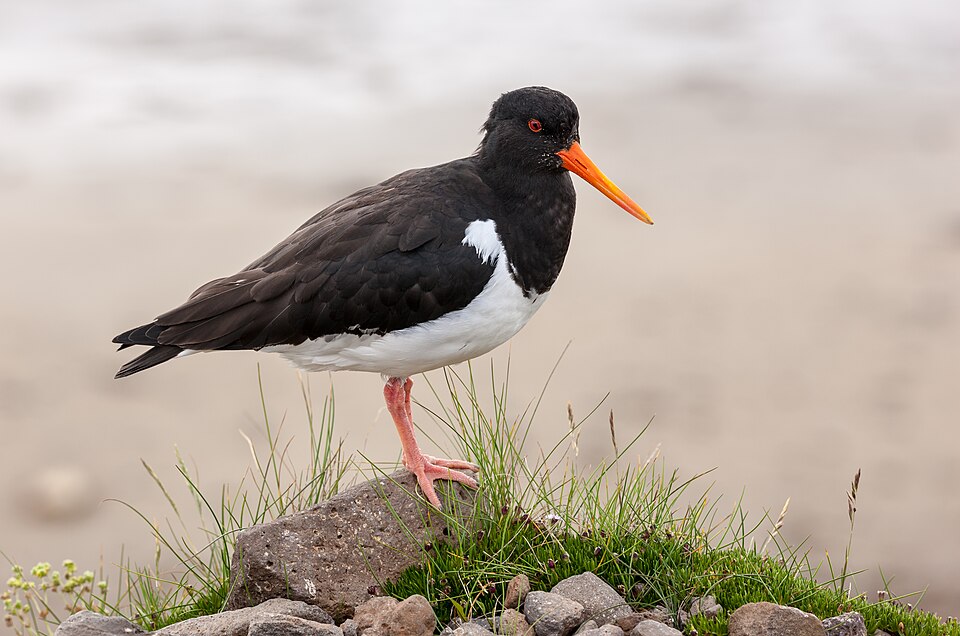
The Eurasian Oystercatcher is a medium-sized wading bird, easily recognized by its distinctive black and white plumage and long bright orange bill. It inhabits sandy, muddy, or rocky coastlines where it forages for shellfish and invertebrates. This gregarious bird often forms large flocks outside the breeding season, particularly on coastal mudflats. In Tunisia, it is observed mainly in winter along coasts and lagoons. Its sharp, repetitive call makes it easy to identify even from a distance. It is a good indicator of the health of coastal wetlands.
The Eurasian Oystercatcher measures approximately 40 to 45 cm in length with a wingspan of 80 to 85 cm. Its plumage is black on the head, back, and breast, contrasting with a white belly and barred wings. The bill is long and sturdy, orange in color, and adapted for opening shellfish, while the legs are bright pink.
Characteristics
Indicative values: they vary by subspecies, sex and region.
Habitat and distribution
The oystercatcher frequents sandy, muddy, and rocky coasts, as well as estuaries and lagoons. During breeding season, it selects open beaches or shorelines near food sources. Outside the nesting season, it gathers on extensive intertidal mudflats.
CURRENT RANGE
The species breeds widely across Europe, temperate Asia, and certain North African coasts. Northern populations migrate to more southern areas in winter, particularly to Mediterranean and Atlantic shores. Tunisia hosts wintering birds along its coastline.
Behaviour
The Eurasian Oystercatcher is a diurnal bird, most active at low tide when feeding areas are exposed. It is territorial during the breeding season but becomes gregarious and forms sometimes large gatherings outside the nesting period. Its loud and repeated alarm call serves to alert others to the presence of predators or intruders.
Reproduction
The female typically lays 2 to 4 eggs in a simple scrape on the ground, often on an open beach or shoreline. Incubation lasts about 24 to 27 days and is shared by both parents. The chicks are precocial but remain dependent on adults for food for several weeks after hatching.
Peculiarities
Its bright orange bill and specialized shellfish-opening technique are its most distinctive features. Each bird typically adopts one particular method—hammering or probing—which becomes its specialty throughout its life.
Threats and conservation
Degradation of coastal wetlands, marine pollution, and human disturbance on breeding beaches are the main threats. Overexploitation of shellfish beds can also reduce its food resources.
Numbers and trends vary across sources and regions. See the IUCN assessment for the latest reference data.
Gallery
1 documented photographs.
References
Profile updated 08 September 2026 · Reviewed by the TunisieVet editorial team.
Comments (0)
No comments yet.
CONSERVATION STATUS
Near threatened (NT)
IUCN source, latest published assessment.
Species health
Documented diseases for this species.
This information is provided for educational purposes only and is not a substitute for a veterinary consultation. If you have any concerns about your animal's health, consult a veterinarian.
Similar animals
Other species documented in Animalpedia.

TunisieVet in your pocket 📱🐾 Access your veterinary services wherever you are. [ Download the app ]
Learn more