
Presentation
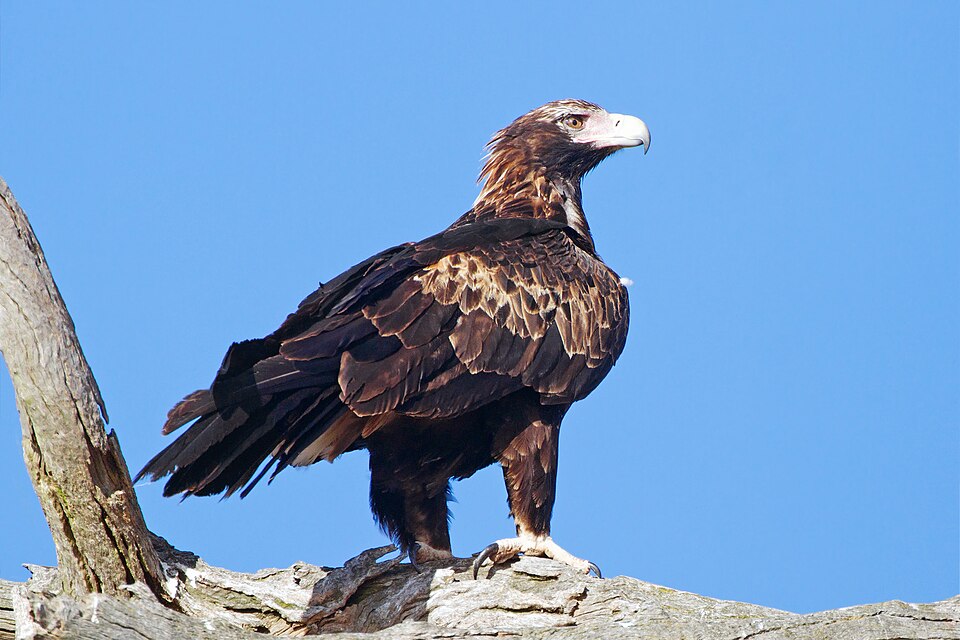
The Wedge-tailed eagle is the largest diurnal raptor on the Australian continent. It is distinguished by its long, wedge-shaped tail, which gives it its name in English. Its dark brown to blackish plumage lightens with age, with older adults sporting a more golden nape and coat. An opportunistic hunter, it exploits a vast territory which it patrols in flight using its large and powerful wings. It occupies a dominant predator position in many Australian ecosystems.
This species has a wingspan that can exceed 2.3 meters, one of the largest among eagles. The legs are feathered down to the fingers, a typical trait of the Aquila genus. The powerful, hooked bill and sharp claws make it a well-equipped predator. Juveniles are lighter than adults and gradually darken as they molt.
Characteristics
Indicative values: they vary by subspecies, sex and region.
Habitat and distribution
The species frequents a wide variety of open environments, from arid plains to light forests and mountainous areas. It generally avoids dense forests and heavily built-up urban areas. Semi-arid regions and grasslands offer ideal hunting conditions due to their clear visibility. It can also be observed at altitude, exploiting the reliefs for its reconnaissance flights.
CURRENT RANGE
Wedge-tailed eagle is endemic to the Australian continent, where it occurs in almost all regions, as well as Tasmania. The Tasmanian subspecies is distinct and more endangered than the mainland population. It does not occur naturally outside Oceania.
Behaviour
Solitary or in pairs, this eagle defends a vast territory which it monitors from high perches or in gliding flight. It uses thermal currents to rise to high altitudes without expending unnecessary energy. Pairs remain united for several years and share the construction of the nest as well as the rearing of the young. It can be aggressive towards intruders, including other birds of prey, near its territory.
Reproduction
The female generally lays one to three eggs in a large nest of branches built on a tall tree or cliff. Incubation lasts about six weeks and is shared by both parents, although the female spends more time on it. The young fledge after about three months but remain dependent on the parents for several additional weeks. The same nest can be reused and enlarged over several successive years.
Peculiarities
Its English name “wedge-tailed eagle” refers to the distinctive wedge shape of its tail, visible in flight. It is one of the largest eagles in the world in terms of wingspan. It has long been seen as a threat to livestock, leading to significant historical persecution.
Threats and conservation
The species suffered massive culling campaigns in the 20th century due to its largely exaggerated reputation as a predator of lambs. Collisions with vehicles when consuming road carrion and electrocution on power lines remain current causes of mortality. Secondary poisoning from bait intended for other species also poses a threat. The Tasmanian subspecies is more vulnerable due to loss of forest habitat.
Numbers and trends vary across sources and regions. See the IUCN assessment for the latest reference data.
Gallery
1 documented photographs.
References
Profile updated 19 August 2026 · Reviewed by the TunisieVet editorial team.
Comments (0)
No comments yet.
CONSERVATION STATUS
Least concern (LC)
IUCN source, latest published assessment.
Species health
Documented diseases for this species.
See the 7 diseases of this species Find a veterinarianThis information is provided for educational purposes only and is not a substitute for a veterinary consultation. If you have any concerns about your animal's health, consult a veterinarian.
To discover around: Wedge-tailed eagle
Videos, facts, stories and records linked to this species.
Similar animals
Other species documented in Animalpedia.

TunisieVet in your pocket 📱🐾 Access your veterinary services wherever you are. [ Download the app ]
Learn more