
Presentation
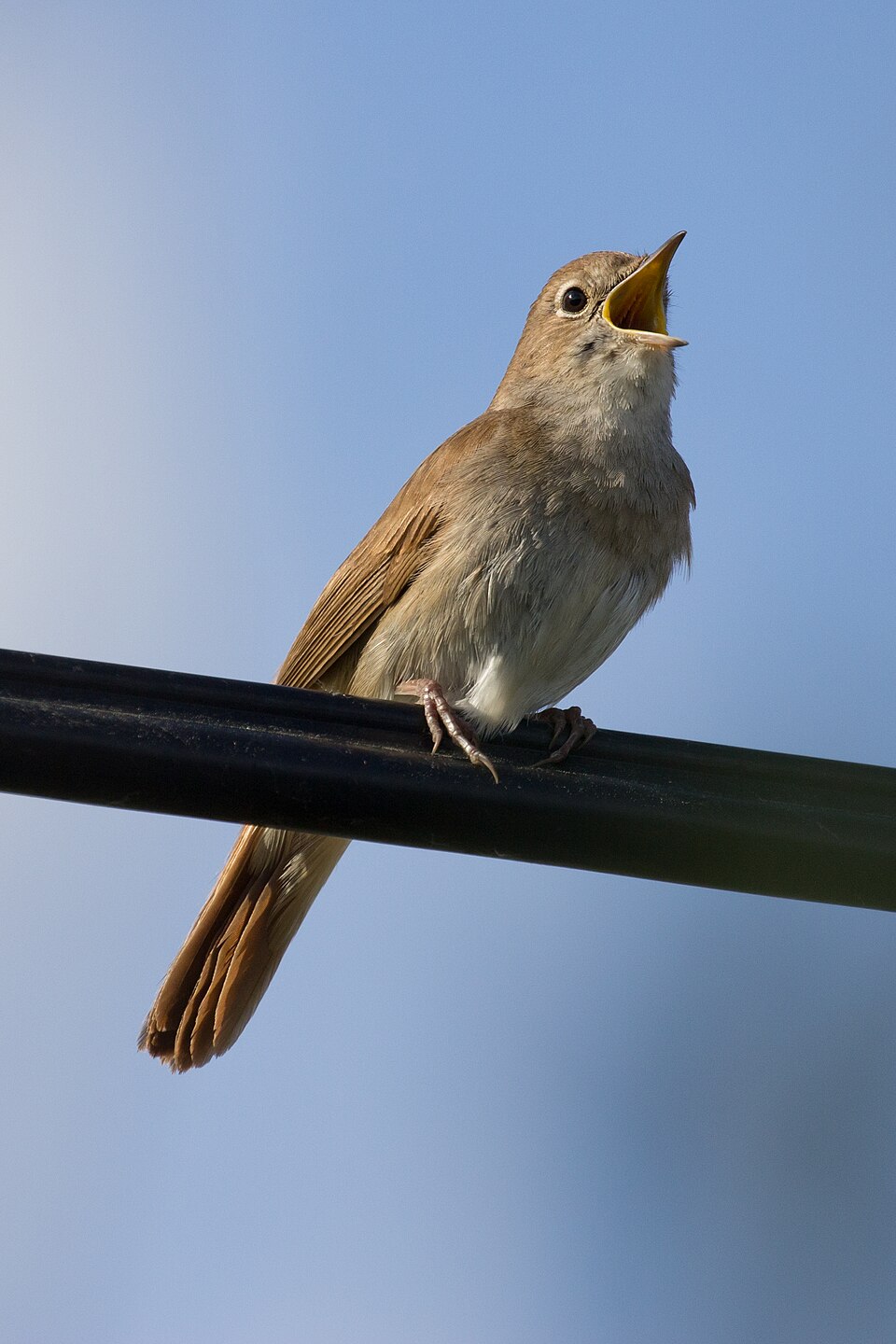
The Common Nightingale (Luscinia megarhynchos) is a small insectivorous songbird renowned for its powerful and melodious song, particularly audible at night in spring. Discreet and reddish-brown in colour, it hides readily in dense thickets. A migratory bird, it spends summer in Europe and North Africa before moving to sub-Saharan Africa for winter. It is present in Tunisia during the breeding season, notably in humid wooded areas. Its song has inspired many literary and musical works throughout the centuries.
The nightingale measures approximately 15 to 16.5 cm in length with a wingspan of 23 to 26 cm. Its plumage is reddish-brown above, brighter on the tail, and whitish-grey below. The sexes are similar, making visual identification difficult; it is chiefly its song that allows recognition. Its beak is fine and pointed, typical of insectivorous birds.
Characteristics
Indicative values: they vary by subspecies, sex and region.
Habitat and distribution
The nightingale favours dense woodland undergrowth, thorny thickets and thick hedgerows, often near water sources. It avoids open or highly urbanised areas, preferring low dense vegetation to remain concealed. It is found on plains as well as in wooded hill country.
CURRENT RANGE
The species breeds in Europe, North Africa and western Asia. It winters in sub-Saharan Africa, south of the Sahara. In Tunisia, it is present as a breeding bird or migrant in the north and central parts of the country.
Behaviour
This is a shy and elusive bird, difficult to observe as it remains hidden in thick bushes. The male is famous for its complex and powerful song, delivered day and night to defend its territory and attract a female. Outside the breeding season, it leads a rather solitary life.
Reproduction
The breeding season runs from April to July depending on the region. The female builds a low nest, often on the ground or near ground level, hidden in dense vegetation. She lays 4 to 5 eggs which she incubates alone for about 13 days, with the young leaving the nest after approximately 10 additional days.
Peculiarities
The male nightingale's song can contain more than 250 distinct phrases, making it one of the most complex bird songs in the world. It sings both day and night, a rare trait among songbirds.
Threats and conservation
Degradation and fragmentation of hedgerows and woodland undergrowth threaten its breeding habitats. Urban light and noise pollution can also disrupt its nocturnal song and breeding. Climate change is further altering migration periods.
Numbers and trends vary across sources and regions. See the IUCN assessment for the latest reference data.
Gallery
1 documented photographs.
References
Profile updated 04 September 2026 · Reviewed by the TunisieVet editorial team.
Comments (0)
No comments yet.
CONSERVATION STATUS
Least concern (LC)
IUCN source, latest published assessment.
Species health
Documented diseases for this species.
See the 4 diseases of this species Find a veterinarianThis information is provided for educational purposes only and is not a substitute for a veterinary consultation. If you have any concerns about your animal's health, consult a veterinarian.
Similar animals
Other species documented in Animalpedia.

TunisieVet in your pocket 📱🐾 Access your veterinary services wherever you are. [ Download the app ]
Learn more