
Presentation
The Common Kestrel (Falco tinnunculus) is a small diurnal raptor widely distributed in Europe, Asia and Africa. It can be recognized by its characteristic hovering flight, called “Holy Spirit flight”, which it uses to spot its prey on the ground. This falcon has adapted well to environments transformed by humans, including agricultural and urban areas. In Tunisia, it is among the most common and most visible birds of prey, both in the countryside and in town.
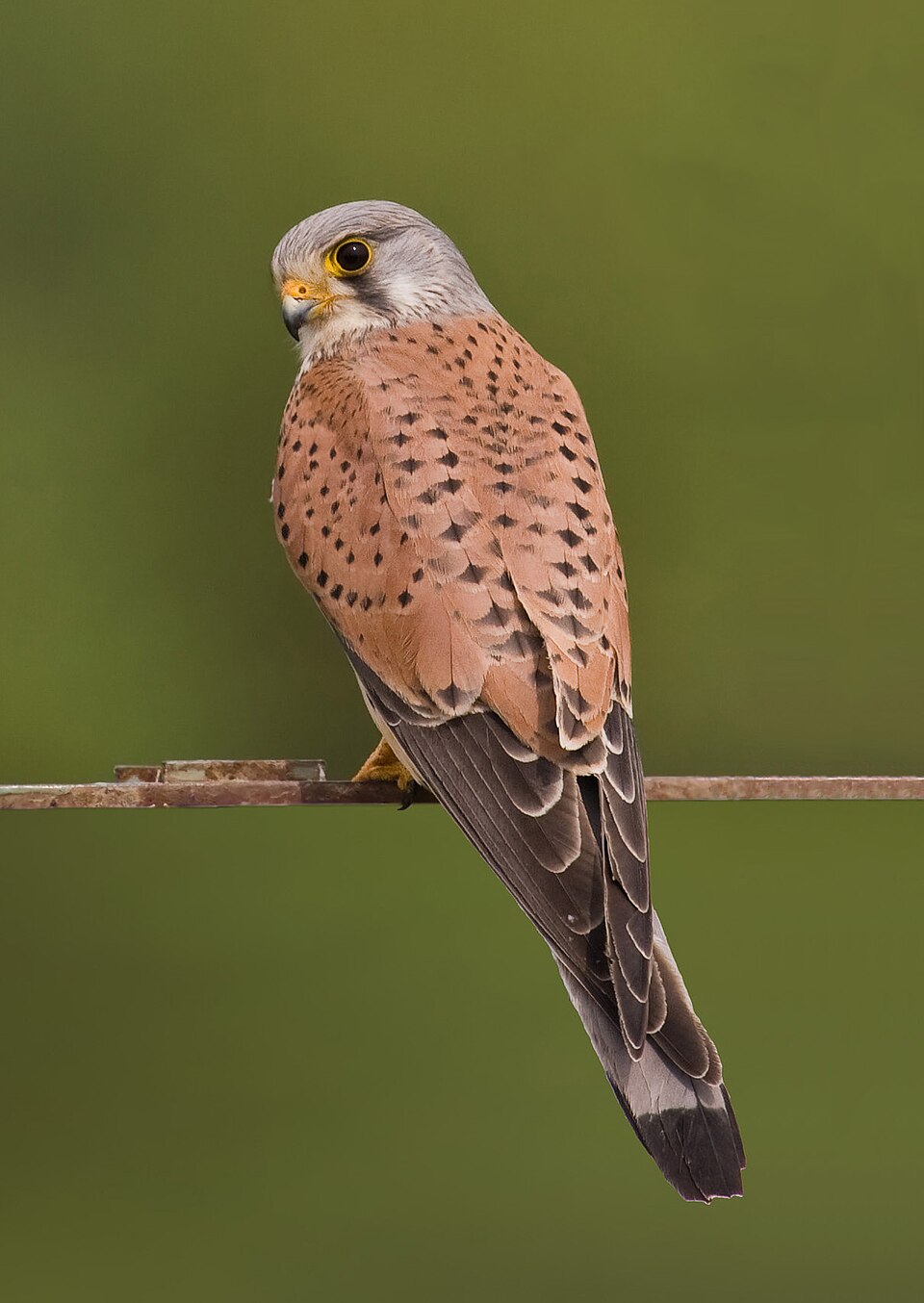
The plumage is rufous spotted with black on the back in the male, with a gray-blue head and tail, while the female is more uniformly brown and barred. The wings are long and pointed, suitable for agile flight and hovering. The bill is short and hooked, typical of raptors, and the claws are powerful despite the bird's small size.
Characteristics
Indicative values: they vary by subspecies, sex and region.
Habitat and distribution
The Common Kestrel frequents a wide variety of open environments: steppes, agricultural lands, meadows and rocky areas. It also adapts very well to urban environments, sometimes nesting on buildings or bridges. It mainly avoids dense forests and areas without open spaces for hunting.
CURRENT RANGE
The species is present over a vast area covering Europe, a large part of Asia and Africa, including the Maghreb. In Tunisia, it is observed throughout the territory, from the humid north to the more arid regions of the center and south. Some populations are migratory while others, particularly in North Africa, are sedentary.
Behaviour
It is an essentially solitary bird or living in pairs during the breeding season. It is territorial around its nesting site but often tolerates human proximity. Its hovering into the wind is an easily recognizable behavioral signature in the field.
Reproduction
The female generally lays 3 to 6 eggs in a basic nest, often reused from year to year, on a ledge, an old corvid nest or a building. Incubation lasts about a month and is shared by both parents. The young fledge after four to five weeks but remain dependent on adults for a few more weeks.
Peculiarities
Hovering, or “Holy Spirit flight,” allows the bird to remain almost motionless in the air facing the wind by rapidly flapping its wings. It also has sensitivity to ultraviolet which would allow it to identify traces of rodent urine, visible under this light. It is one of the easiest raptors to observe in the open environment.
Threats and conservation
The species remains generally common but locally suffers the effects of agricultural intemperance, in particular the use of pesticides which reduces prey populations and causes secondary poisoning. The destruction of nesting sites and collisions with infrastructure also constitute occasional threats. Overall, its world population remains stable.
Numbers and trends vary across sources and regions. See the IUCN assessment for the latest reference data.
Gallery
1 documented photographs.
References
Profile updated 03 September 2026 · Reviewed by the TunisieVet editorial team.
Comments (0)
No comments yet.
CONSERVATION STATUS
Least concern (LC)
IUCN source, latest published assessment.
Species health
Documented diseases for this species.
This information is provided for educational purposes only and is not a substitute for a veterinary consultation. If you have any concerns about your animal's health, consult a veterinarian.
To discover around: Common Kestrel
Videos, facts, stories and records linked to this species.
Similar animals
Other species documented in Animalpedia.

TunisieVet in your pocket 📱🐾 Access your veterinary services wherever you are. [ Download the app ]
Learn more