Presentation
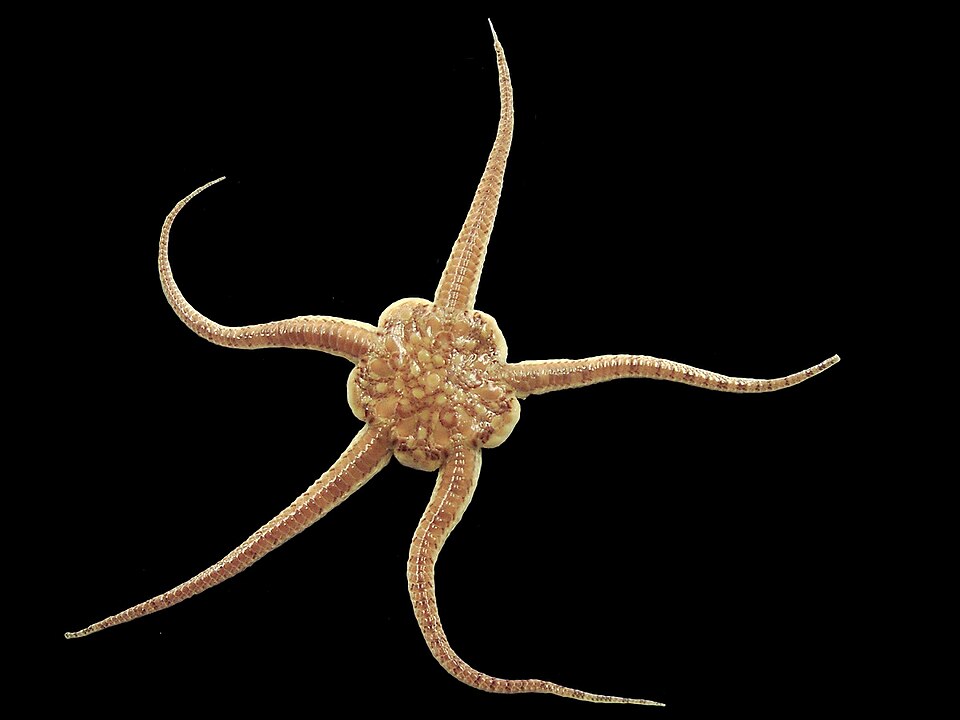
The brittle star is a marine echinoderm closely related to the starfish, characterized by a small central disc and five long, thin, jointed arms. It lives fixed on the seafloor, often hidden under rocks, in crevices, or buried in sediment. Its flexible arms, covered in tiny spines, allow it to move by undulating rather than using tube feet for crawling. Thousands of brittle star species exist, distributed across all the world's oceans, from coastal zones to the greatest depths. This discreet animal plays an important role in benthic ecosystems as a detritivore and sometimes as a predator of small invertebrates.
The brittle star's body consists of a flat central disc, typically a few centimetres across, extended by five thin, long, and highly mobile arms. Unlike starfish, its arms are clearly separated from the disc and do not contain internal organs, making them more flexible. The body surface is covered with calcareous plates and small spines that provide protection against predators. Some species display varied colours, ranging from dull brown to bright red, depending on their habitat and depth.
Characteristics
Indicative values: they vary by subspecies, sex and region.
Habitat and distribution
Brittle stars inhabit a wide variety of seafloors, ranging from rocky coastal zones to abyssal plains located thousands of meters deep. They particularly favor substrates that provide shelter, such as coral reefs, seagrass meadows, and sandy or muddy bottoms. Some species live in association with sponges, corals, or other invertebrates that offer them additional refuge. Their broad ecological tolerance allows them to be present in nearly all types of marine habitats.
CURRENT RANGE
Brittle stars are found in all the world's oceans, from the Arctic to the Antarctic, including temperate and tropical seas. They are particularly abundant in the Mediterranean, where several species are commonly observed along the Tunisian coast. Their range extends across a wide depth spectrum, with some species living in shallow waters while others inhabit the deep ocean. This broad geographic and bathymetric distribution makes them a highly diverse group.
Behaviour
The brittle star is mainly nocturnal and retiring, remaining hidden during the day under stones, in crevices, or buried in sediment. It moves by undulating its arms in a coordinated manner, a faster form of locomotion than that of starfish. When threatened, it can intentionally shed an arm to escape from a predator, with the limb later regenerating gradually. It typically lives in dense colonies that can number several hundred individuals per square metre on certain seafloor areas.
Reproduction
Brittle stars reproduce most often by sexual reproduction, releasing gametes into the water where fertilization is external. The larvae that result are planktonic and disperse with ocean currents before metamorphosing into benthic juveniles. Some species also practice asexual reproduction through fission, with the central disk dividing into two parts that each regenerate a complete individual. This regenerative capacity also applies to lost arms, which regrow over a period of weeks to months.
Peculiarities
The brittle star is distinguished by its capacity for autotomy—the ability to sever one or more of its own arms to escape a predator. This defense mechanism is followed by complete regeneration of the lost limb. Some species are bioluminescent, emitting green or blue light when disturbed, a phenomenon still being studied by scientists. Its close relationship to starfish, while displaying distinct morphology and locomotion, makes it a subject of interest for evolutionary biology.
Threats and conservation
Brittle stars do not face major identified threats on a global scale, with most species being widely distributed and abundant. Locally, coastal habitat degradation, pollution, and bottom trawling can affect certain populations. Climate change and ocean acidification represent potential long-term threats to these calciferous echinoderms. Overall, the group is considered relatively resilient compared to other marine taxa.
Numbers and trends vary across sources and regions. See the IUCN assessment for the latest reference data.
Gallery
1 documented photographs.
References
Profile updated 01 September 2026 · Reviewed by the TunisieVet editorial team.
Comments (0)
No comments yet.
CONSERVATION STATUS
Least concern (LC)
IUCN source, latest published assessment.
Species health
Documented diseases for this species.
Find a veterinarianThis information is provided for educational purposes only and is not a substitute for a veterinary consultation. If you have any concerns about your animal's health, consult a veterinarian.
Similar animals
Other species documented in Animalpedia.

Be among the first to use our app. Sign up and get early Google Play access.
Discover