
Presentation
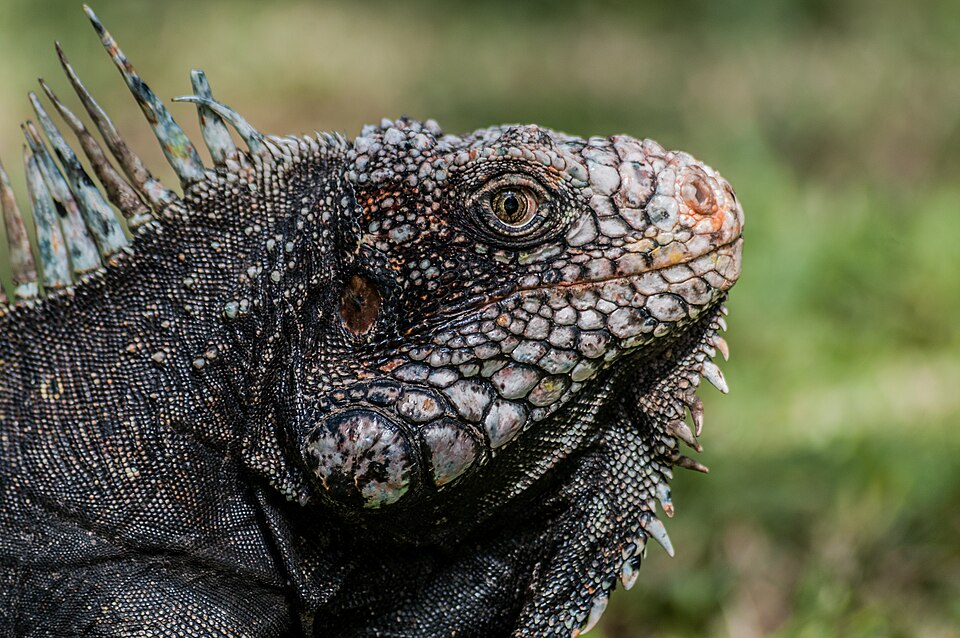
The Green Iguana (Iguana iguana) is a large arboreal lizard native to Central and South America. It is distinguished by its spiny dorsal crest, its dewlap under the throat and its long tail. Herbivorous, it lives mainly in the canopy of tropical forests, near water points. Very popular as a terrarium animal, it is also bred in captivity in many countries. Its color can vary from bright green to brown depending on age, mood and subspecies. Today it is one of the most common pet reptiles in the world.
The green Iguana has a massive body covered in scales, a ridge of soft quills along its back and tail, and a large gular dewlap used for thermoregulation and displays. Its tail, very long, represents more than half of the total length and serves as a defensive whip. It has a third parietal eye on the top of the skull, sensitive to variations in light.
Characteristics
Indicative values: they vary by subspecies, sex and region.
Habitat and distribution
The green Iguana likes tropical rainforests, often near rivers, lakes or marshy areas. It occupies the upper layers of vegetation, which allows it to flee quickly in case of danger by diving into the water below. In captivity, it requires a habitat reproducing high heat and high humidity.
CURRENT RANGE
The species is native to Central and South America, from Mexico to Brazil and Paraguay. It has also been introduced to several tropical regions, notably Florida and some Caribbean islands, where it is considered invasive. It is not present in the wild in Tunisia.
Behaviour
It is a diurnal and mainly arboreal animal, spending most of its time in branches. It regulates its body temperature by exposing itself to the sun on open branches. A good swimmer, he can drop into the water to escape a predator. Males adopt display postures and head nods to defend their territory.
Reproduction
The female lays between 20 and 70 eggs which she buries in loose, sandy soil. Incubation lasts about 90 to 120 days without parental care after laying eggs. The young Iguanas are autonomous from the moment they hatch and must immediately protect themselves from predators.
Peculiarities
The green Iguana has a third parietal eye capable of detecting light variations and the silhouettes of aerial predators. Its tail can partially detach if attacked, a defense strategy called autotomy. It can hold its breath for several minutes when submerged.
Threats and conservation
In its natural environment, the species is threatened by deforestation and hunting for its meat and eggs in certain regions. International pet trade also puts pressure on certain wild populations. Overall, the species remains common and is not considered threatened.
Numbers and trends vary across sources and regions. See the IUCN assessment for the latest reference data.
Gallery
1 documented photographs.
References
Profile updated 01 September 2026 · Reviewed by the TunisieVet editorial team.
Comments (0)
No comments yet.
CONSERVATION STATUS
Least concern (LC)
IUCN source, latest published assessment.
Species health
Documented diseases for this species.
See the 8 diseases of this species Find a veterinarianThis information is provided for educational purposes only and is not a substitute for a veterinary consultation. If you have any concerns about your animal's health, consult a veterinarian.
To discover around: Iguana
Videos, facts, stories and records linked to this species.
Similar animals
Other species documented in Animalpedia.

TunisieVet in your pocket 📱🐾 Access your veterinary services wherever you are. [ Download the app ]
Learn more