
Presentation
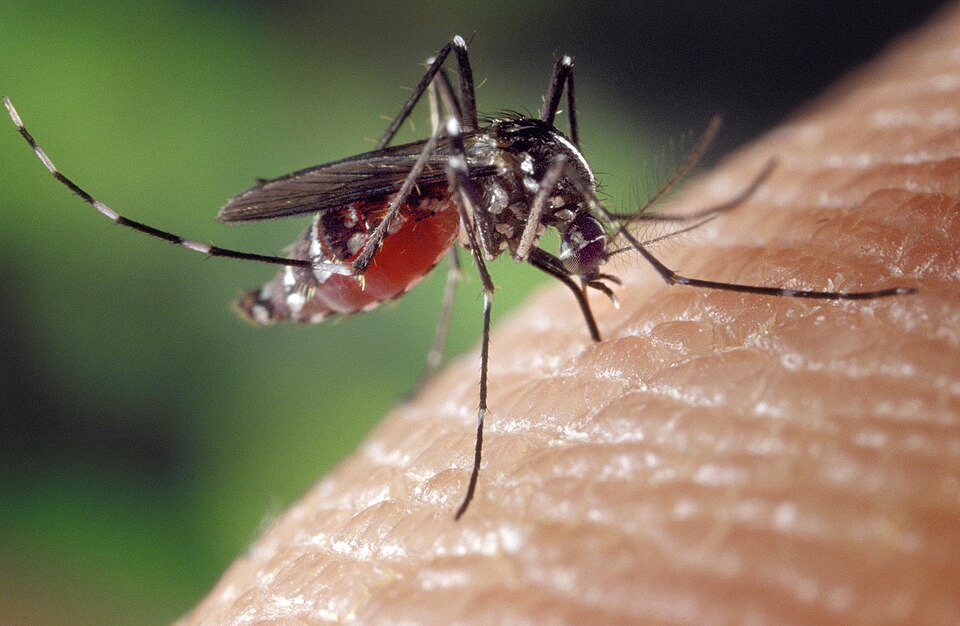
The mosquito is a dipteran insect of the Culicidae family, found on nearly every continent. It is characterized by a slender body, long thin legs, and a beak-like mouthpart called a proboscis. Only the female bites vertebrates to feed on blood, which is necessary for her eggs to mature; the male feeds on nectar and plant juices instead. Thousands of species exist worldwide, some of which transmit serious diseases such as malaria, dengue, and chikungunya. In Tunisia, several genera including Culex and Aedes are commonly observed, particularly near stagnant water sources.
The mosquito measures just a few millimeters and has two membranous wings and well-developed sensory antennae, more prominent in males. Its body is often striped or spotted depending on the species, which helps with identification. The female's elongated proboscis allows her to pierce skin and draw blood.
Characteristics
Indicative values: they vary by subspecies, sex and region.
Habitat and distribution
The mosquito develops in any environment with stagnant water suitable for egg-laying: ponds, puddles, water tanks, wetlands, or even small urban containers. It is found in both rural and urban settings, near human habitation. Wetlands and slow-flowing rivers are particularly favorable for its reproduction.
CURRENT RANGE
The mosquito is present on all continents except Antarctica, from tropical regions to temperate zones. Its distribution is very wide due to its adaptability and the diversity of its species. In North Africa, including Tunisia, several species are well established, particularly in coastal and humid areas.
Behaviour
The mosquito is mainly active at dusk and dawn, although some species also bite during the day. It is attracted by carbon dioxide, body heat, and certain odors in sweat. Flight is silent but produces a characteristic buzzing sound caused by the rapid beating of the wings.
Reproduction
The female lays her eggs on the surface or at the edge of stagnant water, in small clusters or singly depending on the species. The eggs develop into aquatic larvae, then pupae, before the emergence of the adult winged mosquito—a complete cycle taking from a few days to two weeks depending on temperature. A single female can produce several batches of eggs during her lifetime, each requiring a blood meal beforehand.
Peculiarities
The mosquito is considered the most dangerous animal to humans because of the diseases it transmits, even though it is not venomous itself. Its ability to detect exhaled carbon dioxide and body heat from several meters away is remarkable. Some species can also transmit diseases to domestic and farm animals.
Threats and conservation
The mosquito is not a threatened species; rather, it is the subject of control and eradication programs because of the diseases it carries. The use of insecticides and the destruction of breeding sites constitute the main pressures exerted on populations. Climate change, however, favors the expansion of certain species to new regions.
Numbers and trends vary across sources and regions. See the IUCN assessment for the latest reference data.
Gallery
1 documented photographs.
References
Profile updated 10 September 2026 · Reviewed by the TunisieVet editorial team.
Comments (0)
No comments yet.
CONSERVATION STATUS
Least concern (LC)
IUCN source, latest published assessment.
Species health
Documented diseases for this species.
See the 4 diseases of this species Find a veterinarianThis information is provided for educational purposes only and is not a substitute for a veterinary consultation. If you have any concerns about your animal's health, consult a veterinarian.
To discover around: Mosquito
Videos, facts, stories and records linked to this species.
RECORD
approximately 700,000 human deaths per year
The deadliest animal to humans
Estimate based on diseases transmitted by insect bites (malaria, dengue, etc.) according t...
Similar animals
Other species documented in Animalpedia.
