
Presentation
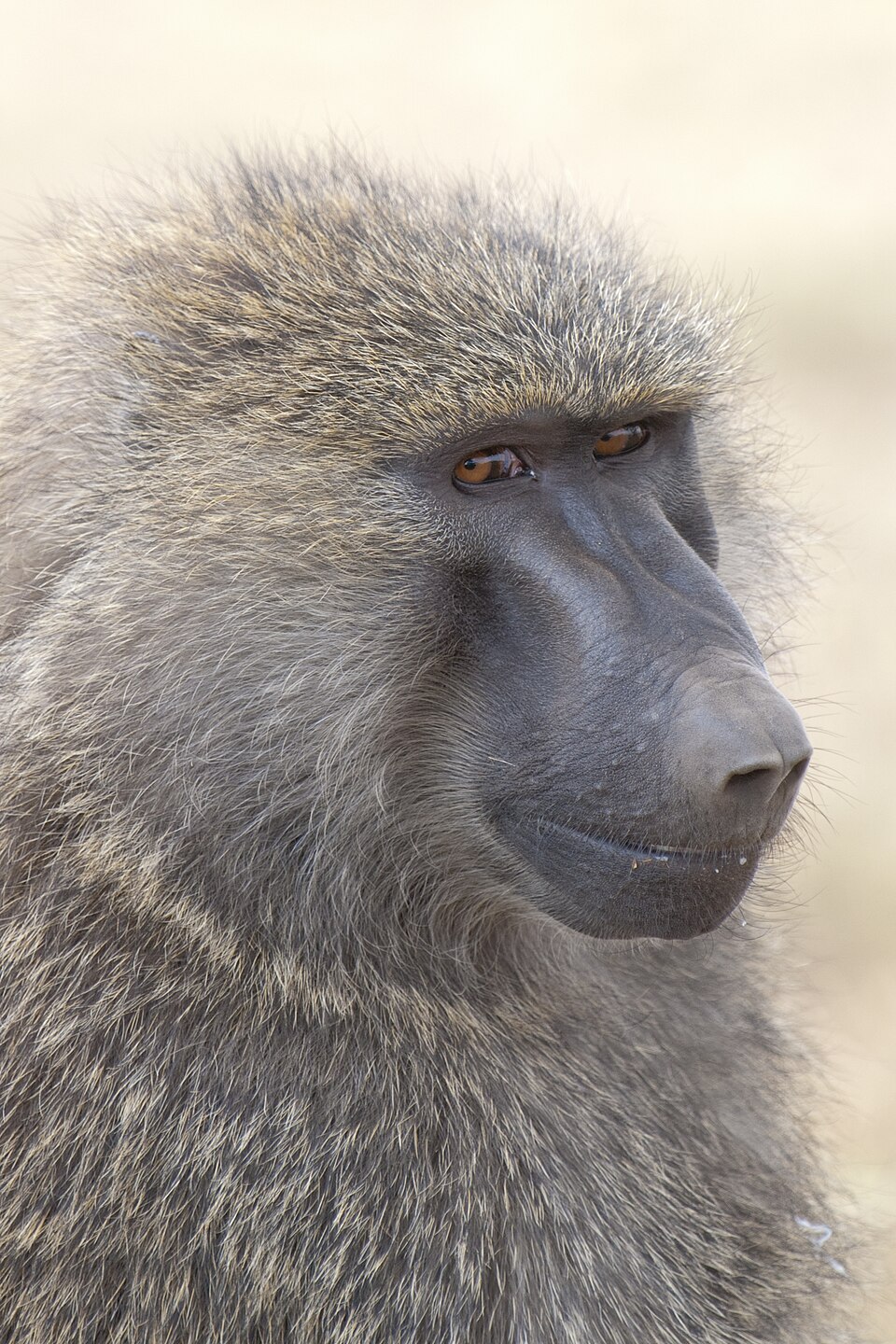
The Baboon is a great ape from the Old World belonging to the genus Papio, bringing together several species distributed across Africa and part of the Arabian Peninsula. Recognizable by its elongated snout and its quadrupedal gait, it lives in structured and hierarchical troops. This terrestrial animal mainly frequents savannahs, steppes and rocky areas, where it exploits a very diversified omnivorous diet. The Baboon is renowned for its social intelligence and complex interactions within the group. It is not present in the natural state in Tunisia, but remains known to the general public via zoological parks and popular culture.
The Baboon has a robust body, an elongated muzzle reminiscent of a dog and a powerful jaw with developed canines, especially in males. Its coat varies from light brown to olive gray depending on the species, and some have colorful buttock calluses. The tail is long but not prehensile, carried in a characteristic arc. The fore and hind limbs are of comparable length, adapted to mainly terrestrial locomotion.
Characteristics
Indicative values: they vary by subspecies, sex and region.
Habitat and distribution
The Baboon mainly frequents wooded savannahs and steppe areas, but it also adapts to light forests and rocky surroundings. It tolerates a wide range of climatic conditions, from semi-arid to more humid areas. Its increasing proximity to human habitation sometimes makes it a regular visitor to outlying agricultural and urban areas.
CURRENT RANGE
Baboon is widely distributed across sub-Saharan Africa, from the Sahel to southern Africa. One species, Baboon hamadryas, also extends into the Arabian Peninsula. It is absent from North Africa and is not present naturally in Tunisia.
Behaviour
The Baboon is a diurnal and highly social primate, living in hierarchical troops that can number several dozen individuals. The social structure is based on strict dominance ranks, both among males and females, and on relationships of alliance and mutual grooming. These animals communicate through a wide range of vocalizations, postures and facial expressions. They demonstrate great behavioral adaptability, exploiting both natural environments and the surroundings of areas inhabited by humans.
Reproduction
The Baboon female generally gives birth to a single calf after a gestation of approximately six months. The newborn clings to its mother's womb and later travels on her back. Sexual maturity is reached around four to six years of age depending on sex and species. Females often remain in their natal group throughout their lives, while young males migrate to other troops as adolescents.
Peculiarities
Male Baboons exhibit marked sexual dimorphism, being significantly larger and heavier than females. Some species, such as Baboon hamadryas, had symbolic importance in ancient Egypt, associated with the deity Thoth. Their complex social intelligence makes them a preferred study model for comparative primatology.
Threats and conservation
Baboon is generally under threat thanks to its wide distribution and ecological adaptability. Locally, it can nevertheless suffer from the destruction of its habitat and from conflicts with agricultural populations who consider it harmful. Certain populations are subject to direct persecution in retaliation for damage caused to crops.
Numbers and trends vary across sources and regions. See the IUCN assessment for the latest reference data.
Gallery
1 documented photographs.
References
Profile updated 25 August 2026 · Reviewed by the TunisieVet editorial team.
Comments (0)
No comments yet.
CONSERVATION STATUS
Least concern (LC)
IUCN source, latest published assessment.
Species health
Documented diseases for this species.
See the 4 diseases of this species Find a veterinarianThis information is provided for educational purposes only and is not a substitute for a veterinary consultation. If you have any concerns about your animal's health, consult a veterinarian.
To discover around: Baboon
Videos, facts, stories and records linked to this species.
Similar animals
Other species documented in Animalpedia.

TunisieVet in your pocket 📱🐾 Access your veterinary services wherever you are. [ Download the app ]
Learn more