
Presentation
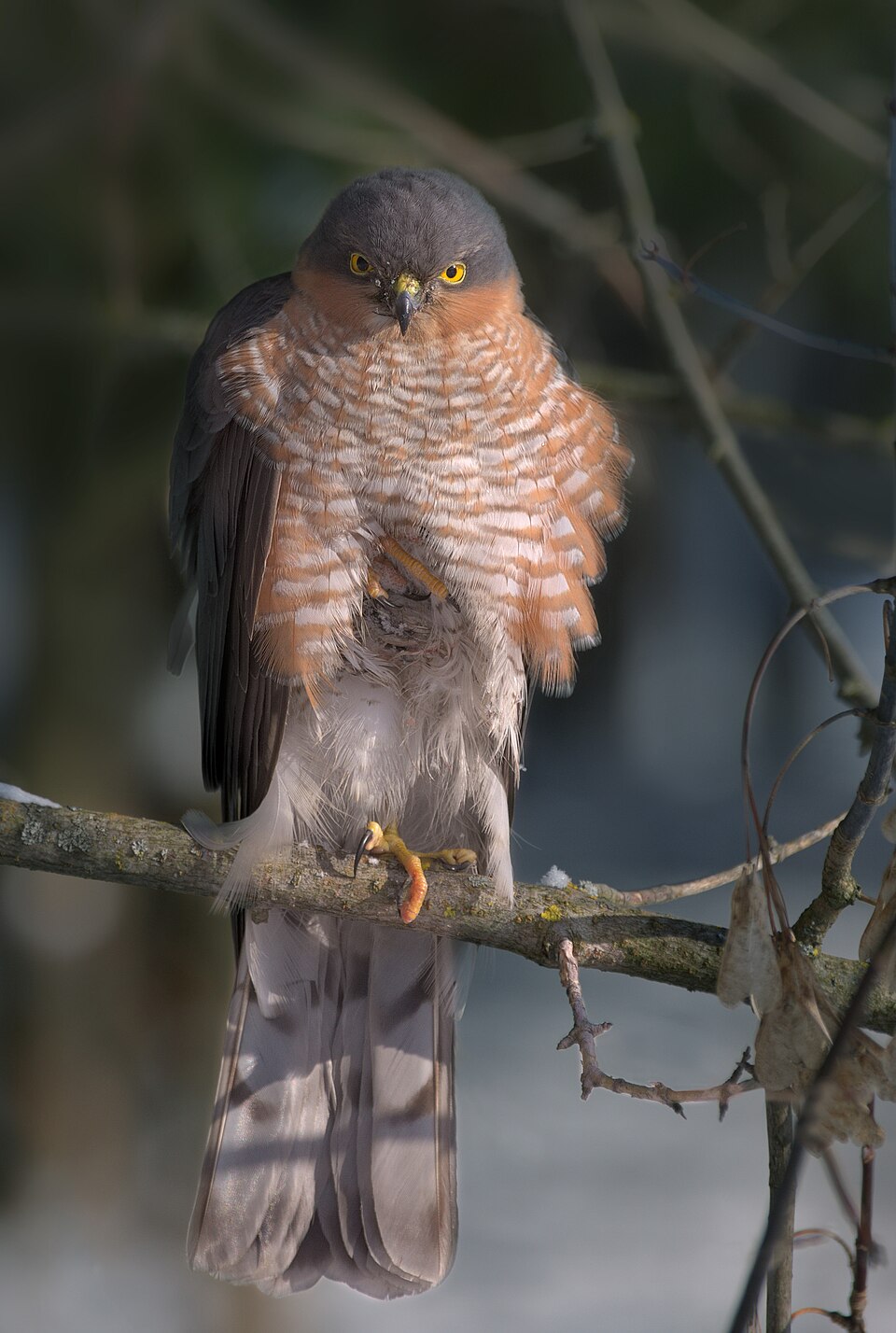
The Sparrowhawk is a small diurnal raptor belonging to the Accipiter genus, renowned for its fast and agile flight in wooded environments. In Europe and North Africa, the most common species is the European Sparrowhawk (Accipiter nisus). This predator mainly hunts small birds that it surprises in flight. It presents a clear sexual dimorphism in size, the female being significantly larger than the male. The Sparrowhawk frequents forests, bocages and sometimes urban areas with trees. In Tunisia, it is present during the nesting period and during migrations in the wooded areas of the north of the country.
The Sparrowhawk has short, rounded wings and a long tail, suitable for rapid flight between branches. Its dorsal plumage is gray-blue to brown, while the underside is barred with fine orange or brown stripes. Its yellow to orange eyes and its thin, powerful legs with sharp claws complete its characteristic silhouette.
Characteristics
Indicative values: they vary by subspecies, sex and region.
Habitat and distribution
The Sparrowhawk favors forests, sparse woods and edge areas offering both cover and abundant prey. It can also frequent urban parks and gardens rich in small passerines. In Tunisia, it is mainly observed in the forests in the north and center of the country.
CURRENT RANGE
European Sparrowhawk is widely distributed across Europe, North Africa and much of temperate Asia. Northern populations migrate south in winter, some reaching North Africa. In Tunisia, the species is present as a localized and wintering breeder.
Behaviour
The Sparrowhawk is a solitary and territorial hunter, known for its surprise attacks carried out at high speed. It alternates between rapid flapping flights and short slides to slip between obstacles. Outside of the breeding season, it leads a discreet life and generally avoids contact with humans.
Reproduction
The female usually lays 4 to 5 eggs in a nest built in a tree, often a conifer or dense deciduous tree. Incubation lasts about a month and is mainly carried out by the female. The young leave the nest after about a month, but remain dependent on the parents for a few more weeks.
Peculiarities
The male, being smaller, hunts smaller prey than the female, which reduces food competition within the pair. The Sparrowhawk is often confused with the northern goshawk, although the latter is significantly larger and more massive.
Threats and conservation
The main threats to Sparrowhawk include the destruction of its forest habitat, prey depletion, and collisions with human infrastructure. He was once the victim of direct persecution and secondary poisoning linked to pesticides, a phenomenon which is now declining in several regions.
Numbers and trends vary across sources and regions. See the IUCN assessment for the latest reference data.
Gallery
1 documented photographs.
References
Profile updated 03 September 2026 · Reviewed by the TunisieVet editorial team.
Comments (0)
No comments yet.
CONSERVATION STATUS
Least concern (LC)
IUCN source, latest published assessment.
Species health
Documented diseases for this species.
This information is provided for educational purposes only and is not a substitute for a veterinary consultation. If you have any concerns about your animal's health, consult a veterinarian.
Similar animals
Other species documented in Animalpedia.

TunisieVet in your pocket 📱🐾 Access your veterinary services wherever you are. [ Download the app ]
Learn more